Question 1 2 / 2 points
An 18-year-old man presents with periumbilical pain, vomiting, and abdominal cramping over the past 48 hours. Physical examination reveals rebound tenderness and laboratory analysis shows the pr
...
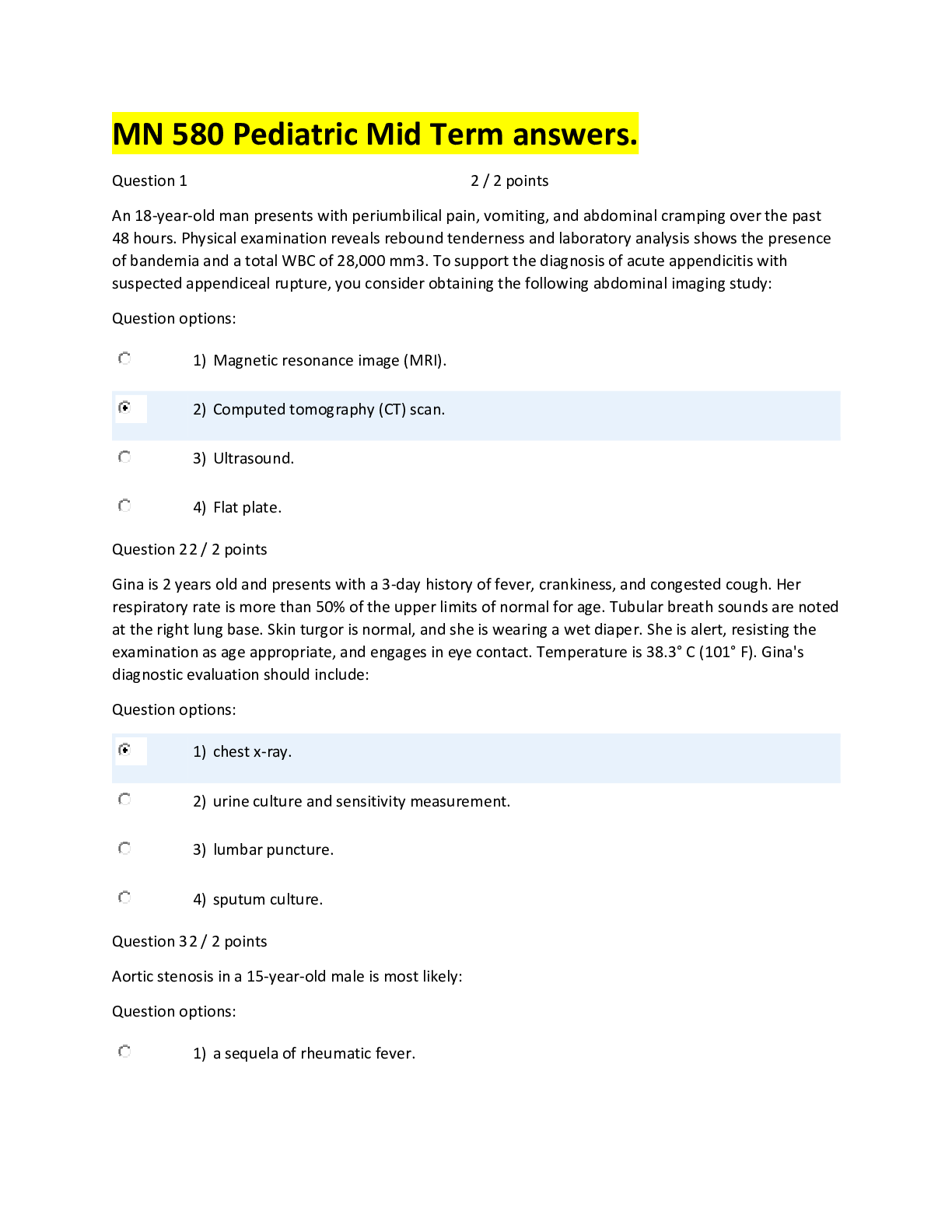
Question 1 2 / 2 points
An 18-year-old man presents with periumbilical pain, vomiting, and abdominal cramping over the past 48 hours. Physical examination reveals rebound tenderness and laboratory analysis shows the presence of bandemia and a total WBC of 28,000 mm3. To support the diagnosis of acute appendicitis with suspected appendiceal rupture, you consider obtaining the following abdominal imaging study:
Question options:
Gina is 2 years old and presents with a 3-day history of fever, crankiness, and congested cough. Her respiratory rate is more than 50% of the upper limits of normal for age. Tubular breath sounds are noted at the right lung base. Skin turgor is normal, and she is wearing a wet diaper. She is alert, resisting the examination as age appropriate, and engages in eye contact. Temperature is 38.3° C (101° F). Gina's diagnostic evaluation should include:
Question options:
Question 3 2 / 2 points
Aortic stenosis in a 15-year-old male is most likely:
Question options:
Question 4 2 / 2 points
Which of the following laboratory tests can identify the causative organism of bronchiolitis?
Question options:
Question 5 2 / 2 points
A Still murmur:
Question options:
Question 6 2 / 2 points
A physiological murmur has which of the following characteristics?
Question options:
Question 7 2 / 2 points
You anticipate that adult car seat belts fit correctly when a child is approximately _____ tall and is____ old.
Question options:
Question 8 2 / 2 points
Physical examination findings in otitis externa include:
Question options:
Question 9 2 / 2 points
In infants, solid foods are best introduced no earlier than:
Question options:
Question 10 2 / 2 points
When advising a patient about injectable influenza immunization, the nurse practitioner (NP) considers the following about the use of this vaccine:
Question options:
Question 11 2 / 2 points
A healthy 2-year-old child is able to:
Question options:
Question 12 2 / 2 points
The preferred treatment option for a 6-year-old boy with pertussis is:
Question options:
Question 13 2 / 2 points
At which of the following ages in a young child's life is parental anticipatory guidance about using “time out” as a discipline method most helpful?
Question options:
Question 14 2 / 2 points
Common causative organisms of acute suppurative conjunctivitis include all of the following except:
Question options:
Question 15 2 / 2 points
At which of the following ages in a young child's life is parental anticipatory guidance about protection from falls most helpful?
Question options:
Question 16 2 / 2 points
Which of the following statements is true about inactivated poliovirus vaccine (IPV)?
Question options:
Question 17 2 / 2 points
Problems after tetanus immunization typically include:
Question options:
Question 18 0 / 2 points
Which of the following is true about the MMR vaccine?
Question options:
Question 19 2 / 2 points
Treatment of viral conjunctivitis can include:
Question options:
Question 20 2 / 2 points
A healthy 6–7-month-old infant is able to:
Question options:
Question 21 2 / 2 points
At which of the following ages in a young child's life is parental anticipatory guidance about temper tantrums most helpful?
Question options:
Question 22 2 / 2 points
Which of the following findings is most consistent with the diagnosis of acute bacterial rhinosinusitis (ABRS)?
Question options:
Question 23 2 / 2 points
Which of the following is the most prudent first-line treatment choice for an otherwise well toddler with acute otitis media (AOM) who requires antimicrobial therapy?
Question options:
Question 24 2 / 2 points
Which of the following is one of the more common sources of hepatitis A infection in the United States?
Question options:
Question 25 2 / 2 points
Juice intake is acceptable in children 6 months and older per which of the following recommendations? Select all that apply.
Question options:
Question 26 2 / 2 points
You are examining an 18-year-old man who is seeking a sports clearance physical examination. You note a mid-systolic murmur that gets louder when he stands. This may represent:
Question options:
Question 27 2 / 2 points
A healthy infant at age 9–11 months is expected to:
Question options:
Question 28 2 / 2 points
You examine a 10-year-old boy with suspected streptococcal pharyngitis. His mother asks if he can get a “shot of penicillin.” Which of the following statements is/are true regarding the use of intramuscular (IM) penicillin? Select all that apply.
Question options:
Question 29 2 / 2 points
At which of the following ages in an infant's life is parental anticipatory guidance about teething most helpful?
Question options:
Question 30 2 / 2 points
First-line treatment for uncomplicated hordeolum is:
Question options:
Question 31 2 / 2 points
Which of the following imaging studies potentially exposes the patient being evaluated for abdominal pain to the lowest ionizing radiation burden?
Question options:
Question 32 2 / 2 points
You are examining an 18-month-old boy who is not speaking any discernible words. Mom tells you he has not said “mama or dada” yet or babbled or smiled responsively. You:
Question options:
Question 33 2 / 2 points
The gastric parietal cells produce:
Question options:
Question 34 2 / 2 points
The most common causative organism of bronchiolitis is:
Question options:
Question 35 2 / 2 points
Which of the following would not be found in newborns?
Question options:
[Show More]