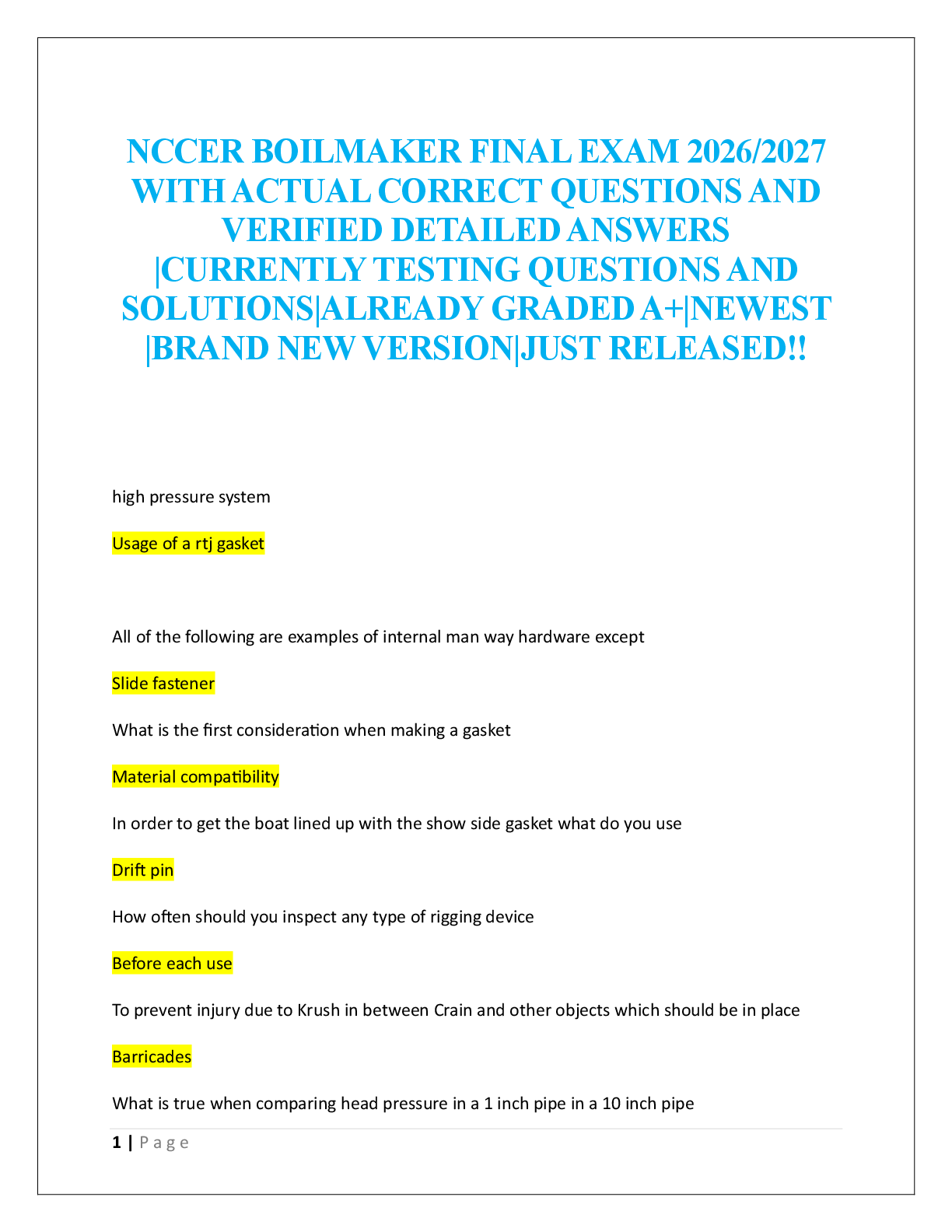
ESP 735 Final Study Guide
Frequency Correct Answer: The number of times a behavior occurred
Rate Correct Answer: How many times a behavior occurs per second, minute, hour, etc.
Duration Correct Answer: How lo
...
ESP 735 Final Study Guide
Frequency Correct Answer: The number of times a behavior occurred
Rate Correct Answer: How many times a behavior occurs per second, minute, hour, etc.
Duration Correct Answer: How long a behavior occurs during an observation period
Latency Correct Answer: Time between request to start and when response occurs
Event recording Correct Answer: Record how many times the behavior occurs within a specific time period
Objective is to either decrease or increase the behavior
Should be used with discrete behavior only (had obvious beginning and ending)
Whole interval recording Correct Answer: Count the behavior only when the behavior occurs for the entire behavior.
Used if the purpose is to increase behavior.
Partial interval recording Correct Answer: Count the behavior of one or more of the instance of behavior is observed. Used if the purpose is to decrease behavior
Momentary time sampling Correct Answer: Count the behavior when it occurs at the moment the interval ends
Shows the least representation of the actual occurrence of the behavior among all recording systems
Is most suitable for recording behavior that are frequent or of long duration
Duration recording Correct Answer: Time how long behavior occurs: the behavior should have a clear beginning and ending
Average duration vs. whole duration
Use stop watch or start/stop time
Latency recording Correct Answer: Time how long before starts responding (the length of time between the presentation of an antecedent stimulus and the initiation of the behavior)
Example: following direction
Inter observer reliability Correct Answer: Also called inter observer agreement
To ensure the consistency of data collections a evaluated by having a second observer view the same time period and collect data separately
Gross method Correct Answer: The percentage of smaller number to larger number
ABC assessment Correct Answer: Assessment that records the antecedent, behavior, and consequence of events as well as the time it occurred during a session and the duration
Gathering data for the purpose of describing and evaluating the stimuli surrounding a behavior
Conducted by directly observing the student and recording anecdotal data over several observations
Indirect assessment Correct Answer: Anecdotal reporting, parent or teacher reports, interviews, and surveys
Setting events Correct Answer: Events that precede the antecedent that makes a behavior more or less likely to occur
Anecdotal reports Correct Answer: Reports from parents or teachers. Stories and recollections of behaviors
Direct assessment Correct Answer: Scatter plot assessment
ABC data
Direct of observation
Pinpointing Correct Answer: Specifying in measurable, observable terms a behavior targeted for change
Functional behavioral assessment Correct Answer: The process of recording a problem behavior to collect baseline data, developing a hypothesis, identifying replacement behaviors, implementing interventions, and identifying the function(s) of behaviors.
Scatter plot assessment Correct Answer: Teacher prepared a grid. Successive days or observation periods are plotted along the horizontal. Time is plotted along the vertical. Time may be divided into different increments. As grid is filled in, each cells contains a designation indicating whether the behavior occurred at a high, low, or zero rate
Antecedent Correct Answer: Stimulus that happens immediately before the behavior.
Consequence Correct Answer: Stimulus presented contingent on a particular response.
Functional analysis Correct Answer: Procedures (usually reversal design or multi-element design) that test a hypothesized relation by manipulating the variables thought to occasion or maintain a behavior in order to verify a functional relation.
Strategy of manipulating the student's environment and observing the effect on the student's behavior.
Function Correct Answer: Reason for the behavior
Hypothesis Correct Answer: Look for patterns across the behaviors you have gathered on the behavior(s).
The assessment should be based on assessment information (ABC assessment, rating scales, interviews, direct assessment, etc.)
Topography Correct Answer: What the behavior looks like
Observable and measurable Correct Answer: Terms to describe or define behavior
Competing pathways Correct Answer: allows one to illustrate the relationships between the environmental factors and the behavior. It allows teachers to develop interventions to address each aspect of the factors affecting the behavior.
Positive reinforcement Correct Answer: A stimulus given that increases the likelihood of the behavior
Negative reinforcement Correct Answer: Taking away a stimulus to increase the likelihood of the behavior
Prompt Correct Answer: An added stimulus that increases the probability that the SD will occasion the desired response (also known as supplementary antecedent stimulus)
Shaping Correct Answer: Teaching new behaviors through differential reinforcement of successive approximations to a specified target behavior
Stimulus control Correct Answer: Occurs when an antecedent stimulus systematically affects the probability of a response occurring. Sets the occasion for a behavior to occur.
Intervention Correct Answer: Any change in a person's environment that is designed to change that person's behavior
Baseline Correct Answer: Data points that reflect on operant level of the target behavior. Operant level is the natural occurrence of the behavior before intervention. Baseline data serve a purpose similar to that of a protest, to provide a level of behavior against which the results of an intervention procedure can be compared.
Chaining Correct Answer: An instructional procedure that reinforces individual responses in sequence, forming a complex behavior.
Fading Correct Answer: The gradual removal of prompts to allow the SD to occasion a response independently.
Task analysis Correct Answer: Breaking down a task into smaller, simpler steps
Modeling Correct Answer: Demonstrating a desired behavior in order to prompt an imitative response.
Graduated guidance Correct Answer: Reduce full physical guidance to "shadowing" (following movement but not touching the student), a light touch at a distance from the part of the body performing the behavior.
Non-social functions of behavior Correct Answer: - release tension
- manage confusion
- manage discomfort or pain
- relaxation
- manage unpleasant thought process
- stimulation when bored
- calm yourself down when over-stimulated
- cope with fear or anxiety
- manage stress or uncertainty
Social Functions of Behavior Correct Answer: - interact to gain attention
- interact to gain tangibles
- escape
Discriminative stimulus Correct Answer: An antecedent that occurs immediately before a behavior and is said to occasion a behavior.
Discrimination training Correct Answer: Teachers establish specific times, places, instructions, and other antecedent events as discriminative stimuli for various student behaviors.
Extinction Correct Answer: Withholding reinforcement for a previously reinforced behavior to reduce he occurrence of the behavior.
Response cost Correct Answer: Reducing inappropriate behavior through withdrawal of specific amounts of reinforcer contingent upon the behavior's occurrence.
Time out Correct Answer: Reducing inappropriate behavior by denying t
[Show More]


.png)