Pharm Chapter 6-10 study guide questions
1. After teaching a group of nursing students about sulfonamides, the instructor determines that the teaching was
successful when the students identify which of the following a
...
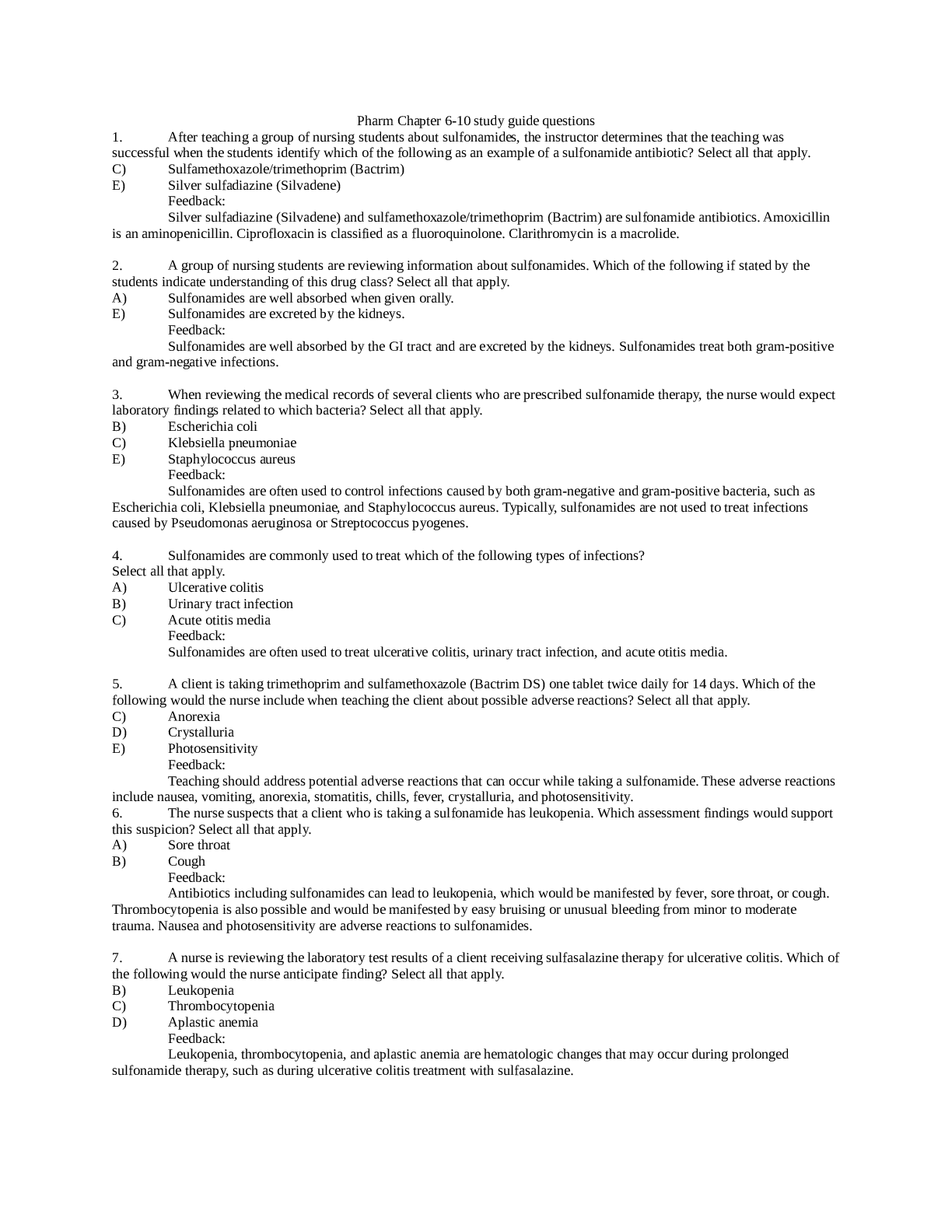
Pharm Chapter 6-10 study guide questions
1. After teaching a group of nursing students about sulfonamides, the instructor determines that the teaching was
successful when the students identify which of the following as an example of a sulfonamide antibiotic? Select all that apply.
C) Sulfamethoxazole/trimethoprim (Bactrim)
E) Silver sulfadiazine (Silvadene)
Feedback:
Silver sulfadiazine (Silvadene) and sulfamethoxazole/trimethoprim (Bactrim) are sulfonamide antibiotics. Amoxicillin
is an aminopenicillin. Ciprofloxacin is classified as a fluoroquinolone. Clarithromycin is a macrolide.
2. A group of nursing students are reviewing information about sulfonamides. Which of the following if stated by the
students indicate understanding of this drug class? Select all that apply.
A) Sulfonamides are well absorbed when given orally.
E) Sulfonamides are excreted by the kidneys.
Feedback:
Sulfonamides are well absorbed by the GI tract and are excreted by the kidneys. Sulfonamides treat both gram-positive
and gram-negative infections.
3. When reviewing the medical records of several clients who are prescribed sulfonamide therapy, the nurse would expect
laboratory findings related to which bacteria? Select all that apply.
B) Escherichia coli
C) Klebsiella pneumoniae
E) Staphylococcus aureus
Feedback:
Sulfonamides are often used to control infections caused by both gram-negative and gram-positive bacteria, such as
Escherichia coli, Klebsiella pneumoniae, and Staphylococcus aureus. Typically, sulfonamides are not used to treat infections
caused by Pseudomonas aeruginosa or Streptococcus pyogenes.
[Show More]