Imagine you are following a Nurse Practitioner as part of your clinical experience in
nursing school. Before you enter the examining room the Nurse Practitioner pulls the
chart off the door and hands it to you. You ent
...
Imagine you are following a Nurse Practitioner as part of your clinical experience in
nursing school. Before you enter the examining room the Nurse Practitioner pulls the
chart off the door and hands it to you. You enter the room and greet the patient. What is
your tentative diagnosis?
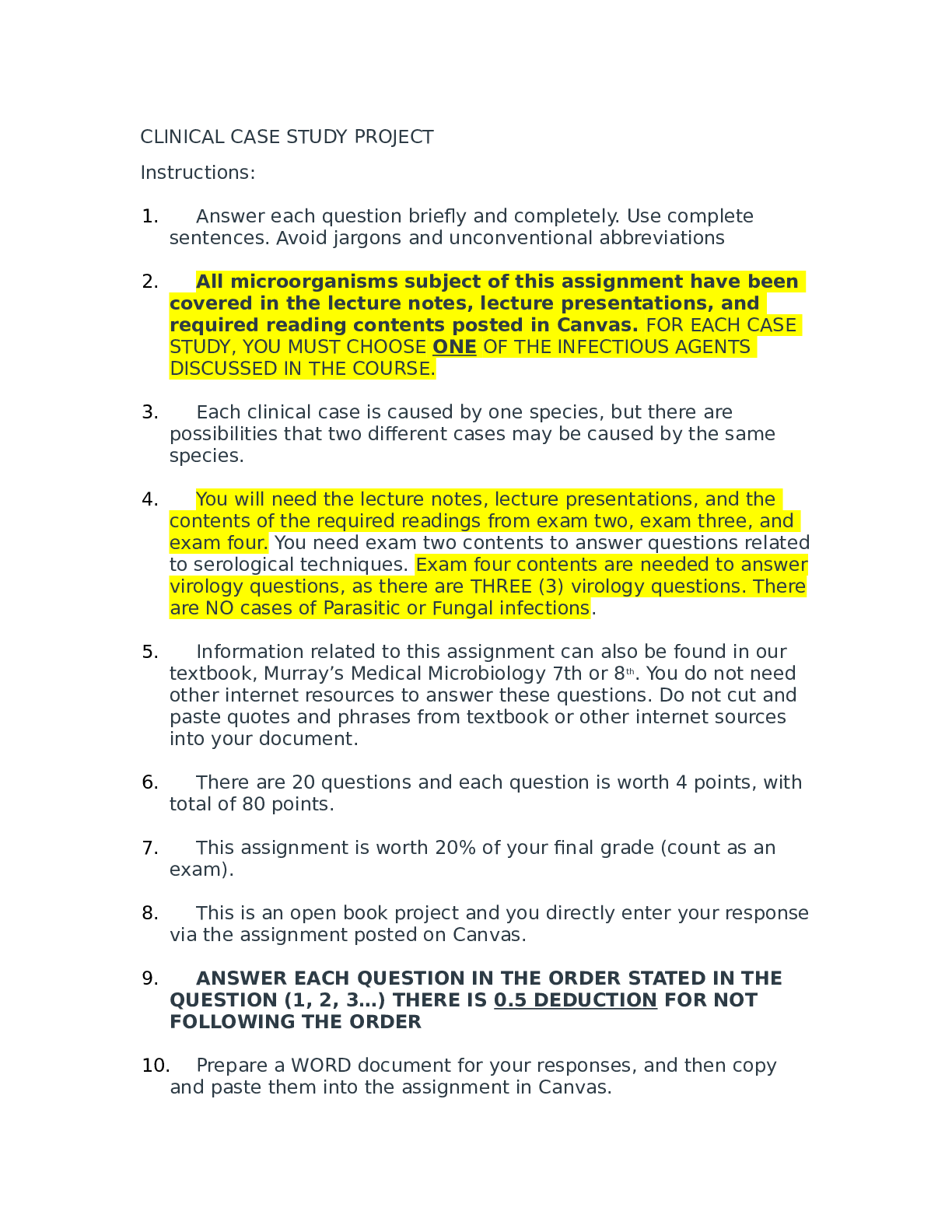
Each case study is worth 2 points.
Use a scantron to answer the following questions.
Clinical Case 1
A 62-year old diabetic man presents himself in the emergency room with a swollen left leg with
areas of blanching and blue mottling. A "foul odor" is coming from a dressed wound. The
physicians remove the dressing and a brownish fluid is seeping from a wounded area. The fluid
contains what appear to be small bits of the tissue. No pus appears to be present. The wound
has a strong "rotten" odor. Five days earlier, while at his work as a farmer, he caught the leg in
his manure spreader, sustaining a deep, crushing, grossly dirty injury. His wife cleaned the wound
as well as she could with soap and water, dressed it with clean gauze, and wrapped it tightly with
an elastic bandage to stop the bleeding. The second day they redressed the wound and applied
triple antibiotic ointment. The patient treated his pain with ibuprofen (Advil). He reported the pain
was not very bad for the first 72 hours. In the past 24 hours, the leg swelled and the mottling
began to appear. A foul odor and severe pain accompanied the swelling. His wife convinced him
to come to the emergency room even though they did not have medical insurance.
What organism is most likely to be responsible for these symptoms and findings?
a. Clostridium tetani
b. E.coli 0157:H7
c. Clostridium perfringens
d. Bacillus anthracis
Clinical case 2
A 3 month old baby, Jarret Fox, was admitted into the ER for dehydration. According to his
mother, the baby had stopped eating four days ago. Jarret was about 5% dehydrated and was
much floppier than usual. He seemed passive and expressionless and lay as limp as a rag doll in
his hospital crib. An emergency electromyogram (a test of Jarret’s muscle and nerve function)
revealed abnormal nerve responses. His breathing has become labored and when a blood-gas
analysis revealed signs of respiratory failure, he was transferred to the ICU where he was placed
on a ventilator. The mother assured the doctor that the baby was exclusively breast-fed. On
further inquiry, the doctor finds out that his little sister had offered him a spoonful of oatmeal
topped with natural honey straight from the hive on the day that he stopped eating.
What was the diagnosis?
Dr. C. Telles Page 1
This study source was downloaded by 100000823742721 from CourseHero.com on 09-18-2022 04:29:24 GMT -05:00
https://www.coursehero.com/file/6237701/Clinical-Case-studies/
a. Tuberculosis
b. Botulism
c. Tetanus
d. Scalet fever
Clinical Case 3
A 58-year old lawyer is presented in the emergency room with a headache, irritability, generalized
muscle pain and uncontrollable back spasms. He has become very restless and worried because
he has had the back spasms all through his court case that afternoon and they became extremely
painful.
In his history, the lawyer states that he has a very busy practice. He is on medication for high
blood pressure and has mild asthma. He injured himself about 10 days earlier, puncturing his left
arm with a nail from an old barn he is tearing. The wound has produced moderate quantities of
pus, but he has been keeping it clean.
The wound was sampled for microscopic examination and culture. The back appears to have
very tight contractions and spasms. The patient is in obvious agonizing pain.
What type of infection do you believe he has?
a. Streptococcus pyogenes
b. Clostridium tetani
c. Pseudomonas aeruginosa
d. Clostridium botulinum
Clinical Case 4
A 68-year old patient with Alzheimer disease was brought to the emergency room by the staff of a
local nursing home. He presented as lethargic with a sallow complexion. He had an admission
temperature of 102.4F and a respiratory rate of 33/minute. During respiration, the right side of his
chest moved better than the left. He showed dense consolidation of the lower lobe of the left lung
on physical exam. A sputum sample revealed blood and a greenish color. A chest x-ray showed
tight consolidation of the left lung with evidence of formation of cavities in the lung tissue from
cytotoxic damage. The patient complained of chills in the exam room, combined with his fever. A
smear of his sputum demonstrated no acid-fast bacteria.
What type of infection do you believe he has?
a. Staphylococcus aureus
b. Streptococcus pyogenes
c. Mycobacterium tuberculosis
d. Streptococcus penumoniae
Clinical Case 5
A 24-year old female automotive technician presents herself at the nurse practitioner’s office. She
complains of fever and of pain in her left hand. On physical examination, the patient had a deep
wound on her left palm that was oozing pus. She had purplish, red streaks running up her left
arm. She had enlarged lymph nodes at the elbow and under her arm. The patient’s skin was
warm and dry. In her history, the patient had punctured her left palm with a sharp metal from the
Dr. C. Telles Page 2
This study source was downloaded by 100000823742721 from CourseHero.com on 09-18-2022 04:29:24 GMT -05:00
https://www.coursehero.com/file/6237701/Clinical-Case-studies/
undercarriage of a "real cherry" 1977 Malibu about a week earlier. She said the wound had bled
for a few minutes and she thought that she had washed it "real good" with soap and water. She
had covered the wound with a large "band-aid" and gone back to work. She developed a fever
about three days later. For the past couple of days, she "did not feel so good" and had vomiting
and diarrhea.
What type of infection do you believe she has in this hand?
a. Streptococcus pyogenes
b. Staphylococcus aureus
c. Clostridium botulinum
d. Pseudomonas aeruginosa
Clinical Case 6
A male college student is presented to the emergency room at an outside hospital with a
pounding headache, vomiting, and a stiff neck with pain running up his back. On admission, his
temperature was 101°F. The young man appeared to have trouble hearing during the nurse’s
interview and also seemed to have trouble concentrating. The history revealed that the young
man was a wrestler for the local high school team. He had felt as though he were getting a cold
the past few days, since his last meet in Hicksville. He did not smoke or drink, but he attended a
party two days earlier thrown by his girlfriend and the other cheerleaders to celebrate his victory
in the sectionals. He had been holding his weight at 162 pounds for the season, so he ate little
and did not drink on the day of the meet s (today is the day of the meet). On the physical exam,
the nurse practioner observed several areas of purplish spots on the skin of the back, thigh, and
arm. The boy thought those were from wrestling. Blood cultures were drawn and a Gram stain
revealed Gram-negative cocci in pairs.
What type of infection do you believe he has?
a. Staphylococcus aureus
b. Neisseria meningiditis
c. Mycobacterium tuberculosis
d. Streptococcus pneumoniae
Clinical Case 7
A 22-year old woman presents at the walk-in health clinic with slight fever (38.5C), a complaint of
frequent urination, burning on urination, vaginal discharge and a small lesion on the labia. The
woman reported that she was moderately sexually active and had three sexual partners in the
past six months. Her last sexual contacts were about 7 days earlier. She had developed mild
symptoms about 5 days earlier, beginning with a discharge from the vagina. She began having
pain on urination about 3 days earlier. Urine analysis revealed a pH of 8.2, some white cells and
a few red blood cells. There was protein in the urine. A smear of the vaginal secretion showed a
number of Gram-negative cocci.
What was the diagnosis?
a. Syphilis
b. HIV infection
c. Gonorrhea
d. Shingles
[Show More]


.png)