BARKLEY FNP EXAMEN FINAL DEFINITIVO RAFAEL
1. A 59-year-old is having a follow-up evaluation two years after the successful conclusion of radiation
therapy for leukemia. He tells you that he has been feeling run-down
...
BARKLEY FNP EXAMEN FINAL DEFINITIVO RAFAEL
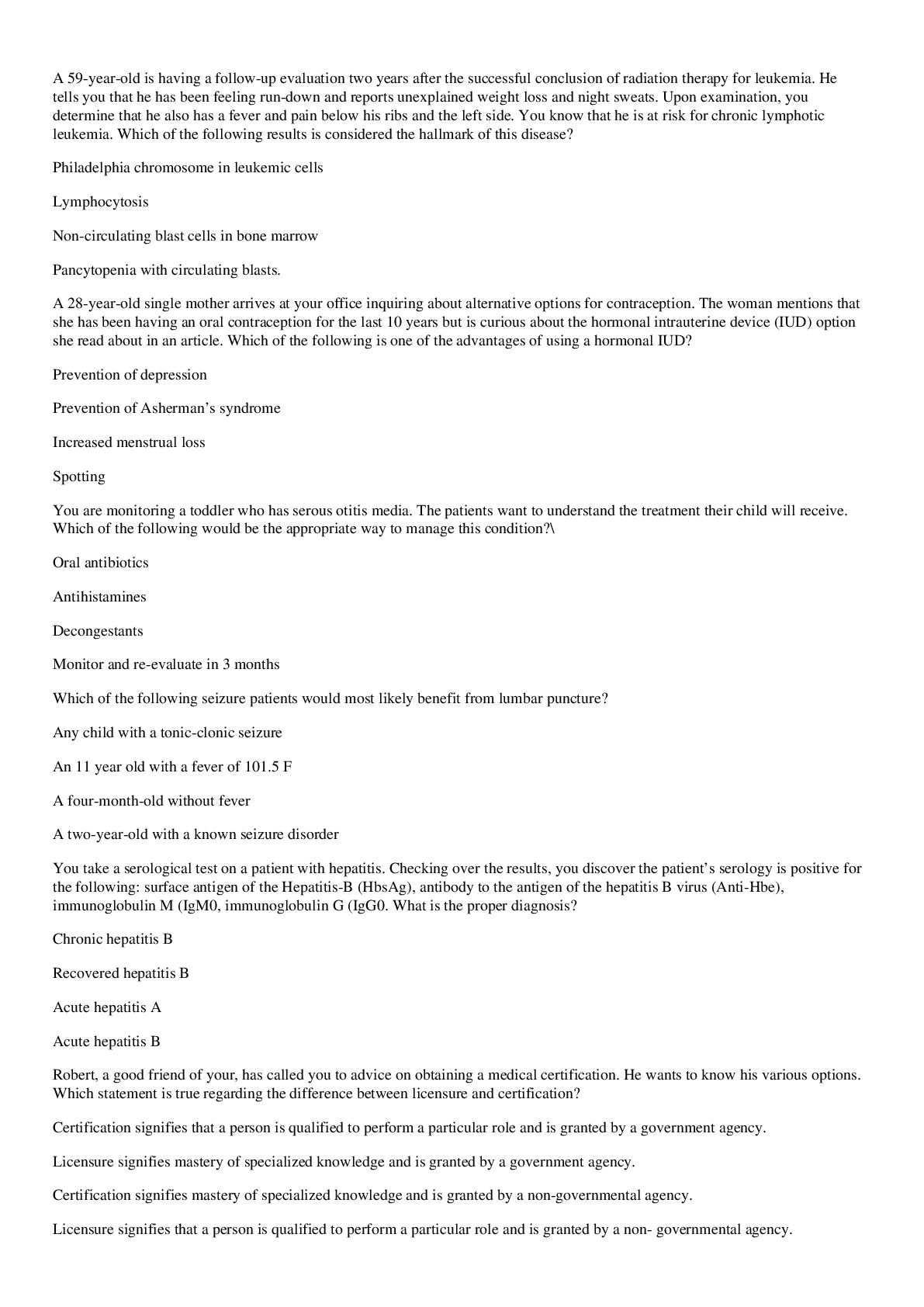
1. A 59-year-old is having a follow-up evaluation two years after the successful conclusion of radiation
therapy for leukemia. He tells you that he has been feeling run-down and reports unexplained weight
loss and night sweats. Upon examination, you determine that he also has a fever and pain below his ribs
and the left side. You know that he is at risk for chronic lymphotic leukemia. Which of the following
results is considered the hallmark of this disease?
A. Philadelphia chromosome in leukemic cells
B. Lymphocytosis
C. Non-circulating blast cells in bone marrow
D. Pancytopenia with circulating blasts.
2. A 28-year-old single mother arrives at your office inquiring about alternative options for contraception.
The woman mentions that she has been having an oral contraception for the last 10 years but is curious
about the hormonal intrauterine device (IUD) option she read about in an article. Which of the following
is one of the advantages of using a hormonal IUD?
A. Prevention of depression
B. Prevention of Asherman’s syndrome
C. Increased menstrual loss
D. Spotting
3. You are monitoring a toddler who has serous otitis media. The patients want to understand the treatment
their child will receive. Which of the following would be the appropriate way to manage this condition?\
A. Oral antibiotics
B. Antihistamines
C. Decongestants
D. Monitor and re-evaluate in 3 months
4. Which of the following seizure patients would most likely benefit from lumbar puncture?
A. Any child with a tonic-clonic seizure
B. An 11 year old with a fever of 101.5 F
C. A four-month-old without fever
D. A two-year-old with a known seizure disorder
5. You take a serological test on a patient with hepatitis. Checking over the results, you discover the
patient’s serology is positive for the following: surface antigen of the Hepatitis-B (HbsAg), antibody to
the antigen of the hepatitis B virus (Anti-Hbe), immunoglobulin M (IgM0, immunoglobulin G (IgG0.
What is the proper diagnosis?
A. Chronic hepatitis B
B. Recovered hepatitis B
C. Acute hepatitis A
D. Acute hepatitis B
6. Robert, a good friend of your, has called you to advice on obtaining a medical certification. He wants to
know his various options. Which statement is true regarding the difference between licensure and
certification?
A. Certification signifies that a person is qualified to perform a particular role and is granted by a
government agency.
B. Licensure signifies mastery of specialized knowledge and is granted by a government
agency.
C. Certification signifies mastery of specialized knowledge and is granted by a non-governmental
agency.
D. Licensure signifies that a person is qualified to perform a particular role and is granted by a nongovernmental agency.7. A mother brings her 3-month-old baby to your clinic to screen for failure to thrive (FTT). Which of the
following is not a sign or symptom that would cause you to associate the infant with FTT?
A. Absolute length/width are below the 5th percentile
B. Weight falling greater than 2nd percentiles below the standard
C. Avoids eye contact
D. Commonly cries for more food or milk
8. Which of the following is not true of progestin-only birth control?
A. It has excellent reversibility
B. It most likely changes tubal transport of female and male gametes
C. Its mechanism of action affects the cervical mucus and the endometrium
D. It is typically more effective than combination pulls but has more side effects
9. The parents of a 1-year-old patient presents to you with concerns regarding their daughter’s health. At
birth, they were told that their daughter had abnormal features and decreased muscle tone. They hope
that their daughter would “grow out” of some these defects but, to their disappointment, she has not.
They report that their daughter is having trouble walking and sitting up by herself. Furthermore, they
state that no matter how much they feed their baby, she is always crying out for more food and, as a
result, has been rapidly gaining weight. You suspect a chromosomal condition. Which of the following
would be most likely?
A. Prader-Willi Syndrome
B. Hurler syndrome
C. Down syndrome
D. DiGeorge syndrome
10. The mother of a toddler complains that her 2-year-old child is picky eater, and despite evidence of a
healthy growth pattern, she is concerned about her child’s appropriate food intake. Which of the
following is the most accurate regarding toddler nutrition?
A. Your toddler’s diet is appropriate if he consumes 70 to 100 kcal/kg/day
B. Toddlers should consume more protein and a total of 120 kcal/kg/day
C. Toddlers must consume a least 45 kcal/kg/day
D. Parent of toddlers should insist that their children clean their plate and consume 100 to 110
kcal/kg/day
11. During a check-up with a 6-year-old, you wish to conduct an interview the child and his parents. He is a new
patient, and you want to establish the proper doctor-patient relationship. Which of the following is a necessary
component of your interview?
A. Assess child’s cholesterol
B. Informing the parents ahead of time if you are recording data
C. Assess liver function
D. Measure the child’s hematocrit
12. According to Jean Piaget, between the age of seven and 11, a child’s psychological development will be marked
by:
A. Development of intuitive thought
B. Capability of logical thought
C. Trial and error learning
D. Capable of complex problem solving
13. After years of not conceiving, Kelly and Ed finally have a child, a girl named Beverly. They often check with you
about what to expect as Beverly ages. In a month she will be 2 ½ years old. Which of the following is typically
present in a 2 ½ -year-old child?
A. All primary teeth have erupted
B. Birth weight has doubled
C. Anterior fontanel is open
D. The child will be in the industry versus inferiority stage of psychosocial development14. You are doing a well-child check on an infant. Currently, the baby can lifts his head when on his
stomach, laughs aloud, and can crawl to you. When asked to say “mama,” however, the baby just smiles.
Based on this description, what is his approximate age?
A. 6 months
B. 10 months
C. 4 months
D. 2 months
15. A mother visits you with her 13-month-old daughter, Vicky. The mother tells you that Vicky had Hib
conjugate vaccine (Hib) and that she needs her booster. The mother wants to know if Vicky can still get
her Hib booster. Which of the following should you tell the mother?
A. Hib booster is typically given at 12 months of age.
B. Hib booster is typically not recommended until two years of age
C. Hib booster must be given in a series of three before 5 months of age
D. The child does not need a booster until 5 years of age
16. Maggie, 2-month-old, is planning to receive the polio vaccine. Which of the following statements is true
regarding polio vaccine administration to the patient?
A. The inactivated polio vaccine would be given at 3, 6, and 9 months of age, with the last dose
received by 4 years of age.
B. The oral polio vaccine should be started at 6 years old.
C. The final dose of the inactivated polio vaccine would typically be given when the patient is 6
years old.
D. The inactivated polio vaccine should be given in a single dose at 2 months of age.
17. A parent brings her young infant into the clini, asking questions, about the administration of the
rotavirus vaccine to her child. Which of the following is true regarding the rotavirus vaccine?
A. The series of doses should begin before 14 weeks of age
B. The rotavirus vaccine may be administered before 14 weeks of age
C. Feedings should be limited after the child received the vaccine
D. The first dose should be administered at 1 year of age.
18. A new mother who is HBsAg-positive has just delivered her first child. Knowing that the baby will need
to be protected from hepatitis, what would be your best plan of action for his new born?
A. Administer the hepatitis B vaccine and 1.0 mL hepatitis B immune globulin within six hours of birth.
B. Administer the hepatitis B vaccine and 0.75 mL hepatitis B immune globulin within 8 hrs of birth.
C. Test for HBsAg and antibody to HBsAg immediately after birth
D. Administer the hepatitis B vaccine and 0.5mL hepatitis B immune globulin within 12 hrs of
birth.
19. Which of the following is not an event that must be reported to the Vaccine Adverse Events Reposting
System?
A. Anaphylaxis
B. Death
C. Pneumonia
D. Encephalitis
20. You have a patient with a genetic disorder. The physical finding on this patient are an abnormal head,
flattened nose, and upward slating eyes. Based on the physical findings, which would be the most likely
genetic disorder?
A. DiGeorge syndrome
B. Down syndrome
C. Marfan syndrome
D. Turner’s syndrome21. A 3-month-old infant, who was born healthy and weighed 7 lbs 5 oz at birth, presents with hypotonia,
decreased vocalization and suspected seizures, which are all characteristics of Tay-Sachs disease. Which
of the following would most predispose the infant to this condition?
A. Family history of hyperlipidemia
B. Ashkenazic Jewish ethnicity
C. African ethnicity
D. Family history of drug addiction
22. A 2-year-old female patient has a webbed neck, lymphedema, and low hair line. Additionally, you note
the child’s blood pressure to be above the 95th percentile for children her age. The mother also mentions
the child has difficulty grasping concepts at home, especially with learning to use a toilet. With which of
the following genetic syndromes does the child most likely present?
A. Marfan
B. Turner’s
C. DiGeorge
D. Klinefeller’s
23. DiGeorge syndrome causes congenital defects in all of the following except:
A. Basal ganglia
B. Conotruncal region of the heart
C. Parathyroid gland
D. Thymus
[Show More]







.png)

