Exam 1 NURS-104 2021
Syllabus:
How many points total is the class? Correct Answer: 1000
Syllabus:
How many exams will we have and how many points for each? Correct Answer: 6 exams + 1 final (7 total)
Exams
...
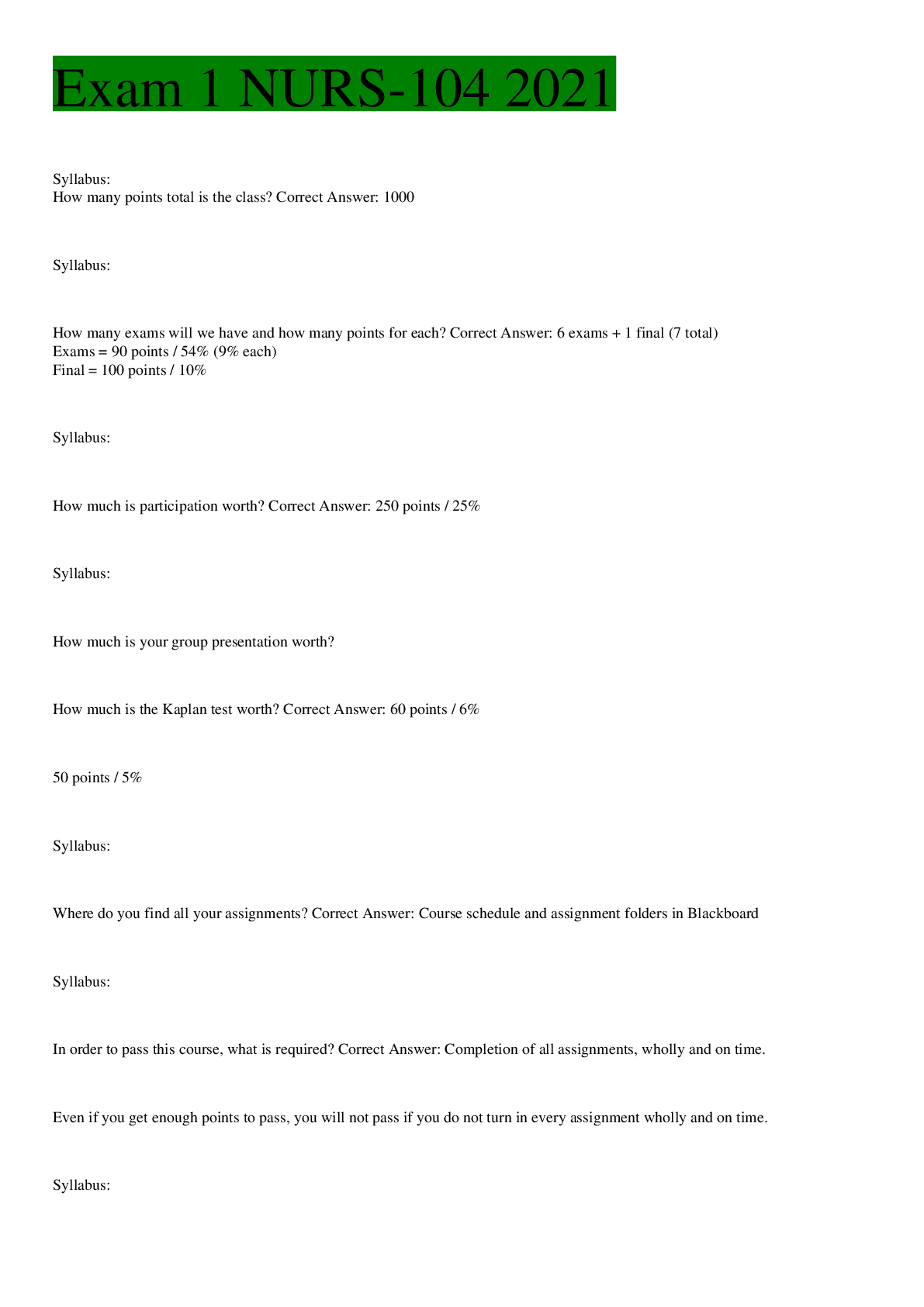
Exam 1 NURS-104 2021
Syllabus:
How many points total is the class? Correct Answer: 1000
Syllabus:
How many exams will we have and how many points for each? Correct Answer: 6 exams + 1 final (7 total)
Exams = 90 points / 54% (9% each)
Final = 100 points / 10%
Syllabus:
How much is participation worth? Correct Answer: 250 points / 25%
Syllabus:
How much is your group presentation worth?
How much is the Kaplan test worth? Correct Answer: 60 points / 6%
50 points / 5%
Syllabus:
Where do you find all your assignments? Correct Answer: Course schedule and assignment folders in Blackboard
Syllabus:
In order to pass this course, what is required? Correct Answer: Completion of all assignments, wholly and on time.
Even if you get enough points to pass, you will not pass if you do not turn in every assignment wholly and on time.
Syllabus:
How often should you check Blackboard and your email? Correct Answer: Daily
Syllabus:
What are the three parts of Student Participation? Correct Answer: • FA Davis Advantage prep work and quizzes - due by 0800 Wednesday before class
• Meaningful participation in class on Wednesday - includes questions in Google doc posted before class to be answered in class
• FA Davis Edge post quiz - due by 1700 (5pm) MTN time on Fridays after class
Syllabus:
What percentage do you need to pass a quiz in prep/post work? Correct Answer: 75% / Green thumbs up
Syllabus:
What are the three parts of the group presentations? Correct Answer: • Presentation itself
• 5 question NCLEX style quiz
• Discussion board moderation
>>No one is required to use the discussion board, but if there are questions posted there, group members are required to answer them
Syllabus:
Why do we have so many tests?
What are the different testing formats?
Are the tests cumulative? Correct Answer: Med/Surg traditionally a very difficult course. Instructional design said smaller, more frequent tests helps reduce test anxiety and increase liklihood of passing the class.
• Proctored by zoom
• Respondus
• Kaplan in testing center
• Verbally
Yes cumulative tests, 25% old material and 75% new material to help with NCLEX prep and study for final through the semester.
Syllabus:
What is the grading policy?
What happens if your grade falls below 75%? Correct Answer: You must have 75% overall grade to progress to next semester. BEFORE any assignments are calculated in, you must have a 75% test average on its own, otherwise you will not progress.
Grades will be rounded on the nearest whole number only on the final grade.
All assignments must be completed wholly and on time.
Syllabus:
What happens if your grade falls below 75%? Correct Answer: If falls below 75% at any time
• You will be put on a "success contract" to help you get back on track. *Not punitive*
• Remedial activities specific to areas you are struggling with from either instructor or faculty advisor.
• Additional Kaplan remadiation reviews
• Optional brown bags offered on various topics throughout semester
Syllabus:
NURS-105 passing and attendance policy Correct Answer: • Paired with 104 - you must pass both to progress
• Pass/Fail only
• Attendance absolutely mandatory, tardiness considered an absence.
>>Due to pandemic, if you are sick, let instructor know ASAP so arrangements can be made on 1-on-1 basis
Syllabus:
What are the components of NURS-105? Correct Answer: • Nursing Skills Lab
• Clinical Rotation
• Simulations, either on-campus or virtual
Syllabus:
What assignments will 105 have? Correct Answer: • Any and all work assigned by skills lab instructors
• 2 clinical packets (due 5 days after clinical day)
• Paired assessment assignment
• On-campus and virtual clinical simulation
>>includes pre-and post assignments and participation
• Final self-evaluation and student evaluation
>>recommend to treat as a living document and add to all semester
What is Med-Surg nursing? Correct Answer: Medical-Surgical nursing - management of acutely ill patients
• Root of all other nursing practices
• Practice settings are growing significantly (over 800 nursing jobs now in the industry)
• Med-Surg is largest group of practicing nusing professionals
Competencies in Med-Surg nursing Correct Answer: • Strong science background
• Nursing process competencies:
>>ADPIE
>>Nursing process closely associated with nurse's clinical decision making
There was a large gap in what reported by nurse leaders regarding new grads? Correct Answer: Satisfaction between knowledge and practice gap.
>> Patho knowledge on pt conditions
>> Pharm implications
>> Decision making
>> Interpretation of assessment data
(largely dissatisfied in amount of knowledge)
What is evidence-based nursing care? Correct Answer: Evidence-based practice is the foundation of professional nursing practice.
>>Research is the foundation of evidence-based care
>>>>Science is the foundation of research
All tied in with problem-solving approach
• In order to make best clinical decisions, have to have best available evidence, clinical expertise and understand patient preferences
What are the steps of evidence-based practice? Correct Answer:
How many levels of evaluating research are there?
Are higher numbers more or less reliable?
What are the levels? Correct Answer: 7 levels. Higher number = less reliable. Want to stay as close to 1 as possible, preferably above 4.
1. Systematic reviews of randomized controlled studies
2. Evidence from at least one randomized controlled study
3. Evidence from quasi-experimental studies
4. Evidence from case-control and cohort studies
5. Evidence from systematic reviews of descriptive or qualitative studies
6. Evidence from a single descriptive or qualitative study
7. Evidence from expert individual authorities or committees
What is patient-centered care used to measure and what are the associated nursing competencies? Correct Answer: • Benchmark for evaluating acute care facilities
• Providing safe, quality care is priority
Associated nursing competencies
• Effective communication skills
• Empathy
• Caring
• Compassion
What approach is used for effective communication to support patient safety outcomes? Correct Answer: I-SBAR
• Identify
• Situation
• Background
• Assessment
• Recommendation
What is QSEN?
What are the QSEN competencies? Correct Answer: Quality and Safety Education for Nurses
Competencies:
• Patient-Centered Care
• Teamwork and Collaboration
• Evidence Based Practice (EBP)
• Quality Improvement (QI)
• Safety
• Informatics
What is the root cause for majority of healthcare errors?
What was the number of errors resulting in patient harm per day that Worbets quoted from 2009 study?
What is being done to reduce errors? Correct Answer: Ineffective interprofessional communication is root cause for majority of healthcare errors. Majority of miscommunication happens during transfer of patient care.
• 40,000 incidents resulting in patient harm per day!
• What's being done? Interprofessional education programs
What are nurses uniquely qualified to do?
Why? Correct Answer: Nurses are uniquely qualified to work with patients in all settings.
• Ability to assess physical and psychosocial needs; Med-Surg skillset/knowledgebase is applicable across the board
• Nursing paradigm/worldview is more holistic, pts are looked at as whole people and treated accordingly which makes us very qualified to help guide people through transition
What is the transitional care model?
What are the goals of TCM?
Who does it focus on and who manages it? Correct Answer: • Offers a model for managing transitions from acute care to post-acure care settings
• Patient-centered
Goals:
• Avoid poor outcomes
• Ensure continuity of care
• Facilitate safe transitions
• Save money for the healthcare system
• Focus on chronically ill adults with comorbidities
• Managed by transitional care nurse (typically bachelors or masters, but can be ASN with lots of experience)
What are the components of transitional care programs? Correct Answer: • Transitions coaches (nurses, social workers)
• Interdisciplinary collaboration
• Education, coaching and encouragement in order to decrease risk of dehospitalization
>>Often nurse will visit pt before discharge, be involved in discharge and follow up by phone or in person for 30 days after discharge - proven to decrease rehospitalizations
What are the national programs focused on improving transitional care? Correct Answer: PCMH (Patient Centered Medical Home)
Project Red (Re-Engineered Discharge)
Project BOOST (Better Outcomes for Older Adults through Safe Transitions)
What are the 8 Ps? Correct Answer: The scale used for discharge planning that tells you how high risk your pts are for complications after discharge as well as for readmission.
1. Problems with medication / Polypharmacy, high-risk meds
2. Psychological history
3. Principal diagnosis (cancer, stroke, DM, COPD, heart failure)
4. Physical limitations (deconditioned, frail, malnourished)
5. Poor health literacy (inability to teach-back)
6. Patient support (isolation, insufficient connection with primary care provider)
7. Prior hospitalization (non-elective in last 6 mo)
8. Palliative care
What is TCAB and what is the focus of it? Correct Answer: Transforming Care At the Bedside project
• Safe and reliable care
• Vitality and teamwork
• Patient-centered care
• Value-added processes
• Transformational leadership
Rapid response teams were a result of this project
What is teach-back? Correct Answer: • Providing patient education in understandable plain language, avoiding medical jargon
• Asking patients to repeat back what they understood in their own words in a non-shaming fashion
• Avoid the use of closed-ended questions
What is interprofessional collaboration?
Who are members of the interprofessional collaboration team? Correct Answer: Occurs when two or more professionals work together to coordinate care.
Members:
• Nurses (RN, LPN, APRN)
• Physicians (MD)
• Certified Registered Nurse Practitioners (CRNP)
• Physician Assistants (PA)
• Social Worker (LCSW)
• Rehab Therapy (PT, OT, SLP)
• Respiratory Therapist (RT)
• Registered Dietitian / Nutritionist (RD)
• Case Manager (CM)
• Home-Care Coordinator (HCC)
• Transition Guide (TG)
• Pharmacist
• Ad hoc Members (can be family members)
Types of interprofessional collaboration Correct Answer: Interprofessional Communication
• Multidisciplinary "rounds" aka MDRs
• Patient-centered care
• SBAR
Interprofessional Education (IPE)
What kinds of patient situations require or are enhanced by interprofessional collaboration (IC)? Correct Answer: Complex patients with multi-system disease
• Transplant patients
• Patients with chronic diseases such as CHF or COPD
• Oncology patients
• Catastrophic traumatic injury involving orthopedic, neuro, cardio and respiratory issues
What are the five catogories of CAM? Correct Answer: 1. Whole medical and alternative medicine systems
2. Mind/body therapies
[Show More]