Geography > STUDY GUIDE > Midterm review Geo 2120 Spring 2018. (All)
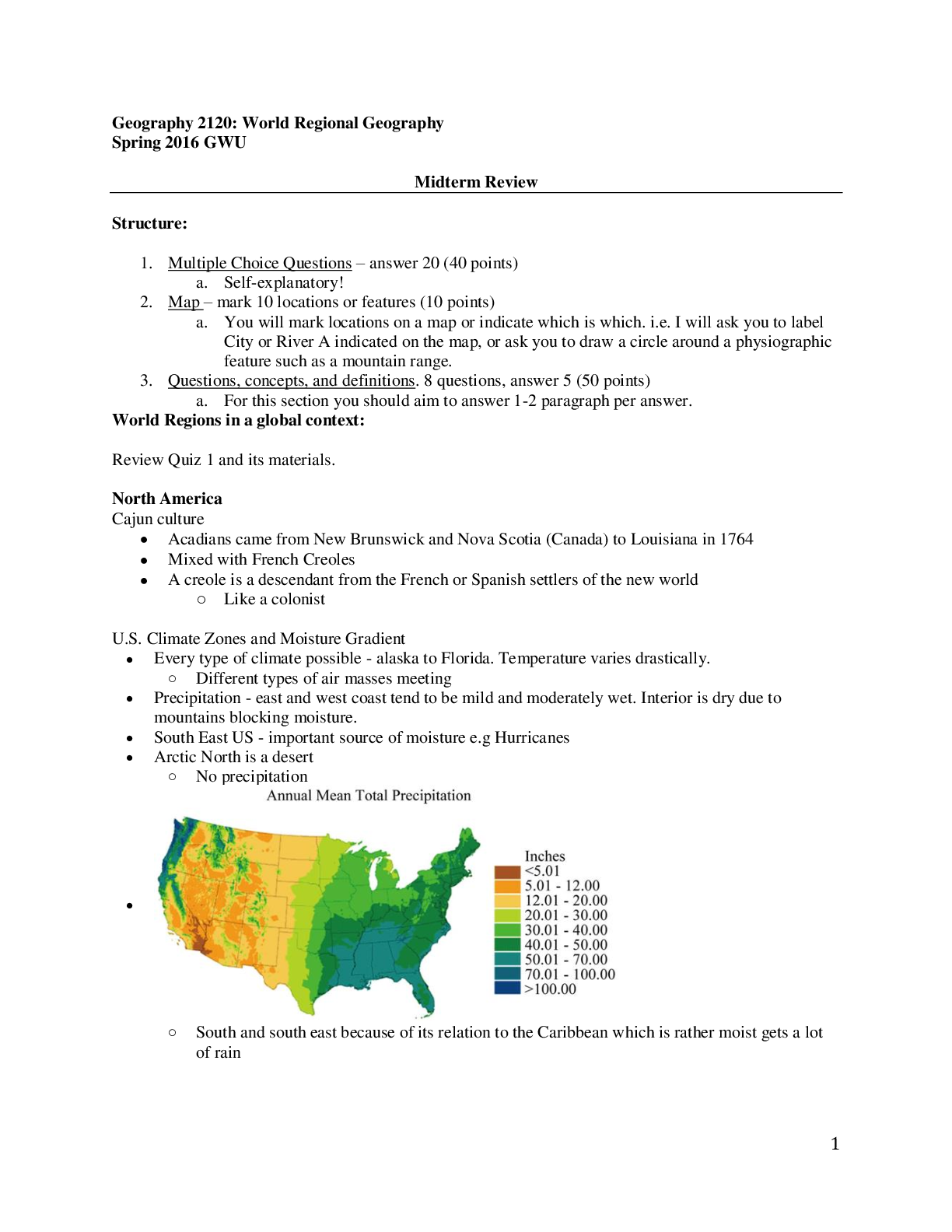
Structure: 1. Multiple Choice Questions – answer 20 (40 points) a. Self-explanatory! 2. Map – mark 10 locations or features (10 points) a. You will mark locations on a map or indicate which is ... which. i.e. I will ask you to label City or River A indicated on the map, or ask you to draw a circle around a physiographic feature such as a mountain range. 3. Questions, concepts, and definitions. 8 questions, answer 5 (50 points) a. For this section you should aim to answer 1-2 paragraph per answer. World Regions in a global context: Review Quiz 1 and its materials. North America Cajun culture • Acadians came from New Brunswick and Nova Scotia (Canada) to Louisiana in 1764 • Mixed with French Creoles • A creole is a descendant from the French or Spanish settlers of the new world o Like a colonist U.S. Climate Zones and Moisture Gradient • Every type of climate possible - alaska to Florida. Temperature varies drastically. o Different types of air masses meeting • Precipitation - east and west coast tend to be mild and moderately wet. Interior is dry due to mountains blocking moisture. • South East US - important source of moisture e.g Hurricanes • Arctic North is a desert o No precipitation • o South and south east because of its relation to the Caribbean which is rather moist gets a lot of rain 2 • • • Do not need to know the Biomes at all Environmental Modification • A wealth of resources accompanied by a technological capacity to exploit them. Result: o High quality of life can be had 3 o High level of material consumption and environmental degradation • Those two do not always go hand in hand but often • Climate change o Heave reliance on fossil fuels, producing huge amounts of green house gases. (GHGs) • Carbon footprint o The total set of GHG emissions caused directly and indirectly by an individual, organization or place etc. as a way of understanding how GHGs are contributing to climate change and where their impacts might be reduced • Mineral Resources – The Alberta Oil Tar Sands. The Bakken Shale Formation • Both countries possess vast mineral resources o Canada is 2nd in proven oil reserves • Lot of it in the arctics • In canada - oil is located primarily in Alberta = the Texas of Canada • In the US oil deposits are located in Texas, the Gulf of Mexico, Louisiana, Alaska and California • The US is the second largest consumer of energy (after China) and relies on Canadian imports [Show More]
Last updated: 3 years ago
Preview 1 out of 26 pages
Buy this document to get the full access instantly
Instant Download Access after purchase
Buy NowInstant download
We Accept:
Can't find what you want? Try our AI powered Search
Connected school, study & course
About the document
Uploaded On
Jun 30, 2022
Number of pages
26
Written in
All
This document has been written for:
Uploaded
Jun 30, 2022
Downloads
0
Views
76
Scholarfriends.com Online Platform by Browsegrades Inc. 651N South Broad St, Middletown DE. United States.
We're available through e-mail, Twitter, Facebook, and live chat.
FAQ
Questions? Leave a message!
Copyright © Scholarfriends · High quality services·