The 2016 National Nurse Aide Assessment Program (NNAAP®)
Written (Oral) Examination Content Outline
The revised content outline is based on the findings from the 2014 Job Analysis and Knowledge, Skill,
and Ability Stu
...
The 2016 National Nurse Aide Assessment Program (NNAAP®)
Written (Oral) Examination Content Outline
The revised content outline is based on the findings from the 2014 Job Analysis and Knowledge, Skill,
and Ability Study of Nurse Aides published by the National Council of State Boards of Nursing (NCSBN) in
2015. The examination content outline will be effective January 2016.
The NNAAP written examination is comprised of 70 multiple-choice items; 10 of these items are pretest
(non-scored) items on which statistical information will be collected. The NNAAP oral examination is
comprised of 60 multiple-choice items and 10 reading comprehension (word recognition) items.
Content Domain
2016 Content Outline 2011 Content Outline
Weighting
of Content
Domain
Number of
Items in
Domain
Weighting of
Content
Domain
Number of
Items in
Domain
I. Physical Care Skills
A. Activities of Daily Living 14% 9 14% 8
1. Hygiene
2. Dressing and Grooming
3. Nutrition and Hydration
4. Elimination
5. Rest/Sleep/Comfort
B. Basic Nursing Skills 39% 23 39% 24
1. Infection Control
2. Safety/Emergency
3. Therapeutic and Technical Procedures
4. Data Collection and Reporting
C. Restorative Skills 8% 5 7% 4
1. Prevention
2. Self Care/Independence
II. Psychosocial Care Skills
A. Emotional and Mental Health Needs 11% 6 11% 6
B. Spiritual and Cultural Needs 2% 2 2% 2
III. Role of the Nurse Aide
A. Communication 8% 4 8% 5
B. Client Rights 7% 4 7% 4
C. Legal and Ethical Behavior 3% 2 3% 2
D. Member of the Health Care Team 8% 5 9% 5
TOTAL 100% 60 100% 60
go on to next page
2017 Practice Exam
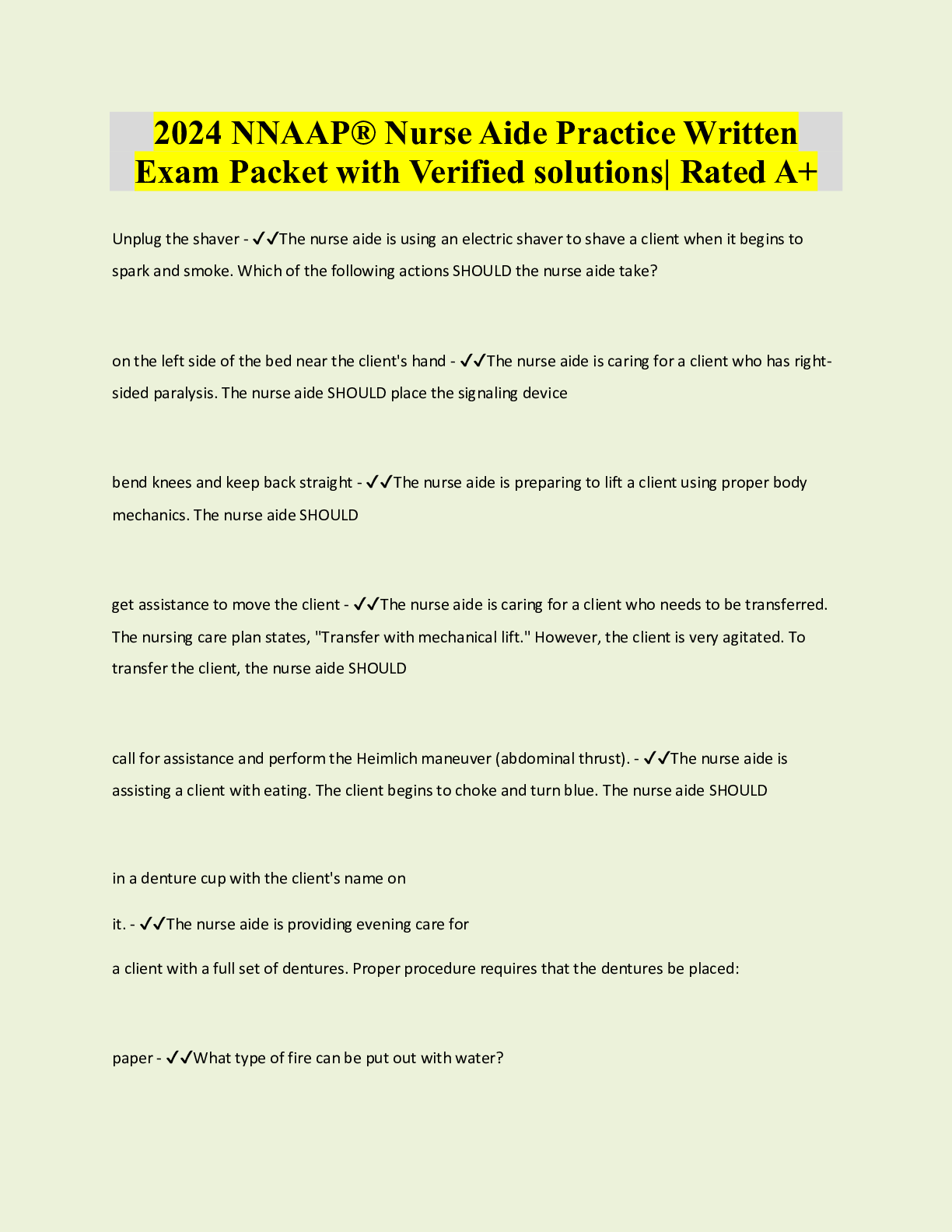
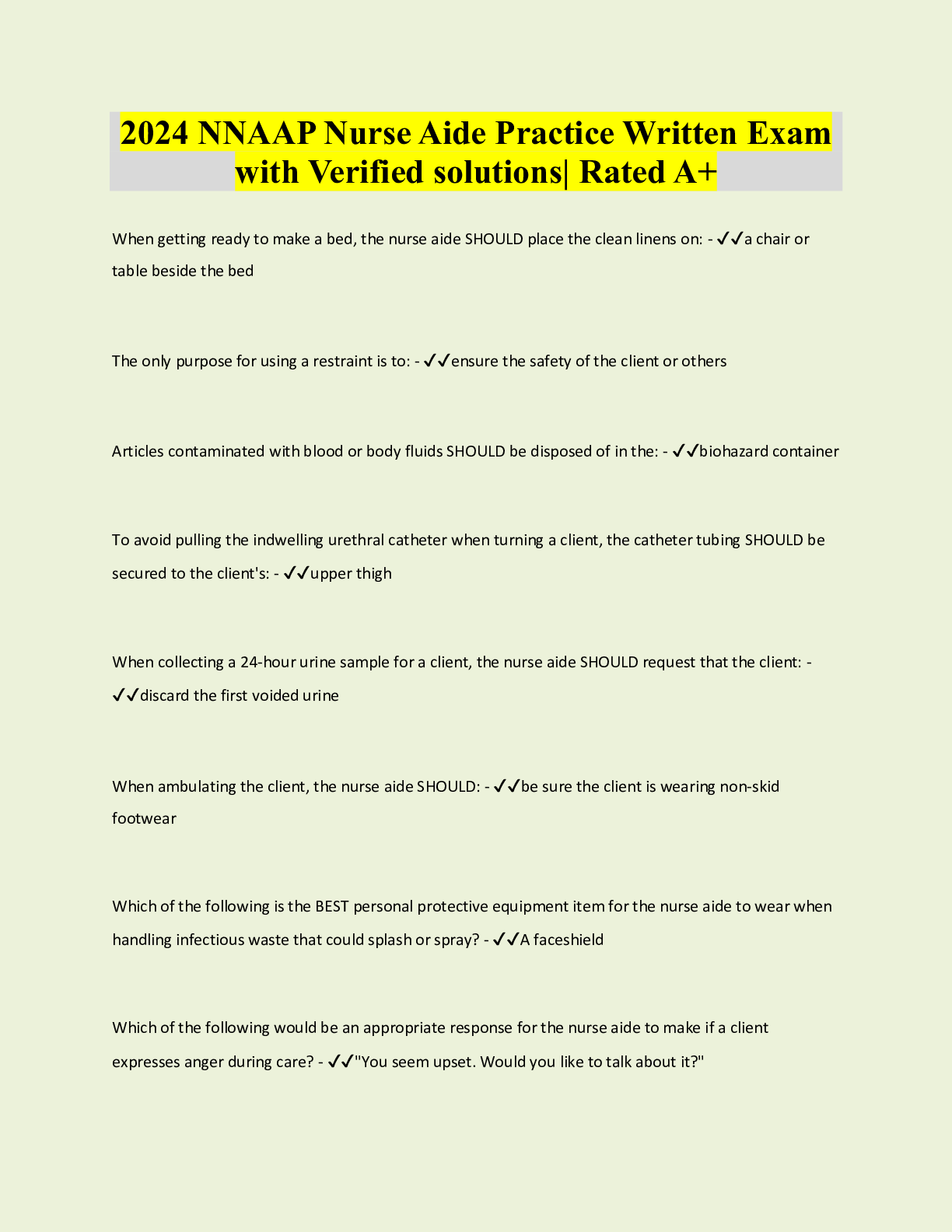
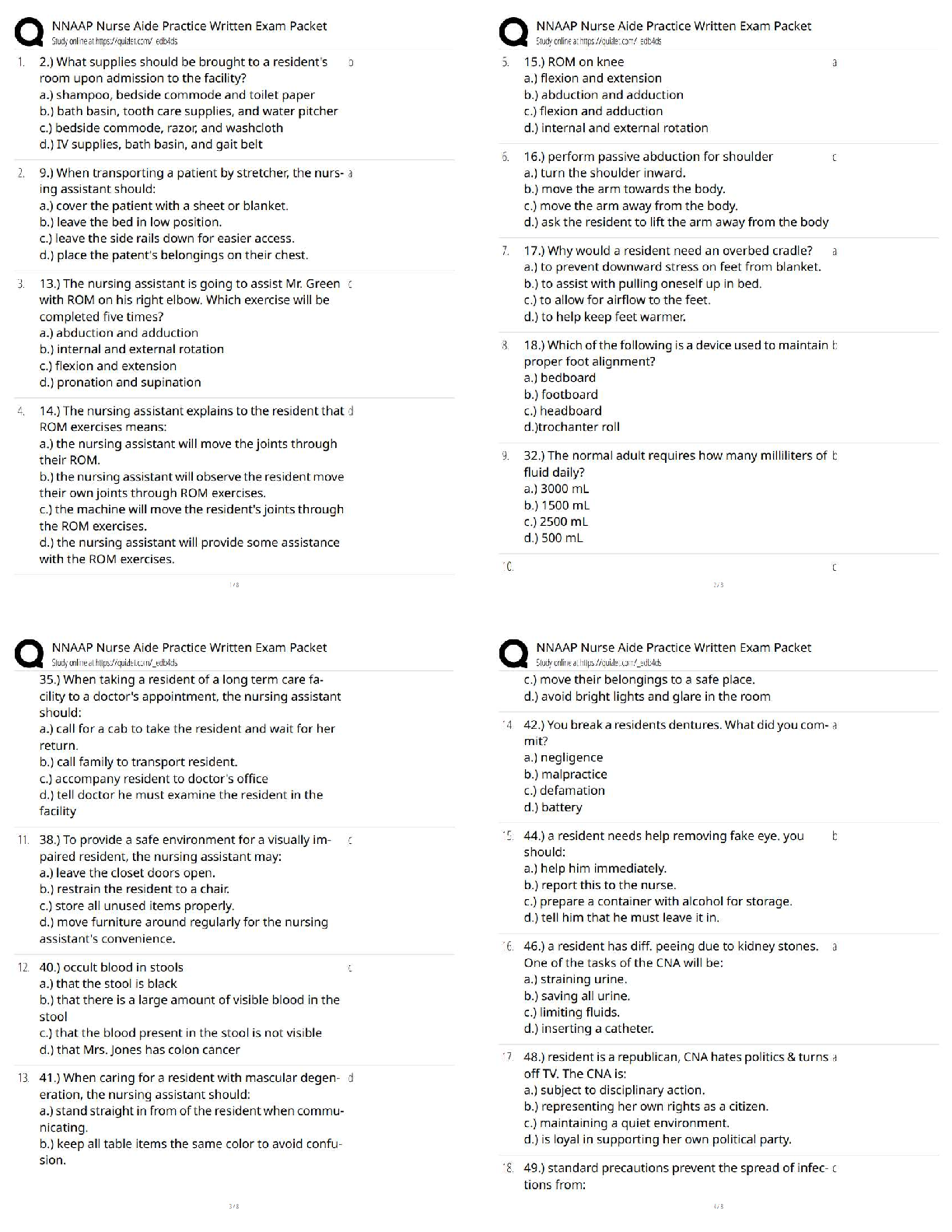
1. If a client expresses anger during care, which
of the following would be an APPROPRIATE
response for the nurse aide to make?
(A) “Why are you being so mean today?”
(B) “You should not say such mean things to
people.”
(C) “I will come back when your bad mood is
over.”
(D) “You seem upset. Would you like to talk
about it?”
2. A client drinks 240 mL of soup, 120 mL of
coffee, and 90 mL of juice for lunch. The
client’s total liquid intake for lunch is:
(A) 360 mL.
(B) 450 mL.
(C) 480 mL.
(D) 520 mL.
3. When a nurse gives the nurse aide
confidential information about a client, the
nurse aide SHOULD:
(A) share it with other clients.
(B) keep the information private.
(C) discuss it with other staff members in the
break room.
(D) discuss it with the client’s family.
4. The nurse aide SHOULD place the client’s
soiled bedsheets:
(A) on the bedside table.
(B) on the floor of the soiled utility room.
(C) in a biohazard bag.
(D) in the soiled linen container.
5. What is the MOST important reason for using
a mechanical lift to transfer clients?
(A) It takes fewer staff to transfer someone
(B) It is the safest method for clients and staff
(C) It is faster than other methods
(D) It is the method that clients like best
6. When preparing to take a meal tray into the
client’s room, what is the MOST important
action for the nurse to take?
(A) Check that the client’s name is displayed
on the tray card
(B) Make sure the client’s favorite foods are
present
(C) Determine if enough fluids have been
ordered
(D) Keep all foods covered until eaten
7. The nurse aide SHOULD use proper body
mechanics in order to:
(A) keep the nurse aide’s weight down.
(B) protect the nurse aide from injury.
(C) keep facility equipment in working order.
(D) make a good impression.
8. When making an occupied bed the nurse aide
SHOULD:
(A) leave the bed in the lowest position.
(B) make the toe pleat.
(C) leave the bottom sheet untucked.
(D) place soiled linens on the floor.
9. Frequent turning and repositioning of the
client help prevent:
(A) cyanosis.
(B) indigestion.
(C) coronary disease.
(D) pressure ulcers.
10. Pillows should be used for a client placed in a
side-lying position to:
(A) promote sleep.
(B) decrease pain.
(C) prevent skin breakdown.
(D) decrease edema.
11. Which of the following is MOST important
for the prevention of skin breakdown in the
client?
(A) Air-drying the client’s skin
(B) Rubbing lotion on the client’s skin
(C) Ambulating the client once a day
(D) Repositioning the client every 2 hours
[Show More]





![Preview of [eBook] [PDF] Clinical Nursing Calculations 3rd Edition By Susan Sienkiewicz, Sandra Meg](https://browseimages.nyc3.digitaloceanspaces.com/paper-images/2025/Jul/04/4jF14r9I2025-07-04-05-586867ec3011731.png)





.png)
.png)

