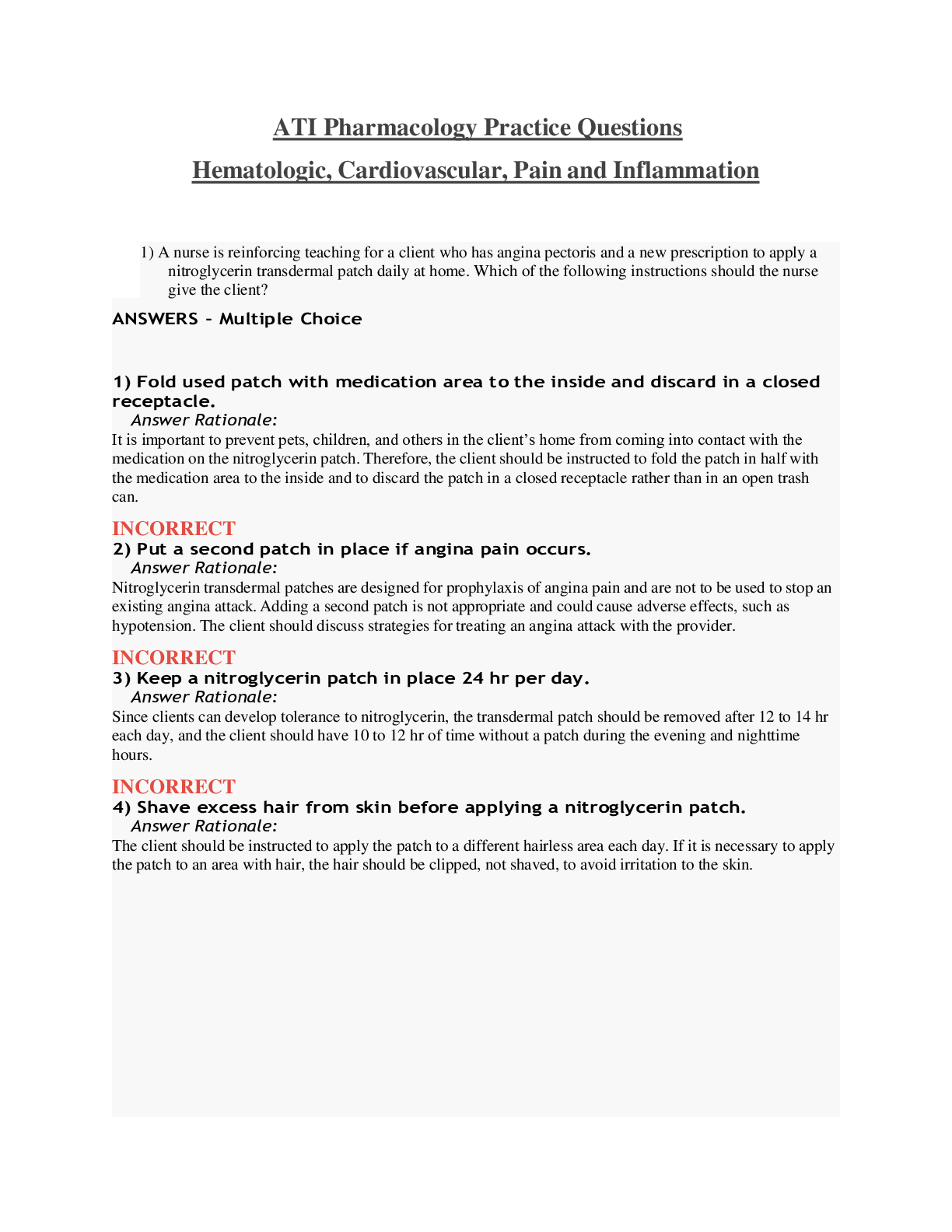
ATI Pharmacology Practice Version 4 | 60, Questions and Answers | LATEST
Document Content and Description Below
ATI Pharmacology Practice Version 4 | 60, Questions and Answers | LATEST
1) A nurse is collecting a med history from a client who has a new prescription for Lithium. The nurse should identify that the client should di
...
[Show More]
Last updated: 6 months ago
Preview 1 out of 34 pages
Instant download

Buy this Document to get the Full Access Instantly
Provided by Students Who Aced it
We Verify Document Content to Gurantee Accuracy
Reviews( 0 )
Document information
Connected school, study & course
About the document
Uploaded On
Nov 25, 2020
Number of pages
34
Written in
All

Additional information
This document has been written for:
Uploaded
Nov 25, 2020
Downloads
0
Views
216
Topic Tags
Related Subjects & Courses
Explore similar study resources and related concepts.
Recommended For You
Get more on EXAM »
$13
33 Pages
ATI Pharmacology Practice Version 3 | LATEST, Questions and An...

$13
31 Pages
ATI Pharmacology Practice Version 2 | LATEST, Questions and An...

$13
7 Pages
ATI Pharmacology Practice Version 1 | 60, Questions and Answer...
$12.5
34 Pages
ATI Pharmacology Practice Version 4 Questions and Answers (Ver...

$12.5
33 Pages
ATI Pharmacology Practice Version 3 Questions and Answers (Ve...
$12.5
33 Pages
ATI Pharmacology Practice Version 2 Questions and Answers (Ve...
.png)

$15
91 Pages
NURS 6640 Psychotherapy with Individuals FINAL EXAM Test Bank...
$24
993 Pages
Test Bank for Brunner & Suddarth's Textbook of Medical-Surgica...

$30
239 Pages
Test Bank for Abrams Clinical Drug Therapy Rationales for Nurs...
$30
1236 Pages
Davis's Diseases & Disorders A Nursing Therapeutics Manual 7th...
$6.5
4 Pages
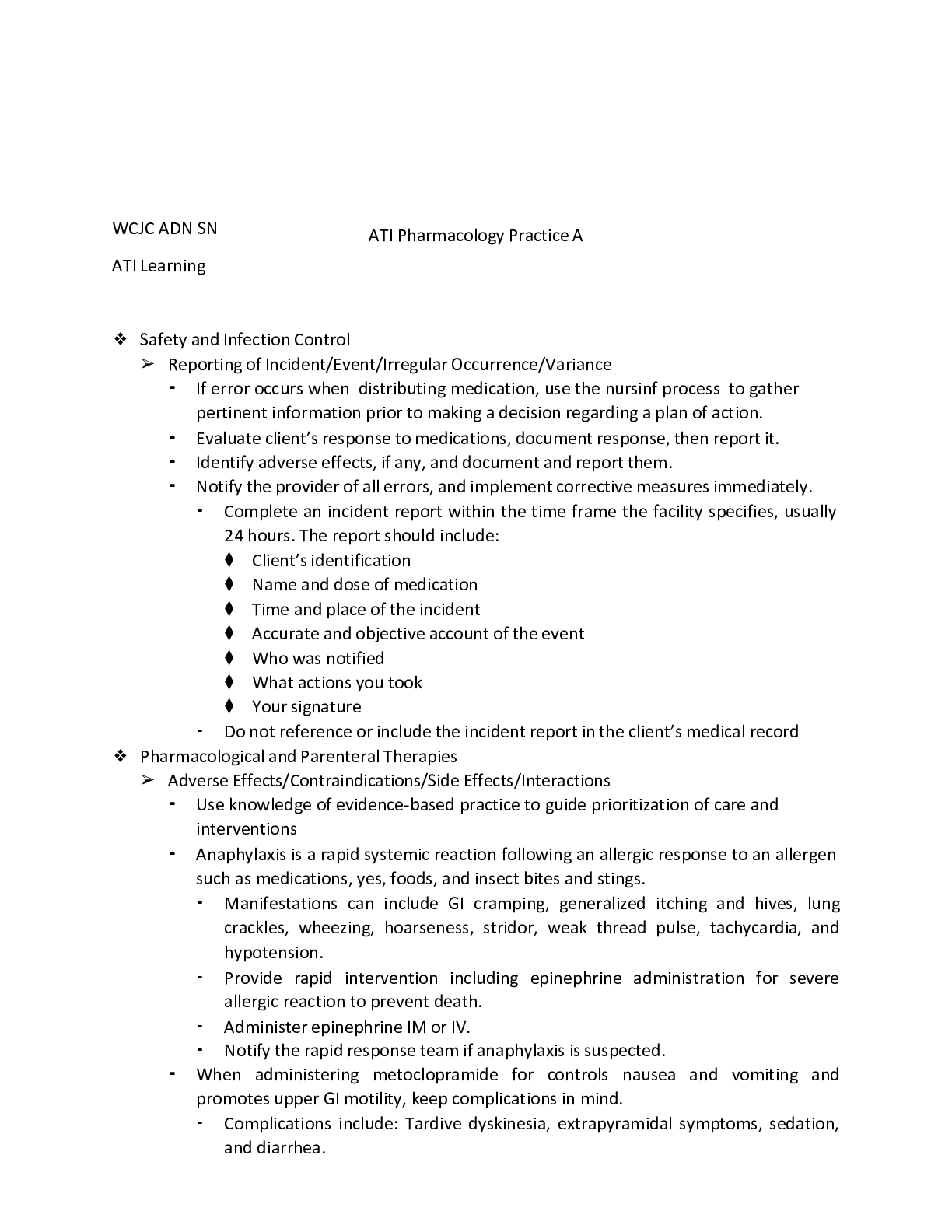
WCJC ADN SN ATI Learning ATI Pharmacology Practice A (Summary)
.png)
More related documents below