PHARMACOLOGY: CHAPTER 57 OPTHALMIC
DRUGS VERIFIED SOLUTION
The nurse will be giving ophthalmic drugs to a patient with glaucoma. Which drug is given
intravenously to reduce intraocular pressure when other medications
...
PHARMACOLOGY: CHAPTER 57 OPTHALMIC
DRUGS VERIFIED SOLUTION
The nurse will be giving ophthalmic drugs to a patient with glaucoma. Which drug is given
intravenously to reduce intraocular pressure when other medications are not successful?
a. Tobramycin (Tobrex)
b. Bacitracin (AK-Tracin)
c. Mannitol (Osmitrol)
d. Ketorolac (Acular) Answers:
ANS: C
Drugs used to reduce intraocular pressure include osmotic diuretics such as mannitol, which is given
intravenously. Tobramycin and bacitracin are antibiotics; ketorolac has anti-inflammatory actions.
The nurse is reviewing the use of ophthalmic preparations. Indications for the direct- and indirectacting miotics include which condition?
a. Cataracts
b. Removal of foreign bodies
c. Open-angle glaucoma
d. Ocular infections Answers:
ANS: C
Indications for the direct- and indirect-acting miotics include open-angle glaucoma, angle-closure
glaucoma, ocular surgery, and convergent strabismus.
A patient has a new prescription for an antiglaucoma eyedrop. The next day, she calls the clinic and
states, "The package insert says this medication might make my blue eyes turn brown! Is this true?"
The nurse realizes that the patient has a prescription for which eye medication?
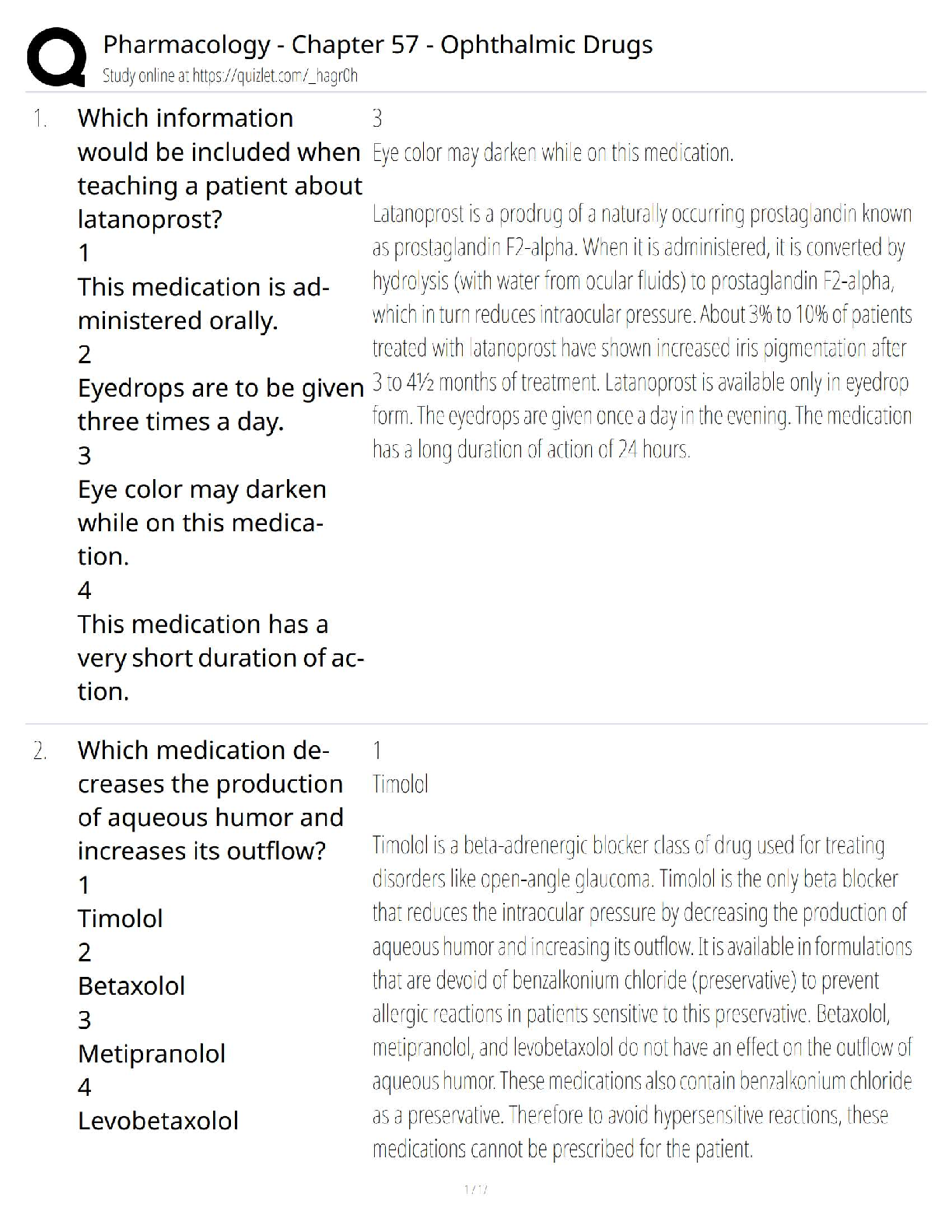
a. Latanoprost (Xalatan), a prostaglandin agonist
b. Dorzolamide (Trusopt), an ocular carbonic anhydrase inhibitor
c. Betaxolol (Betoptic), a direct-acting beta blocker
d. Pilocarpine (Pilocar), a direct-acting cholinergic Answers:
ANS: A
There is one unique adverse effect associated with all prostaglandin agonists—in some people with
hazel, green, or bluish-brown eye color, eye color will turn permanently brown, even if the medication
is discontinued. This adverse effect appears to be cosmetic only, with no known ill effects on the eye.
The other medications do not have this effect.
A patient has been taking the corticosteroid dexamethasone (Decadron) but has developed bacterial
conjunctivitis and has a prescription for gentamicin (Garamycin) ointment. The nurse notes that which
interaction is possible if the two drugs are used together?
a. The infection may become systemic.
b. The gentamicin effects may become more potent.
c. The corticosteroid may cause overgrowth of nonsusceptible organisms.
d. Immunosuppression may make it more difficult to eliminate the eye infection.Answers: ANS: D
Concurrent use of corticosteroids, such as dexamethasone and ophthalmic antimicrobials, may cause
immunosuppression that may make it more difficult to eliminate the eye infection.
When teaching a patient about the proper application of timolol (Timoptic) eyedrops, the nurse will
include which instruction?
a. "Apply the drops into the conjunctival sac instead of directly onto the eye."
b. "Apply the drops directly to the eyeball (cornea) for the best effect."
c. "Blot your eye with a tissue immediately after applying the drops."
d. "Tilt your head forward before applying the eyedrops." Answers:
ANS: A
All ophthalmic drugs should be administered in the conjunctival sac. Gently use a tissue to remove
excess eye medication—do not blot the eye after giving the medication. Tilt the head back before
giving the eyedrops.
A patient is about to undergo ocular surgery. The preoperative nurse anticipates that which drug will
be used for local anesthesia?
a. Oral glycerin
b. Proparacaine (Alcaine)
c. Timolol (Timoptic)
d. Dipivefrin (Propine) Answers:
ANS: B
Proparacaine (Alcaine) and tetracaine are used as a local anesthetic for ocular surgery or other
procedures. The other drugs are used for glaucoma.
A patient with an eye injury requires an ocular examination to detect the presence of a foreign body.
The nurse anticipates that which drug will be used for this examination?
a. Phenylephrine (Neo-Synephrine)
b. Fluorescein sodium (AK-Fluor)
c. Atropine sulfate (Isopto Atropine)
d. Olopatadine (Patanol)
Answers: ANS: B
Fluorescein sodium is an ophthalmic diagnostic dye used to identify corneal defects and to locate
foreign objects in the eye. Phenylephrine is an ocular decongestant; atropine sulfate has mydriatic
and cycloplegic effects, which are useful for examining the inner eye structures; olopatadine is an
ophthalmic antihistamine.
The nurse is administering antibiotic eye drops to a patient for the first time. After the first drop is
given, the patient states, "That eye drop is making my eye sting! Is that normal?" Which is the best
response by the nurse?
a. "That's unusual. Let me rinse the medication from your eye."
b. "Sometimes these eye drops may cause burning and stinging, but it should go away soon."
c. "These may be serious side effects, so I will notify your doctor before the next dose is due."
d. "Let's wait and see if these effects happen the next time you receive these drop
[Show More]

.png)
.png)

.png)



 Med Surg test Latest Verified Questions and all Correct Answers with Explanations Chapter 57 Management of Patients with Female Reproducti.png)

 Med Surg test Latest Verified Questions and all Correct Answers with Explanations Chapter 57 Management of Patients with Female Reproductive Disorders.png)