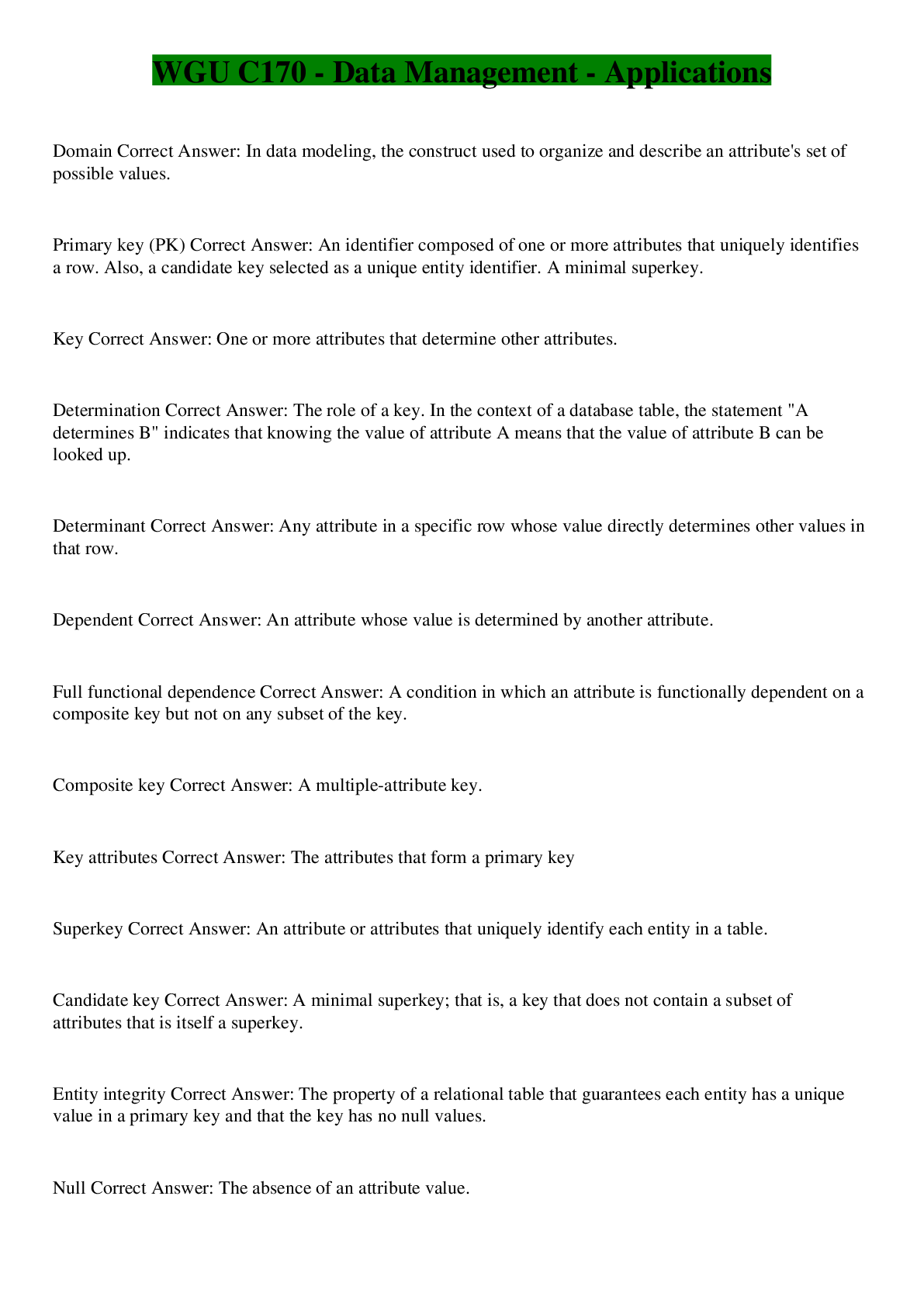
WGU Course C170 - Data Management
A salesperson is authorized to sell many products and a product can be sold by many salespersons.
Which kind of binary relationship does this scenario describe?
A One-to-one
B One-to
...
WGU Course C170 - Data Management
A salesperson is authorized to sell many products and a product can be sold by many salespersons.
Which kind of binary relationship does this scenario describe?
A One-to-one
B One-to-many
C One-to-one binary
D Many-to-many
ANSWERS: D
Which kind of relationship is displayed in this entity-relationship diagram?
A Many-to-many unary
B Many-to-many binary
C One-to-one unary
D One-to-one binary
ANSWERS: A
Which kind of relationship is displayed in this entity-relationship diagram?
A Binary many-to-many
B Unary one-to-one
C Ternary many-to-many
D Ternary one-to-one
D Unary many-to-many
E Binary one-to-one
ANSWERS: B
How is this portion of the entity-relationship diagram read, from left to right?
A At least one book was written by an author.
B Only one book was written by one author.
C No books are written by an author.
D One book was written by more than one author.
ANSWERS: A
Which two examples are attributes?
Choose 2 answers
1 A meeting code
2 A person attending a meeting
3 An employee number4 A sales meeting
A 1,3
B 2,4
ANSWERS: A
Which delete rule sets column values in a child table to a missing value when the matching data is
deleted from the parent table?
A Restrict
B Cascade
C Matching
D Set-to-Null
ANSWERS: D
In this entity-relationship diagram, Salesperson 361 is related to two customers. The table follows the
restrict delete rule.
What happens if someone tries to delete Salesperson 361 from the customer records?
A The delete occurs immediately.
B The lack of a salesperson is flagged for later.
C A new salesperson is assigned instead.
D The delete is prohibited.
ANSWERS: D
Refer to the given SQL statement.
CREATE TABLE member(member_idINT UNSIGNED NOT NULL AUTO_INCREMENT,PRIMARY
KEY (member_id),last_nameVARCHAR(20) NOT NULL,first_nameVARCHAR(20) NOT
NULL,suffixVARCHAR(5) NULL,expirationDATE NULL,emailVARCHAR(100)
NULL,streetVARCHAR(50) NULL,cityVARCHAR(50) NULL,stateVARCHAR(2)
NULL,zipVARCHAR(10) NULL,phoneVARCHAR(20) NULL,
Which two columns are created as something other than variable-length strings in this statement?
Choose 2 answers
1 member_id
2 expiration
3 suffix
4 email
5 last name
6 city
A 1,2
B 3,4ANSWERS: A
This database table has ten different employee numbers in the first column. Employee_ID is the
primary key. In addition, it has ten different names in the second column and two office addresses
repeated five times each in the third column.
Which action should be used to translate this data into third normal form?
A Move the data from the third column into the first column.
B Move the data from the third column into its own table.
C Move the data from the first two columns into separate tables.
D Move the data from the second column into the third column.
ANSWERS: B
A database manager starts to convert data that has been normalized into a form that conforms to the
relational model. A simple primary key has been established and all the repeating groups have been
deleted.
In which form is this data?
A First normal form
B Second normal form
C Third normal form
D Fourth normal form
ANSWERS: B
Two attributes in two related tables have the exact same domain of values. The attribute is a primary
key in one table.
Which kind of key is the attribute in the other table?
A Compound
B Composite
C Primary
D Foreign
ANSWERS: D
In this entity-relationship diagram, many salespersons are shown as working in at least one office.
How is the relationship between salespersons and offices represented in the diagram?
A It is linked through the salesperson ID.
B It is indicated by the tables' adjacency.
C It is undefined.
D It is linked through the office ID.
ANSWERS: D?Which command creates a database only if it does not already exist?
A IF NOT EXISTS CREATE DATABASE db_name ;
B CREATE DATABASE IF NEW db_name ;
C IF NOT EXISTS db_name ;
D CREATE DATABASE IF NOT EXISTS db_name ;
ANSWERS: A
Refer to the given SQL statement.
SELECT PRODNUM, PRODNAME
FROM PRODUCT
Which line should be added to the end of the statement to return the product numbers and product
names for products that cost 20 dollars?
A WHERE PRODCOST>=20;
B WHERE PRODCOST=20;
C AND PRODCOST=20;
D AND PRODCOST>=20;
ANSWERS: B
What does WHERE identify in a basic SQL SELECT statement?
A A table's intersection data
B The associative entity
C A range of included columns
D The rows to be included
ANSWERS
[Show More]


.png)
.png)
.png)