EAPMED REVIEW
MOCK EXAM – BIOLOGY PART 1
1. Chromosomes become most distinct during cell
a. reproduction c. metabolism
b. respiration d. transpiration
2. In which pair of organelles are light and chemical
energ
...
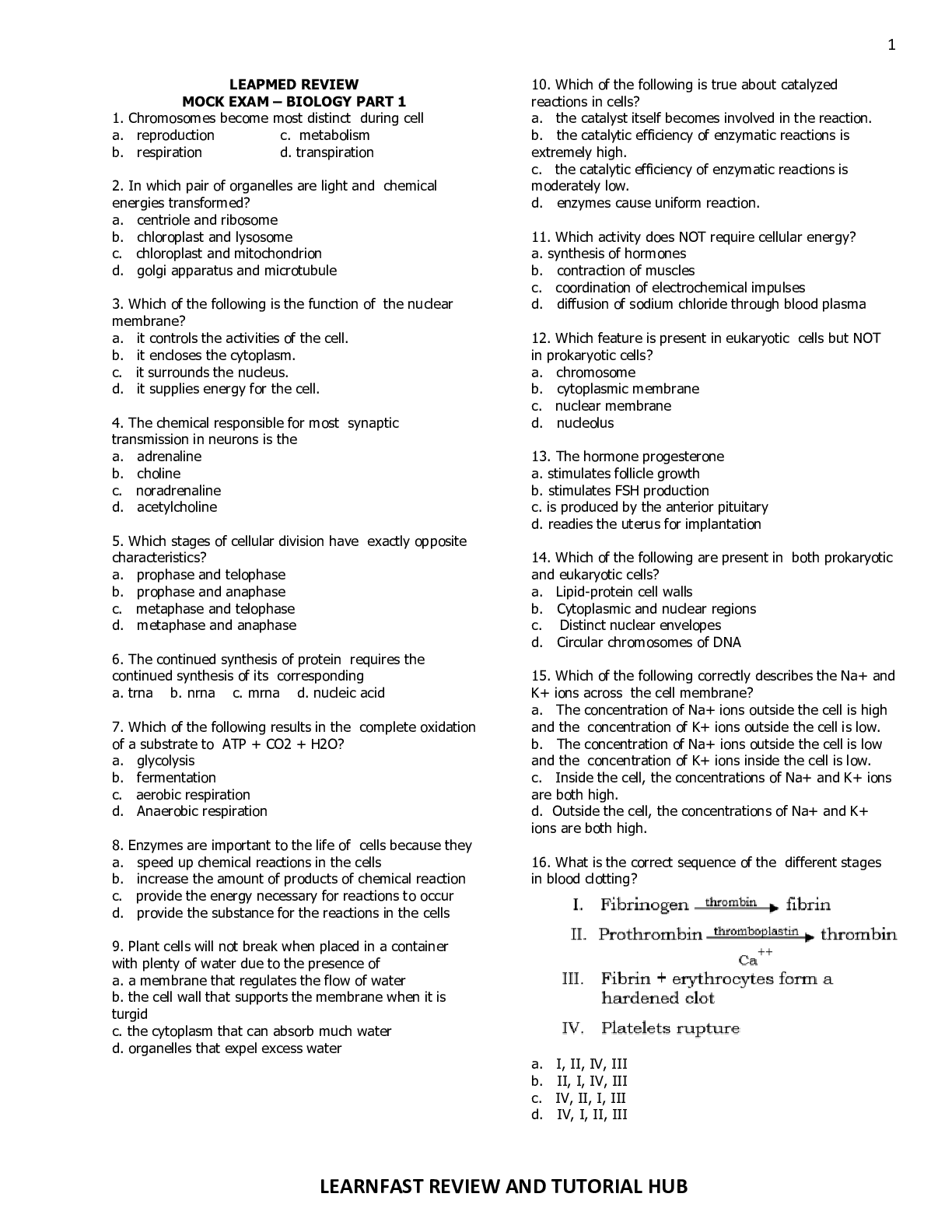
EAPMED REVIEW
MOCK EXAM – BIOLOGY PART 1
1. Chromosomes become most distinct during cell
a. reproduction c. metabolism
b. respiration d. transpiration
2. In which pair of organelles are light and chemical
energies transformed?
a. centriole and ribosome
b. chloroplast and lysosome
c. chloroplast and mitochondrion
d. golgi apparatus and microtubule
3. Which of the following is the function of the nuclear
membrane?
a. it controls the activities of the cell.
b. it encloses the cytoplasm.
c. it surrounds the nucleus.
d. it supplies energy for the cell.
4. The chemical responsible for most synaptic
transmission in neurons is the
a. adrenaline
b. choline
c. noradrenaline
d. acetylcholine
5. Which stages of cellular division have exactly opposite
characteristics?
a. prophase and telophase
b. prophase and anaphase
c. metaphase and telophase
d. metaphase and anaphase
6. The continued synthesis of protein requires the
continued synthesis of its corresponding
a. trna b. nrna c. mrna d. nucleic acid
7. Which of the following results in the complete oxidation
of a substrate to ATP + CO2 + H2O?
a. glycolysis
b. fermentation
c. aerobic respiration
d. Anaerobic respiration
8. Enzymes are important to the life of cells because they
a. speed up chemical reactions in the cells
b. increase the amount of products of chemical reaction
c. provide the energy necessary for reactions to occur
d. provide the substance for the reactions in the cells
9. Plant cells will not break when placed in a container
with plenty of water due to the presence of
a. a membrane that regulates the flow of water
b. the cell wall that supports the membrane when it is
turgid
c. the cytoplasm that can absorb much water
d. organelles that expel excess water
10. Which of the following is true about catalyzed
reactions in cells?
a. the catalyst itself becomes involved in the reaction.
b. the catalytic efficiency of enzymatic reactions is
extremely high.
c. the catalytic efficiency of enzymatic reactions is
moderately low.
d. enzymes cause uniform reaction.
11. Which activity does NOT require cellular energy?
a. synthesis of hormones
b. contraction of muscles
c. coordination of electrochemical impulses
d. diffusion of sodium chloride through blood plasma
12. Which feature is present in eukaryotic cells but NOT
in prokaryotic cells?
a. chromosome
b. cytoplasmic membrane
c. nuclear membrane
d. nucleolus
13. The hormone progesterone
a. stimulates follicle growth
b. stimulates FSH production
c. is produced by the anterior pituitary
d. readies the uterus for implantation
14. Which of the following are present in both prokaryotic
and eukaryotic cells?
a. Lipid-protein cell walls
b. Cytoplasmic and nuclear regions
c. Distinct nuclear envelopes
d. Circular chromosomes of DNA
15. Which of the following correctly describes the Na+ and
K+ ions across the cell membrane?
a. The concentration of Na+ ions outside the cell is high
and the concentration of K+ ions outside the cell is low.
b. The concentration of Na+ ions outside the cell is low
and the concentration of K+ ions inside the cell is low.
c. Inside the cell, the concentrations of Na+ and K+ ions
are both high.
d. Outside the cell, the concentrations of Na+ and K+
ions are both high.
16. What is the correct sequence of the different stages
in blood clotting?
a. I, II, IV, III
b. II, I, IV, III
c. IV, II, I, III
d. IV, I, II, III
2
LEARNFAST REVIEW AND TUTORIAL HUB
17. Which of the following is most likely to occur when a
cell is placed in a hypertonic solution?
a. Hemolysis
b. Plasmolysis
c. An increase in turgor pressure inside the cell
d. A decrease in solute concentration inside the cell
18. The function of manufacturing is common in which of
the following groups of organelles?
a. Microtubules, mitochondria, and Golgi apparatus
b. Chloroplasts, lysosomes, and endoplasmic reticula
c. Golgi apparatus, cell membrane and chloroplasts
d. Ribosomes and chloroplasts
19. Fatty acids are broken down initially by a process
known as
a. glycolysis
b. transamination
c. beta-oxidation
d. pentose phosphate pathway
20. Which of the following cellular structures is related to
protein synthesis?
a. Lysosome
b. Nucleolus
c. Mitochondrion
d. Golgi apparatus
21. The carbon dioxide produced by living organisms
comes from the
a. inhaled oxygen which reacted with carbon in their
bodies
b. foodstuffs ingested by the organisms
c. water which reacted with carbon in their bodies
d. glucose in their bodies
22. In pulmonary circulation in mammals, the veins carry
a. oxygenated blood away from the heart
b. oxygenated blood toward the heart
c. deoxygenated blood away from the heart
d. deoxygenated blood toward the heart
23. Destruction of all beta cells in the pancreas would cause
a. glucagon secretion to stop and a decrease in blood
glucose.
b. glucagon secretion to stop and an increase in blood
glucose.
c. insulin secretion to stop and an increase in blood glucose.
d. insulin secretion to stop and a decrease in blood glucose.
24. In the initial digestive process in man, all of the
following occur in the mouth EXCEPT
a. secretion of enzymes
b. primary carbohydrates digestion
c. fats and protein digestion
d. conversion of food into smaller pieces
25. The growth reaction of plants to gravity is called
a. thigmotropism
b. thermotropism
c. heliotropism
d. geotropism
26. The function of mucus secreted by the lining of the
alimentary canal is to
a. help digest fats into fatty acids and glycerol
b. help increase the amount of juices secreted by the
digestive glands
c. protect the lining from being acted upon by the
digestive juices
d. prevent bacteria from reaching the blood vessels
27. Which of the following is the organism Archips rosana
most closely related to?
a. Rosana pinuta
b. Archips fervidiana
c. Pinuta archips
d. Fervidiana rosana
28. When inhaled, which substance can form a more
stable compound with hemoglobin, thereby causing
adverse reactions in an individual?
a.Ether
b. Nicotine
c. Carbon dioxide
d.Carbon monoxide
In items 29 and 30, refer to the following setups:
[Show More]