Health Care > EXAM > MCAT General Chemistry (The Princeton Review) QUESTIONS AND ANSWERS ALL CORRECT (All)
MCAT General Chemistry (The Princeton Review) QUESTIONS AND ANSWERS ALL CORRECT
Document Content and Description Below
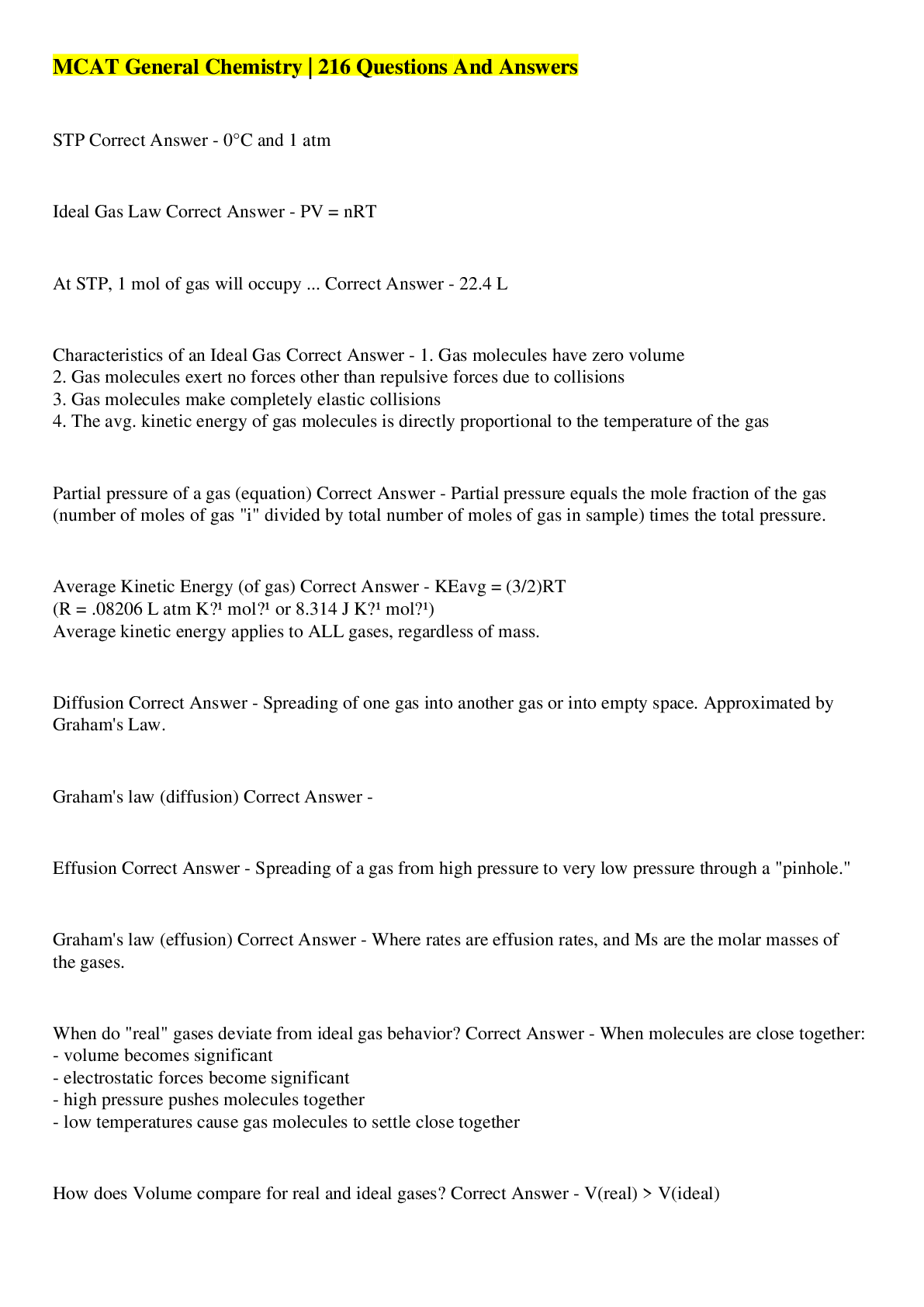
MCAT General Chemistry (The Princeton Review) Density of water Correct Answer: 1 g/cm^3. Molecular Formula Correct Answer: The exact number of each element in a molecule. Empirical Formula ... Correct Answer: The ratio of each element in a molecule. Ammonium Correct Answer: Hydronium Correct Answer: Acetate Correct Answer: Bicarbonate Correct Answer: Cyanide Correct Answer: Hydroxide Correct Answer: Nitrate Correct Answer: Nitrite Correct Answer: Perchlorate Correct Answer: Carbonate Correct Answer: Sulfate Correct Answer: Sulfite Correct Answer: Phosphate Correct Answer: Formula Weight Correct Answer: The sum of the atomic weights of all atoms in the molecule. If an atom's atomic number equals its atomic weight, which of the following would be true? A) The number of protons equals the number of electrons. B) The number of neutrons equals the number of protons. C) The number of neutrons equals the number of electrons. D) The number of protons is less than the number of neutrons. Correct Answer: A) The number of protons equals the number of electrons. The only scenario in which this can occur is if the atom does not contain any neutrons. Thus, for a neutral atom, the number of protons must equal the number of electrons. This is the least wrong answer. Avogadro's Number Correct Answer: What formula is used to find the number of moles in a given amount of a substance? Correct Answer: Percent Mass Calculation Correct Answer: 1. Assume 100g of the total substance. 2. Find the number of moles of each. 3. Adjust the ratio of the components to make whole numbers. Molarity (M) Correct Answer: Mole Fraction of a Solute Correct Answer: What is the mole fraction of NaOH in a solution made from 80g NaOH (mw= 40) in 180g H2O (mw = 18)? A) 0.31 B) 0.20 C) 0.17 D) 0.11 Correct Answer: C) 0.17 80g NaOH = 2 moles 180g H2O = 10 moles mole fraction = (n NaOH)/(n NaOH + n H2O) mole fraction = 2/(2+10) = 1/6 = 0.166 Sign for Heat Correct Answer: Catalyst Correct Answer: A substance that increases the rate of a reaction without being consumed. Catalysts increase reaction rate by stabilizing the transition state. What impact does this have on the reverse reaction? A) No impact: a separate catalyst would be required for the reverse reaction. B) No impact: the reverse reaction is catalytically resistant. C) Increases reverse reaction rate to the same degree as the forward reaction. D) Increases reverse reaction rate by changing the reverse reaction intermediates. Correct Answer: C) Increases reverse reaction rate to the same degree as the forward reaction. Stabilizing the transition state increases the rate of the forward and reverse reactions to the same degree. Catalysts have no impact on equilibrium. Kinetics and thermodynamics are separate entities in chemistry. Oxidation State Oxidation Number Correct Answer: The ownership of valence electrons. The charge a molecule would have if all shared electrons were completely transferred to the more electronegative element. What are the 3 possible oxidation states for hydrogen and when are they used? Correct Answer: Hydrogen is +1 when bound to elements more electronegative than carbon. Hydrogen is 0 when bound to carbon. Hydrogen is -1 when bound to elements less electronegative than carbon. When an element is oxidized, it will: A) gain electrons, and its oxidation state will increase. B) gain electrons, and its oxidation state will decrease. C) lose electrons, and its oxidation state will decrease. D) lose electrons, and its oxidation state will increase. Correct Answer: D) lose electrons, and its oxidation state will increase. List the 9 most electronegative elements from strongest to weakest. Correct Answer: F, O, N = Cl, Br, I, S, C = H. Nucleons Correct Answer: Protons and neutrons. Atomic Number and Mass Number Correct Answer: Isotopes Correct Answer: Two atoms of the same element with different numbers of neutrons. How do atomic numbers and mass numbers vary between isotopes? Correct Answer: They have the same atomic number, but different mass numbers. Which of the following statements about stable chemical isotopes is FALSE? A) Many stable isotopes are naturally occurring. B) Isotopes can be separated by both chemical and physical means. C) Theoretical rate constants of decay are very small. D) Changing the number of neutrons has little effect on nuclear reactivity. Correct Answer: D) Changing the number of neutrons has little effect on nuclear reactivity. Changing the number of neutrons directly affect nuclear stability, particularly for lighter elements. The remaining choices are true statements. Isotopes can be separated by physical (centrifugation) and chemical means (variable reaction rate). What is the difference between anions and cations? Correct Answer: An anion is a negatively charged ion. A cation is a positively charged ion. Strong Nuclear Force Correct Answer: The force which holds protons and neutrons together. It is stronger than electrical force, but only works over very small distances. What are the 3 types of decay? Correct Answer: Alpha, beta, and gamma. Alpha Decay Correct Answer: -Decreases the number of neutrons and protons. -Subtracts 4 from the mass number. -Subtracts 2 from the atomic number. -Stopped by skin or paper. Alpha Particle Correct Answer: What are 3 types of beta decay? Correct Answer: 1. Beta - Decay. 2. Beta + Decay. 3. Electron Capture. Beta - Decay Correct Answer: -Turns a neutron into a proton and an electron. - increases atomic number by 1, atomic mass is still the same -Stopped by aluminum or thick plastic/glass. Beta+ Decay Correct Answer: -Converts a proton into a neutron and a positron. -decreases atomic # by 1 and keeps Atomic mass the same -Stopped by aluminum or thick plastic/glass. What is another name for Beta + decay? Correct Answer: Positron Emission. Electron Capture Correct Answer: -An electron and proton become a neutron. - decreases atomic # by 1 and keeps Atomic mass the same - Stopped by aluminum or thick plastic/glass. What is the most common type of beta decay? Correct Answer: Beta - Decay. Gamma Decay Correct Answer: -Brings an excited nucleus to a lower state. -Doesn't change mass number or atomic number. -Stopped by a few inches of lead or several feet of concrete. When does gamma decay occur? Correct Answer: When the nucleus is in an excited state after alpha or beta decay. Gamma Photons Gamma Rays Correct Answer: Photons of electromagnetic radiation with neither mass nor charge. Exponential Decay formula without e. Correct Answer: T = total time. t = half life. Exponential Decay formula with lambda. Correct Answer: Lambda is the decay constant and equals the inverse of the half-life. Would a sample that was quickly decaying have a large or small decay constant? Correct Answer: Large. The shorter the half-life, the larger the decay constant, the faster the decay. The radioactive isotope 32P has a half-life of 14 days. If 200mg of 32P remains in a vial, approxima [Show More]
Last updated: 3 years ago
Preview 1 out of 45 pages
Buy this document to get the full access instantly
Instant Download Access after purchase
Buy NowInstant download
We Accept:

Also available in bundle (1)
Click Below to Access Bundle(s)

MCAT TESTS COMPILATION BUNDLE
MCAT TESTS COMPILATION BUNDLE
By Crum 3 years ago
$40.5
23
Reviews( 0 )
$14.00
Can't find what you want? Try our AI powered Search
Document information
Connected school, study & course
About the document
Uploaded On
Jul 06, 2022
Number of pages
45
Written in
All

Additional information
This document has been written for:
Uploaded
Jul 06, 2022
Downloads
0
Views
175