Pass the Big ABA Exam-Section 8 Terms
Premack Principle Correct Answer: A principle that states that making the opportunity to engage in a high-probability behavior (i.e., something that you are more likely to do) co
...
Pass the Big ABA Exam-Section 8 Terms
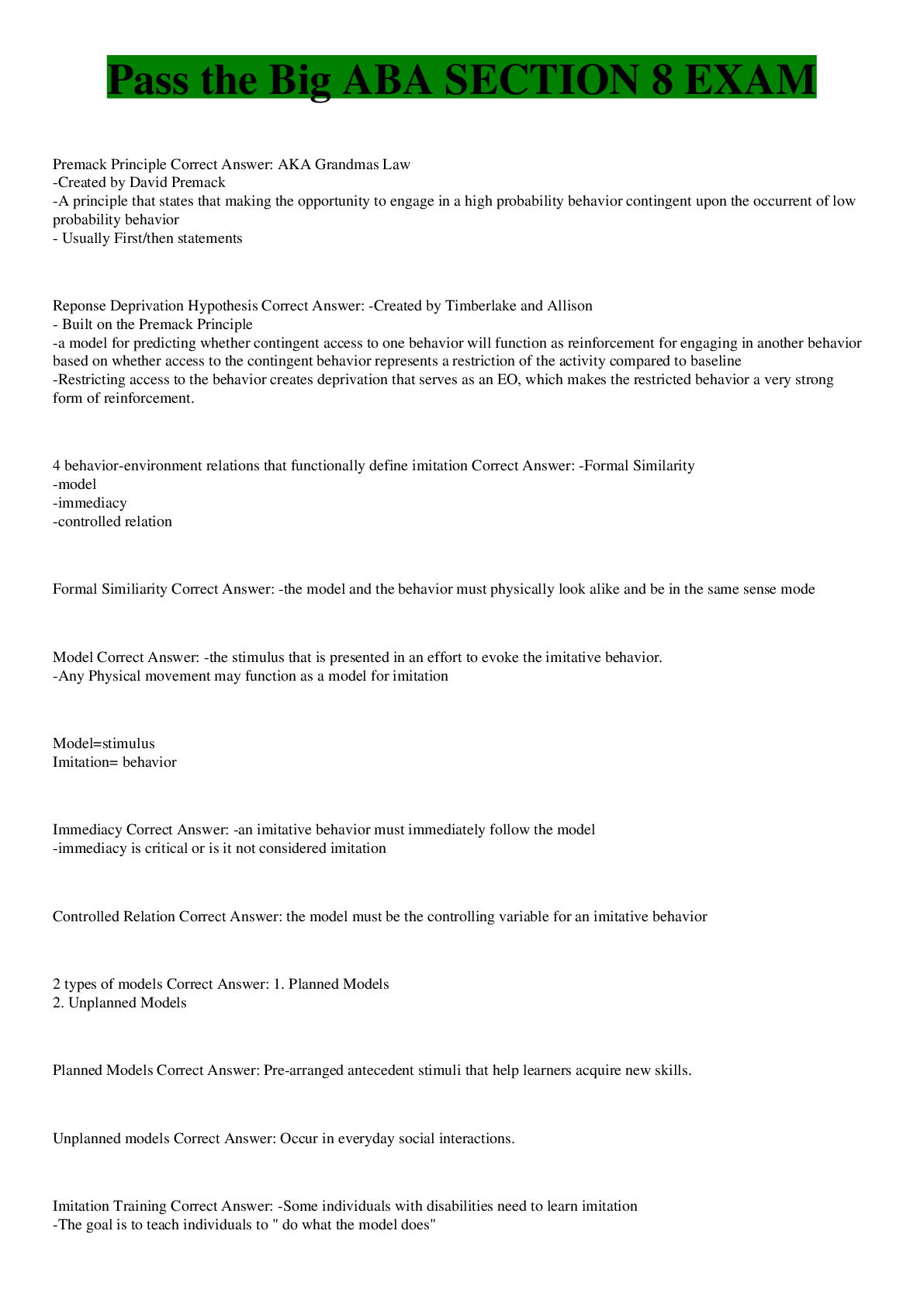
Premack Principle Correct Answer: A principle that states that making the opportunity to engage in a high-probability behavior (i.e., something that you are more likely to do) contingent upon the occurrence of low-probability (i.e., something you are less likely to do) will function as a reinforcer for the low-probability behavior. Usually stated as a "first ___________, then _________."
Response-Deprivation Hypothesis Correct Answer: Created by Timberlake & Allison, 1974. Built on the Premack Principle. A model for predicting whether contingent access to one behavior will function as reinforcement for engaging in another behavior based on whether access to the contingent behavior represents a restriction of the activity compared to baseline. Restricting access to the behavior creates deprivation that serves as an EO, which makes the restricted behavior a very strong form of reinforcement.
Imitation Correct Answer: This is defined by 4 behavior-environment relations: a) any physical movement may function as a model for imitation. A model is an antecedent stimulus that evokes the imitative behavior. b) An imitative behavior must immediately follow the presentation of the model (within 3-5 seconds) c)the model and the behavior must have formal similarity d)the model must be the controlling variable for an imitative behavior.
4 Behaviors that Functionally Define Imitation Correct Answer: Formal Similarity, Model, Immediacy, and Controlled Relation.
Formal Similarity Correct Answer: The model & behavior must have formal similarity (i.e., the model & the behavior must physically look alike & be in the same sense mode.
Model Correct Answer: The stimulus that is presented in an effort to evoke the imitative behavior. Any physical movement may function as this for imitation.
Immediacy Correct Answer: An imitative behavior must immediately follow the model (within a few seconds). This aspect is critical, or it is not considered imitation. "Imitation may also occur at later times & in the context of everyday life situations, but technically, this is not true imitation.
Controlled Relation Correct Answer: The model must be the controlling variable for the imitative behavior. The model must serve as the Sd for the imitative behavior.
Generalized Imitation Correct Answer: When the model is novel & still evokes an imitation.
Planned Models Correct Answer: Pre-arranged antecedent stimuli that help learners acquire new skills.
Unplanned Models Correct Answer: This occurs in everyday social interactions. Example: Watching an individual pay to ride the bus & then imitating or copying that behavior.
Imitation Training Correct Answer: The goal of this training is to teach individuals to "do what the model does."
5 Steps of Imitation Training Correct Answer: 1.) Assess & teach any prerequisite skills for imitation training.
2.) Select models for training.
3.) Pretest
4.) Sequence models for training.
5.) Implement imitation training
Guidelines for Imitation Training Correct Answer: Guidelines for this include:
1.) Keep training sessions active, short (10-15 minutes, couple times a day).
2.) Reinforce both prompted & imitative responses.
3.) Pair verbal praise & attention with tangible reinforcers.
4.) Record Data
5.) Fade out prompts
Shaping Correct Answer: A process involving systematically & deferentially reinforcing successive approximations to a terminal behavior. This teaches novel behaviors. Clicker Training is an application of this. Example: A child's volume of voice is extremely loud. The child is provided with reinforcement for emitting lower volumes of his/her voice. As lower volumes of voice are continually provided with reinforcement, the child speaking in a low volume increases & speaking in a loud volume decreases.
Differential Reinforcement Correct Answer: Reinforcing those responses within a response class that meet a specific criterion along with dimensions (e.g., frequency, magnitude, etc.) & placing all other responses in the class on extinction. This procedure involves 2 parts: (1) Reinforcement contingent on: (a) The occurrence of a behavior other than the challenging behavior, (b) Challenging behavior occurring at a reduced rate. (2) Withholding Reinforcement (i.e., extinction) for the challenging behavior as much as possible. This is an extremely popular & effective strategy.
Successive Approximations Correct Answer: The sequence of new response classes that emerge during the shaping process as a result of differential reinforcement. Each successive approximation is closer in form to the terminal behavior than the response class it replaces.
2 Types of Shaping Methods Correct Answer: Across and Within Response Topographies
Response Differentiation Correct Answer: A behavior change produced by differential reinforcement. Reinforced members of the current response class occur with greater frequency & Unreinforced members occur less frequently (because they are on extinction). The overall results of this is: A new response class.
Shaping Across Response Topographies Correct Answer: The topography of the behavior changes during shaping. Behaviors are still members of the same response class. Example: A speech therapist teaching novel vocalizations to an individual who does not possess any vocal abilities.
Shaping Within Response Topographies Correct Answer: Topography of behavior remains consistent. Another measurable dimension of behavior is changed (e.g., duration of the behavior). Example: Duration of time spent practicing piano increased via shaping.
Guidelines for Shaping Correct Answer: The guidelines for this involves:
1.) Assess Terminal Behavior & Available Resources
[Show More]