PASS BIG BCBA Exam - AKA's for Experimental Design
Single-Subject Designs AKA Correct Answer: Single-Case Designs
Single-Case Designs AKA Correct Answer: Within-Subject Designs
Within-Subject Designs AKA Corre
...
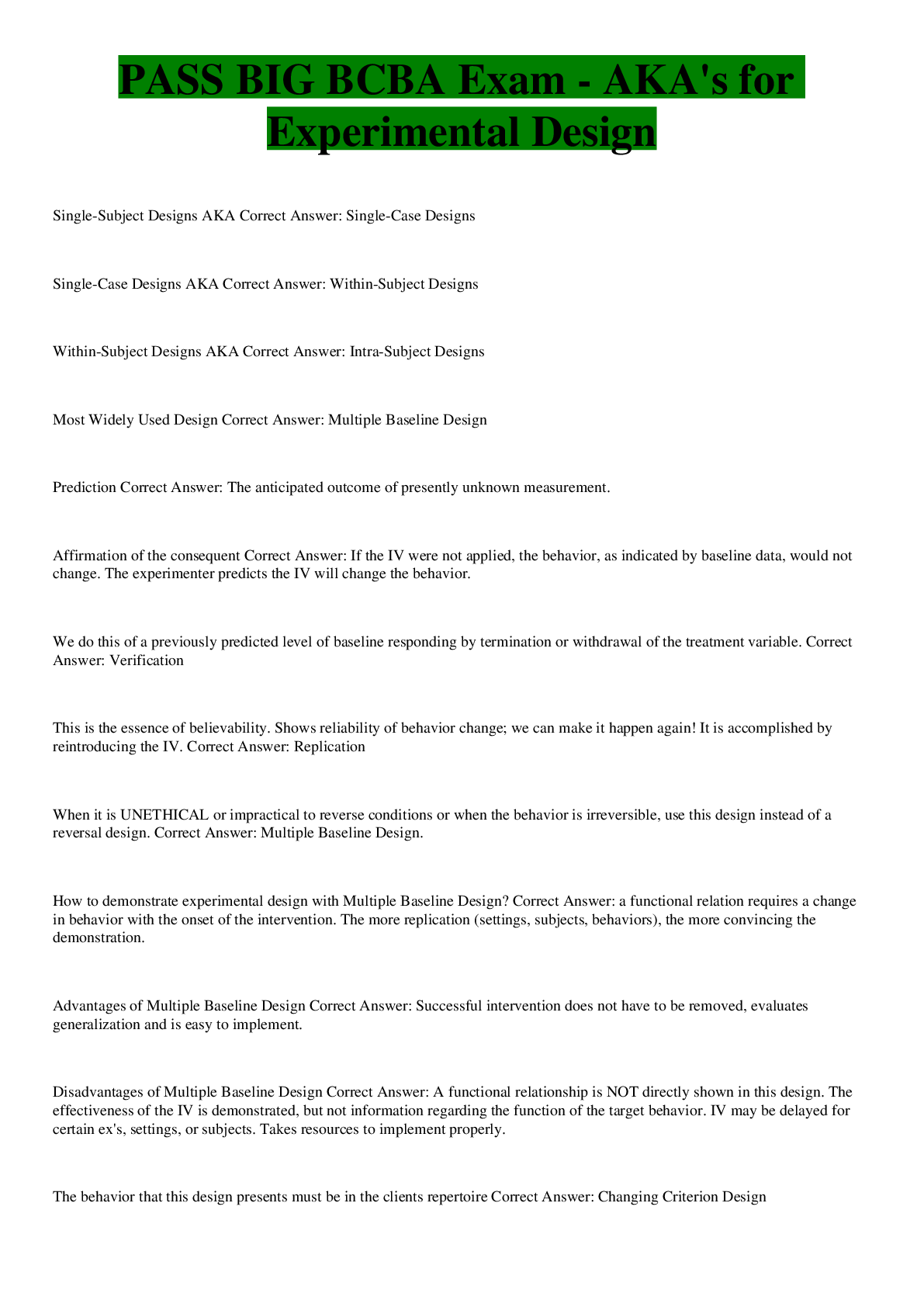
PASS BIG BCBA Exam - AKA's for Experimental Design
Single-Subject Designs AKA Correct Answer: Single-Case Designs
Single-Case Designs AKA Correct Answer: Within-Subject Designs
Within-Subject Designs AKA Correct Answer: Intra-Subject Designs
Most Widely Used Design Correct Answer: Multiple Baseline Design
Prediction Correct Answer: The anticipated outcome of presently unknown measurement.
Affirmation of the consequent Correct Answer: If the IV were not applied, the behavior, as indicated by baseline data, would not change. The experimenter predicts the IV will change the behavior.
We do this of a previously predicted level of baseline responding by termination or withdrawal of the treatment variable. Correct Answer: Verification
This is the essence of believability. Shows reliability of behavior change; we can make it happen again! It is accomplished by reintroducing the IV. Correct Answer: Replication
When it is UNETHICAL or impractical to reverse conditions or when the behavior is irreversible, use this design instead of a reversal design. Correct Answer: Multiple Baseline Design.
How to demonstrate experimental design with Multiple Baseline Design? Correct Answer: a functional relation requires a change in behavior with the onset of the intervention. The more replication (settings, subjects, behaviors), the more convincing the demonstration.
Advantages of Multiple Baseline Design Correct Answer: Successful intervention does not have to be removed, evaluates generalization and is easy to implement.
Disadvantages of Multiple Baseline Design Correct Answer: A functional relationship is NOT directly shown in this design. The effectiveness of the IV is demonstrated, but not information regarding the function of the target behavior. IV may be delayed for certain ex's, settings, or subjects. Takes resources to implement properly.
The behavior that this design presents must be in the clients repertoire Correct Answer: Changing Criterion Design
Advantages of Changing Criterion Design Correct Answer: It does not require reversal of improved behavior and it enables an experimental analysis within the context of a gradually improving behavior.
Disadvantages of Changing Criterion Design Correct Answer: The target behavior must already be in the persons repertoire and not appropriate for analyzing the effects of a shaping program. It is NOT a comparison design.
Shaping Correct Answer: is a behavior change strategy. it is used to teach NOVEL behaviors which is developed by reinforcing responses that meet a gradually changing criterion, which are successive approximations, towards the terminal behavior.
Reversal Design AKA Correct Answer: A-B-A-B and B-A-B
Types of reversal design: Correct Answer: -repeated reversals
-BAB reversal
-Multiple Treatment Design
-NCR Reversal Technique
-DRO/DRA/DRI Reversal Technique
Repeated Reversal Correct Answer: A-B-A-B-A-B-A-B-A-B
Sequence Effects Correct Answer: Effects on a subject's behavior in a given condition that are the result of the subject's experience with prior condition.
Multiple Treatment Reversal Correct Answer: A type of reversal design that compares 2 or more IVs to baseline &/or to one another.
Ex: A-B-A-C-A-B-A-C
Non-contingent reinforcement (NCR) reversal technique Correct Answer: Any moment we see NCR as an intervention and contingent reinforcement then it is this.
Irreversibility Correct Answer: the level of behavior observed in an earlier phase cannot be reproduced even though experimental conditions are the same as they were during the earlier phase.
Alternating Treatment Design AKA Correct Answer: Simultaneous Treatments Design
Simultaneous Treatments Design AKA Correct Answer: Concurrent Schedules Design
Concurrent Schedules Design AKA Correct Answer: Multi-element design
Multi-element design AKA Correct Answer: Multi-element baseline design
Multi-element baseline design AKA Correct Answer: Multiple Schedules Design
How to determine a functional relation in an alternating treatments design? Correct Answer: one data path is consistently higher than the other and no overlapping data paths.
What are the 3 problems avoided by alternating treatments design? Correct Answer: irreversibility, sequence effects, and unstable data
Withdrawal Design Correct Answer: is a term used by some authors as a synonym for A-B-A-B design; also used to describe experiments in which an effective treatment is sequentially or partially withdrawn to promote maintenance of behavior changes.
[Show More]