NRNP 6552 WOMENS HEALTH MIDTERM WALDEN UNIVERSITY
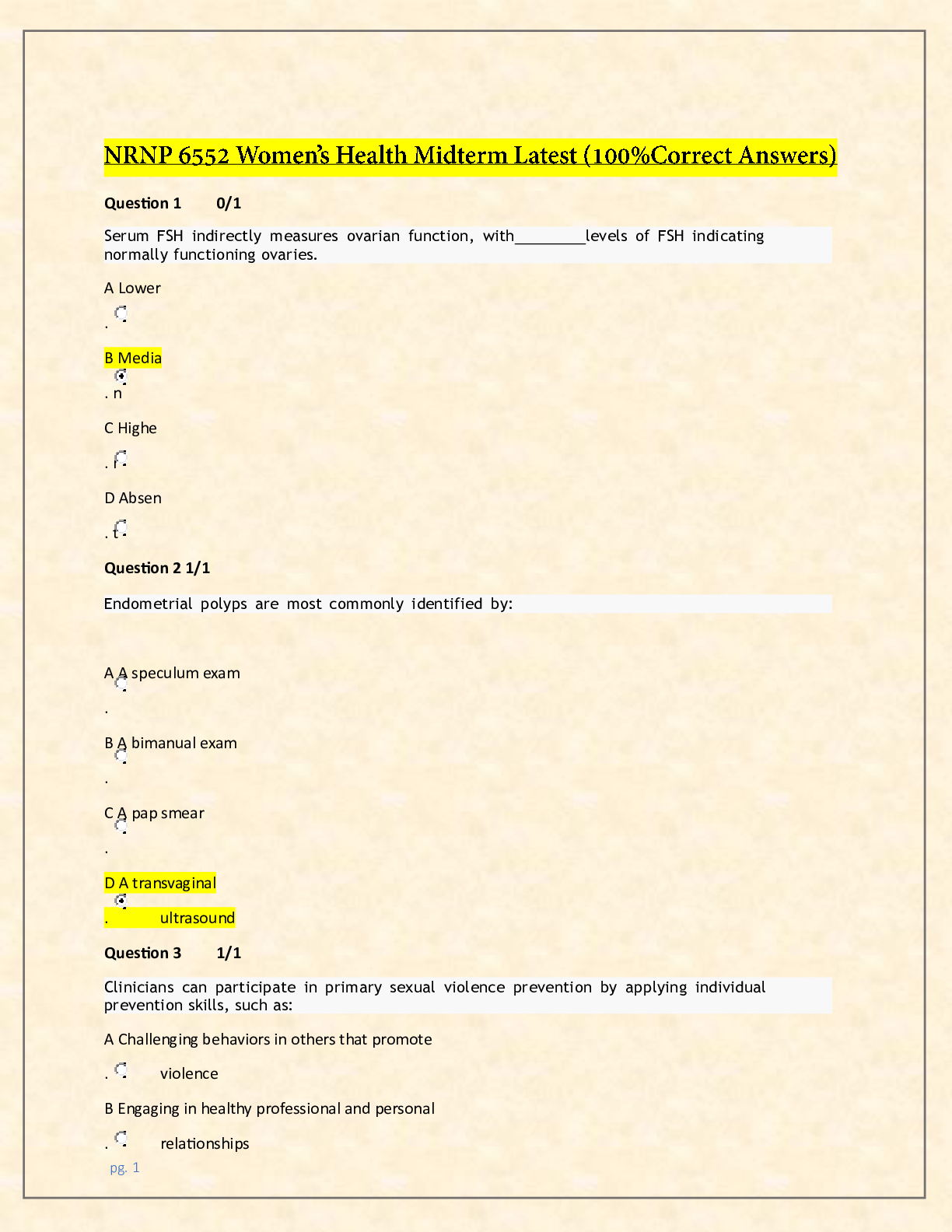
Question 1 0/1
A Lower
.
B
Media
.
n
C
Highe
.
r
D
Absen
.
t
Question 2 1/1
A A speculum exam
.
B A bimanual exam
.
C A pap smear
.
D
A transvagin
...
NRNP 6552 WOMENS HEALTH MIDTERM WALDEN UNIVERSITY
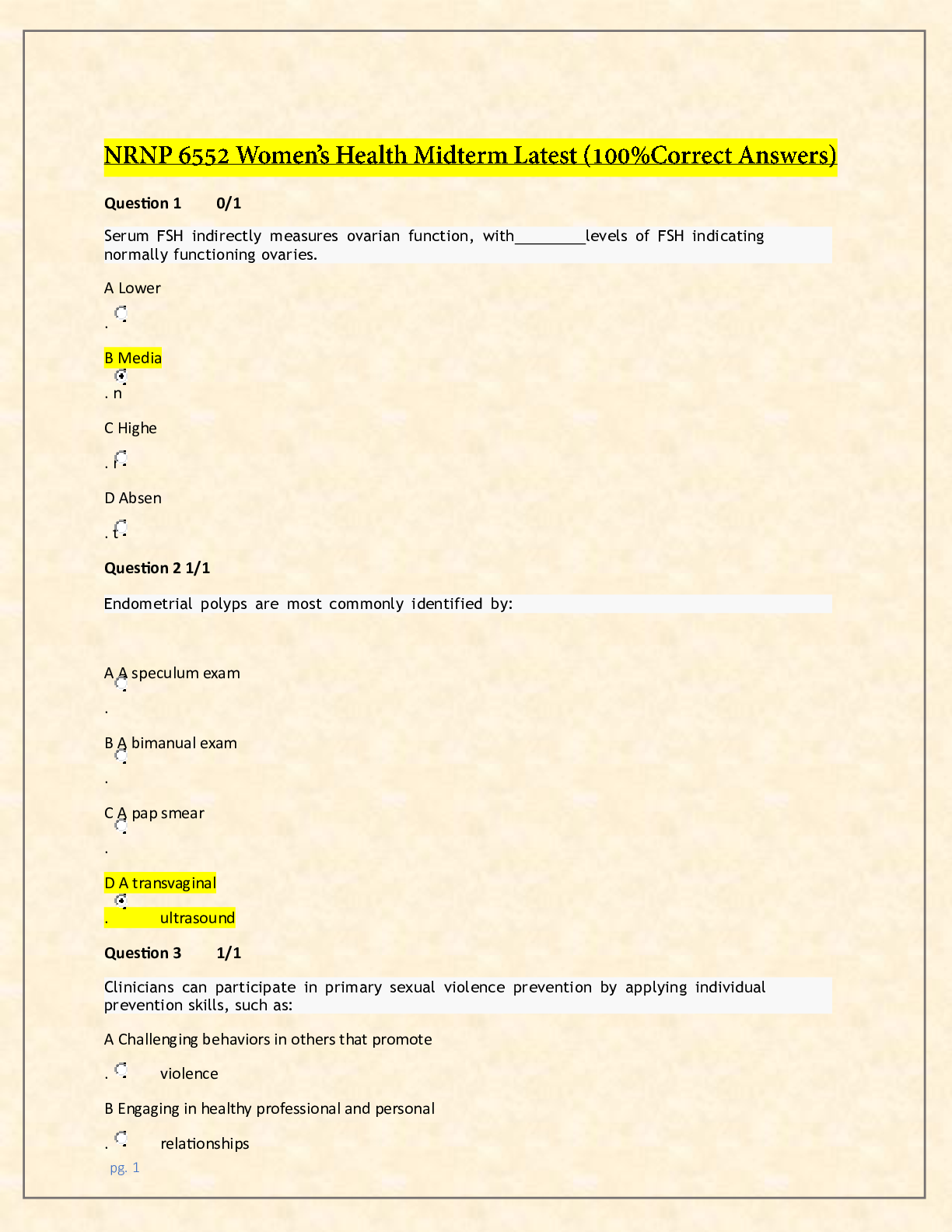
Question 1 0/1
A Lower
.
B
Media
.
n
C
Highe
.
r
D
Absen
.
t
Question 2 1/1
A A speculum exam
.
B A bimanual exam
.
C A pap smear
.
D
A transvaginal
.
ultrasound
Question 3 1/1
A
Challenging behaviors in others that promote
.
violence
B
Engaging in healthy professional and personal
.
relationships
C
Learning to identify risk factors for sexually abusive
.
behaviors
D B and C
.
E A, B, and C
.
Question 4 1/1
A waiting period of between bariatric surgery and pregnancy is recommended.
Clinicians can participate in primary sexual violence prevention by applying individual
prevention skills, such as:
Endometrial polyps are most commonly identified by:
Serum FSH indirectly measures ovarian function, with levels of FSH indicating
normally functioning ovaries.
A
6-12
.
months
B
6-18
.
months
C
12-24
.
months
D 3-5 years
.
Question 5 1/1
Barriers for providers related to intimate partner violence screening include:
A Discomfort with the topic
.
B
Having too much power that might be
.
intimidating
C Time constraints
.
D A and C
.
E A, B, and C
.
Question 6 1/1
Hirsutism is defined as:
A
Excessive terminal hair loss in
.
women
B Excessive nail growth in women
.
C Brittle nail growth in women
.
D
Excessive terminal hair growth in
.
women
Question 7 0/1
A pharmacologic treatment for patients with Hydradenitis Suppurativa (HI) may include
A Clindamycin
.
B Minocycline
.
C Metformin
.
D
All of the
.
above
Question 8 1/1
A There are too many studies involving women
.
B Most of the research is qualitative, which limits the applicability
.
C
For many years, studies were done primarily on men with the findings being
.
generalized to women
D None of the above
.
Question 9 1/1
Most malignancies in breast tissue occur in:
A The areolar area
.
B
The upper outer
.
quadrant
C
The lower outer
.
quadrant
D None of the above
.
Question 10 0/1
On vaginal exam you find that Polly’s cervix is in the most common position, which is:
A Anterior
.
B Midline
.
C Posterior
.
D
Retroflex
.
ed
When looking from a feminist perspective at research studies, one of the great concerns is
that:
Question 11 0/1
A
4
.
0
B
4
.
5
C
5
.
0
D
5
.
5
Question 12 1/1
A Bacterial vaginosis
.
B Trichomoniasis
.
C
Urinary tract
.
infection
D
Vulvovaginal
.
candidiasis
Question 13 1/1
The most common pathogen leading to urinary tract infection is:
A
Escherichia
.
coli
B Enterobacter
.
C Pseudomonas
.
D
Proteus
.
mirabilis
Jenna comes in complaining of intense itching in the vaginal area. She also has some itching
in the vulvar area. It is really bad after she has intercourse. In gathering her history, she tells
you she had an ear infection a few weeks ago and took amoxicillin for it but otherwise, has
been healthy. On exam, you note a thick, white, lumpy discharge with the consistency of
cottage cheese. The vulva is red and swollen as are the labial folds. There is no strong odor.
The most likely diagnosis is:
All organizations recommend beginning screening mammograms in average-risk women at
age
Question 14 1/1
A
25;
.
30
B
32;
.
37
C
35;
.
40
D
45;
.
52
Question 15 1/1
A
Smell
.
test
B
Odor
.
test
C
Sniff
.
test
D
Whiff
.
test
Question 16 1/1
A Bisexual
.
B
Pansexua
.
l
C
Intersexu
.
al
D
Cisgende
.
r
Question 17 0/1
A No ovarian
A progesterone challenge test that produces withdrawal bleeding is indicative of:
A person whose gender identity is the same as their sex when he or she was born is:
The test for the fishy odor that occurs in bacterial vaginosis is called the:
In women, fertility declines gradually b
[Show More]