SSC301 F2
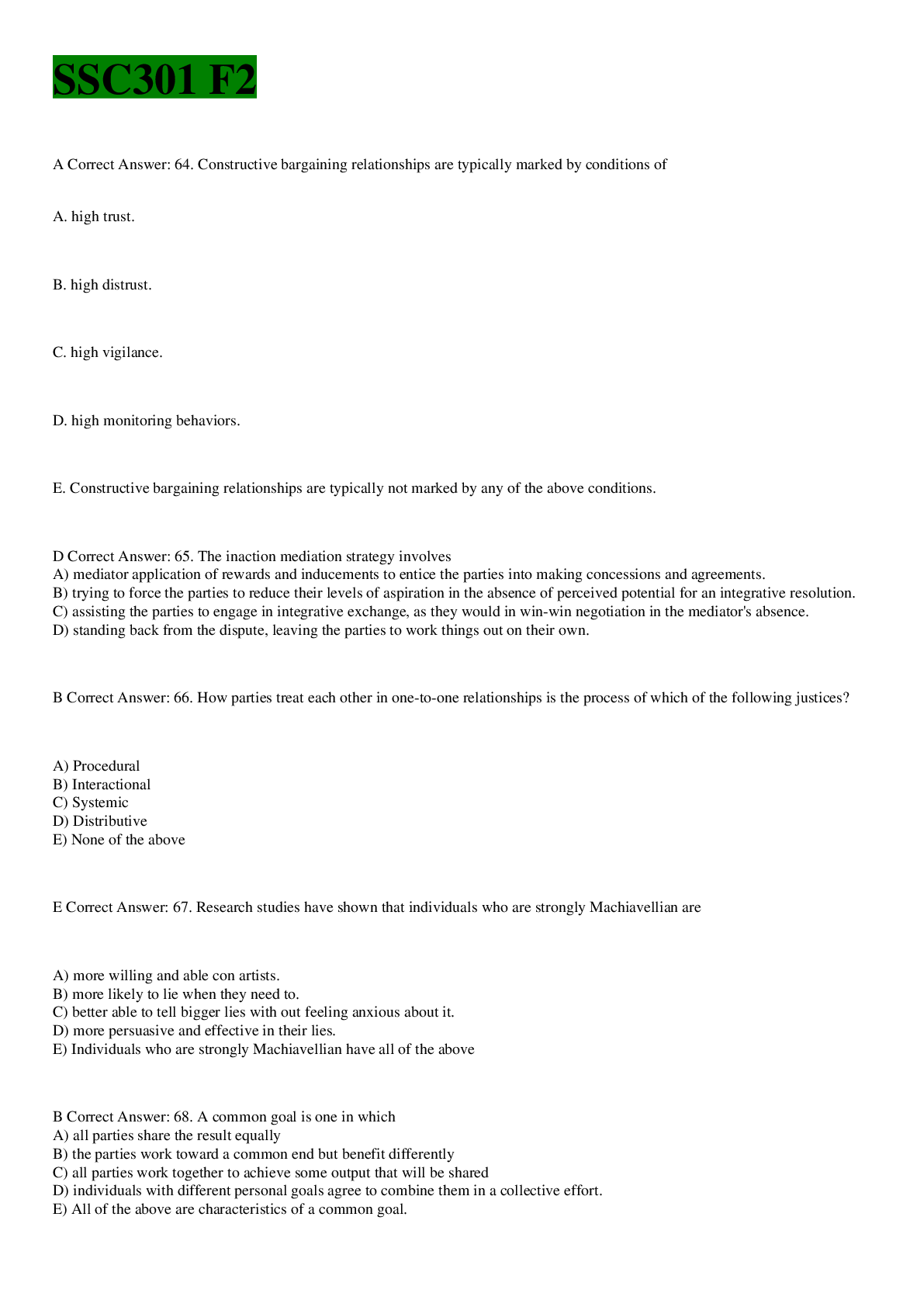
A Correct Answer: 64. Constructive bargaining relationships are typically marked by conditions of
A. high trust.
B. high distrust.
C. high vigilance.
D. high monitoring behaviors.
E. Cons
...
SSC301 F2
A Correct Answer: 64. Constructive bargaining relationships are typically marked by conditions of
A. high trust.
B. high distrust.
C. high vigilance.
D. high monitoring behaviors.
E. Constructive bargaining relationships are typically not marked by any of the above conditions.
D Correct Answer: 65. The inaction mediation strategy involves
A) mediator application of rewards and inducements to entice the parties into making concessions and agreements.
B) trying to force the parties to reduce their levels of aspiration in the absence of perceived potential for an integrative resolution.
C) assisting the parties to engage in integrative exchange, as they would in win-win negotiation in the mediator's absence.
D) standing back from the dispute, leaving the parties to work things out on their own.
B Correct Answer: 66. How parties treat each other in one-to-one relationships is the process of which of the following justices?
A) Procedural
B) Interactional
C) Systemic
D) Distributive
E) None of the above
E Correct Answer: 67. Research studies have shown that individuals who are strongly Machiavellian are
A) more willing and able con artists.
B) more likely to lie when they need to.
C) better able to tell bigger lies with out feeling anxious about it.
D) more persuasive and effective in their lies.
E) Individuals who are strongly Machiavellian have all of the above
B Correct Answer: 68. A common goal is one in which
A) all parties share the result equally
B) the parties work toward a common end but benefit differently
C) all parties work together to achieve some output that will be shared
D) individuals with different personal goals agree to combine them in a collective effort.
E) All of the above are characteristics of a common goal.
E Correct Answer: 69. Effective planning requires hard work on the following points:
A) Defining the issues
B) Defining the bargaining limit
C) Defining interests
D) Defining limits and alternatives
E) All of the above
E Correct Answer: 70. The best way to manage perceptual and cognitive biases is:
A) to be aware that they exist.
B) to participate in group discussions.
C) to tell people about the bias.
D) complete a questionnaire.
E) All of the above help manage biases but may not be enough in and of themselves.
E Correct Answer: 71. The media increasingly provide opportunities for "disorganized majorities" to have a voice through all but one of the following. Which one?
A) Web-based chat rooms.
B) Call-in talk shows.
C) Weblogs.
D) Media polls.
E) Petitions.
B Correct Answer: 72. When successive concessions get smaller, the most obvious message is that
A) the negotiator is reaching the fatigue point.
B) the resistance point is being reached.
C) the concession maker's position is weakening.
D) the negotiator has passed the resistance point.
E) None of the above.
E Correct Answer: 73. Which of the following conclusions about the issue of fairness is not a true statement?
A) Involvement in the process of helping to shape a negotiation strategy increases commitment to that strategy and willingness to pursue it.
B) Negotiators (buyers in a market transaction) who are encouraged ("primed") to think about fairness are more cooperative in distributive negotiations.
C) Parties who are made offers they perceive as unfair may reject them out of hand, even though the amount offered may be better than the alternative settlement, which is to receive nothing at all.
D) Establishment of some "objective standard" of fairness has a positive impact on the negotiations and satisfaction with the outcome.
E) All of the above are true statements.
A Correct Answer: 74. How can we reward people for what they say during a negotiation?
A) acknowledge and support a point that they have made
B) ignore or underplay points that we feel need to be emphasized but which weren't
C) encourage the other party to develop unfavorable points
D) accept all concessions and favors without returning any
E) None of the above tactics can be used to reward people for what they say during a
negotiation.
C Correct Answer: 75. "Adapting to the other party's approach" is best used by parties with
A) no familiarity.
B) low familiarity.
C) moderate familiarity.
D) high familiarity.
E) Adapting to the other party's approach is equally effective for all parties.
B Correct Answer: 76. The collaborative ideal of high trust/low distrust refers to
A. each party's expectations of a competitive motivational orientation from the other.
B. patterns of predictable behavior from each other and will cooperate.
C. minimal commitment to problem-solving behavior.
D. a negotiation which is best suited to distributive bargaining.
E. The collaborative ideal of high trust/low distrust refers to all of the above.
E Correct Answer: 77. When may mediation be less than effective?
A) when the conflict is intense
B) when they have major differences in their expectations for a settlement.
C) when many issues are at stake
D) when the parties disagree on major priorities
E) Mediation tactics may be insufficient in all of the above situations.
C Correct Answer: 78. An individual who pursues his or her own outcomes strongly and shows little concern for whether the other party obtains his or her desired outcomes is using another of the following strategies. Which one?
A) yielding
B) compromising
C) contending
D) problem solving
E) None of the above
E Correct Answer: 79. Skilled negotiators may
A) suggest different forms of a potential settlement that are worth about the same to them.
B) recognize that not all issues are worth the same amount to both parties.
C) frequently save a final small concession for near the end of the negotiation to "sweeten" the deal.
D) make the last concession substantial to indicate that "this is the last offer".
E) Skilled negotiators may take all of the above actions.
C Correct Answer: 80. A joint goal is one in which
A) all parties share the result equally.
B) the parties work toward a common end but benefit differently.
C) individuals with different personal goals agree to combine them in a collective effort.
D) all parties work together to achieve some output that will be shared.
E) All of the above are characteristics of a common goal.
E Correct Answer: 81. Interests can be:
A) substantive, directly related to the focal issues under negotiation
B) process based, related to the manner in which we settle this dispute
C) relationship based, tied to the current or desired future relationship between the parties
D) based in the intangibles of the negotiation
E) all of the above
D Correct Answer: 82. The distinction between mood and emotion is based on which of the following characteristics?
A) specificity
B) intensity
C) duration
D) all of the above
E) none of the above
A Correct Answer: 83. The "harmony-and-light speech"
A) communicates that the other negotiator is interested in building a personal relationship.
B) indicates that the parties are adamant in their positions.
C) is a clear sign that negotiations will be tense.
D) is another name for a deadlocked negotiation.
E) The "harmony and light speech" accomplishes none of the above.
D Correct Answer: 84. Denise Rousseau has researched and defined the "idiosyncratic deal" as the unique ways that employers may come to treat certain employees compared to others in the same office or environment. Which observation stated below is inaccurate?
A) Deals are more common when workers are willing to negotiate.
B) Deals are more likely to work effectively when performance criteria are clear and well specified.
C) Deals are more common in certain countries, such as the United States, the United Kingdom and New Zealand.
D) Deals are more common when workers are located in large organizations.
E) Deals are more likely to work when workers trust the performance appraisal process.
D Correct Answer: 85. Research results have generally indicated that higher levels of moral development are associated with
A) less ethical decisions.
B) more cheating behavior.
C) less helping behavior.
D) more resistance to authority figures who are attempting to dictate unethical conduct.
E) Higher levels of moral development are associated with all of the above.
C Correct Answer: 86. What are three major things that a listener can do to resist another's influence efforts?
[Show More]