BLS Certification Test
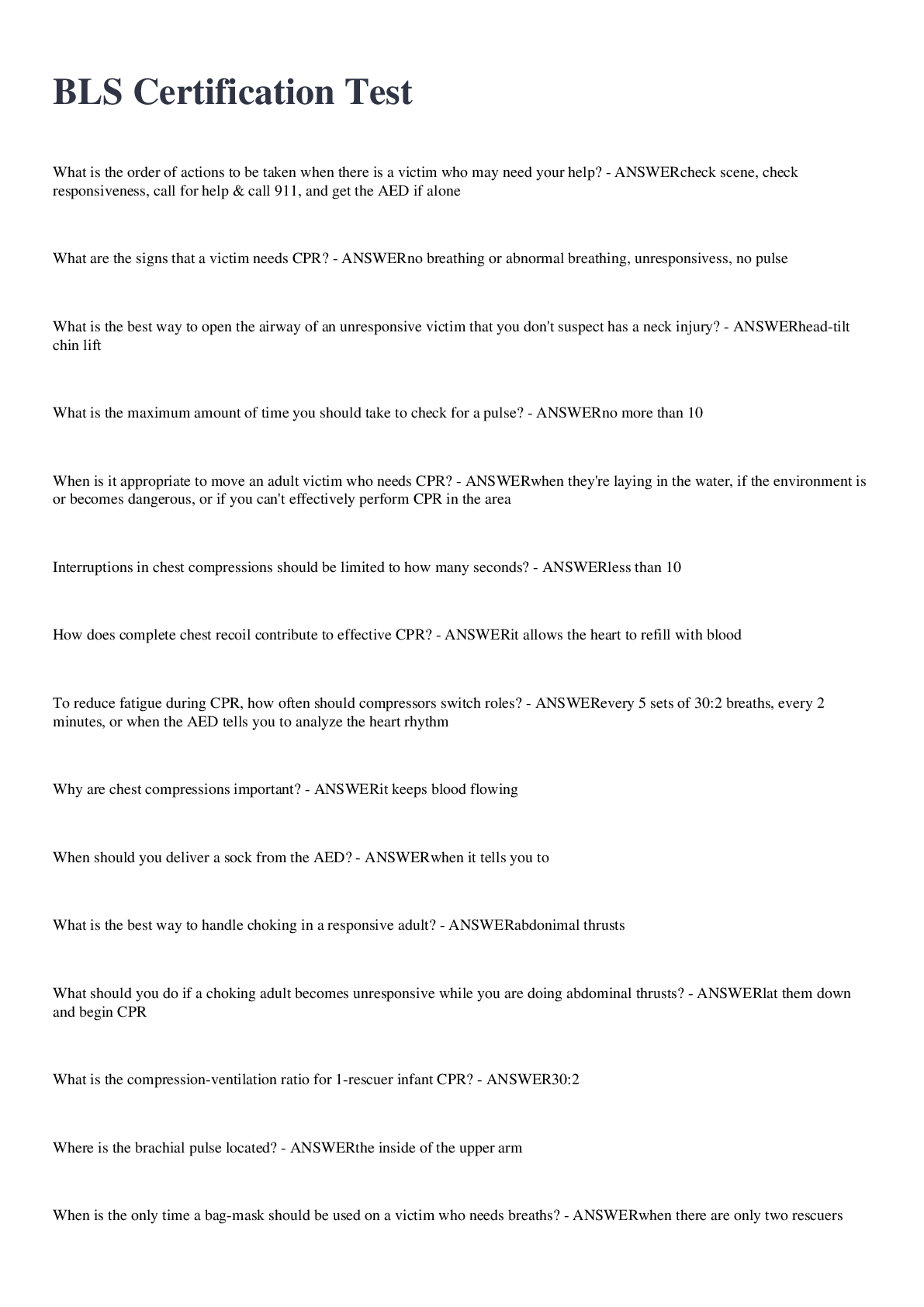
What is the order of actions to be taken when there is a victim who may need your help? Correct Answer: check scene, check responsiveness, call for help & call 911, and get the AED if alone
...
BLS Certification Test
What is the order of actions to be taken when there is a victim who may need your help? Correct Answer: check scene, check responsiveness, call for help & call 911, and get the AED if alone
What are the signs that a victim needs CPR? Correct Answer: no breathing or abnormal breathing, unresponsivess, no pulse
What is the best way to open the airway of an unresponsive victim that you don't suspect has a neck injury? Correct Answer: head-tilt chin lift
What is the maximum amount of time you should take to check for a pulse? Correct Answer: no more than 10
When is it appropriate to move an adult victim who needs CPR? Correct Answer: when they're laying in the water, if the environment is or becomes dangerous, or if you can't effectively perform CPR in the area
Interruptions in chest compressions should be limited to how many seconds? Correct Answer: less than 10
How does complete chest recoil contribute to effective CPR? Correct Answer: it allows the heart to refill with blood
To reduce fatigue during CPR, how often should compressors switch roles? Correct Answer: every 5 sets of 30:2 breaths, every 2 minutes, or when the AED tells you to analyze the heart rhythm
Why are chest compressions important? Correct Answer: it keeps blood flowing
When should you deliver a sock from the AED? Correct Answer: when it tells you to
What is the best way to handle choking in a responsive adult? Correct Answer: abdonimal thrusts
What should you do if a choking adult becomes unresponsive while you are doing abdominal thrusts? Correct Answer: lat them down and begin CPR
What is the compression-ventilation ratio for 1-rescuer infant CPR? Correct Answer: 30:2
Where is the brachial pulse located? Correct Answer: the inside of the upper arm
When is the only time a bag-mask should be used on a victim who needs breaths? Correct Answer: when there are only two rescuers
What are the required depths of compressions for adults, children and infants? Correct Answer: adults: at least 2 inches
children: 1/3 of chest depth or around 2 inches
infants: 1/3 of chest depth or 1 1/2 inches
What do you do if a child has a pulse but is not breathing? Correct Answer: give breaths, one breath every 3-5 seconds (rescue breaths)
[Show More]