Quotas are a necessary part of any affirmative action plan -✔✔ False
Affirmative action applies to all employers, public or private -✔✔ False
Affirmative action is designed to remedy past discrimination based on race o
...
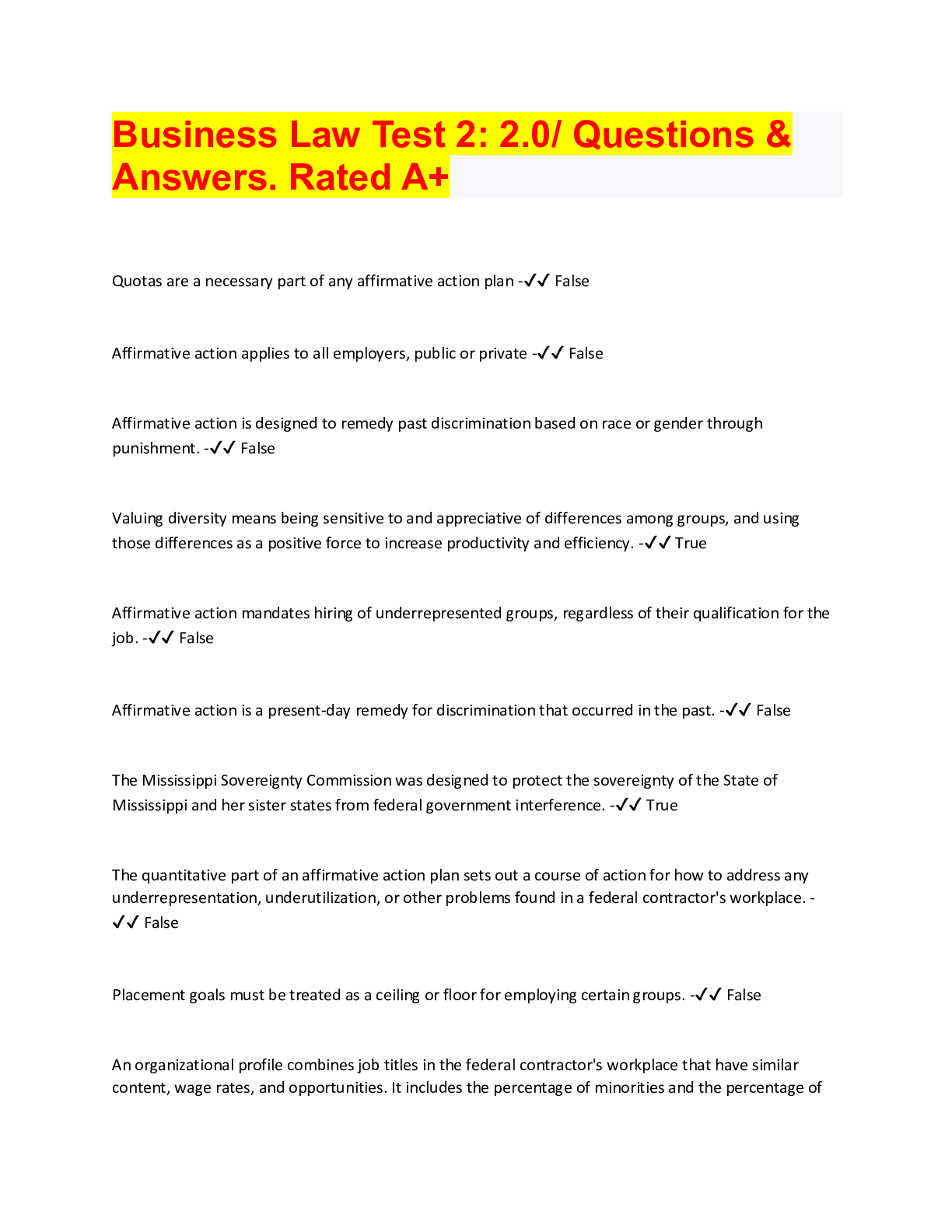
Quotas are a necessary part of any affirmative action plan -✔✔ False
Affirmative action applies to all employers, public or private -✔✔ False
Affirmative action is designed to remedy past discrimination based on race or gender through
punishment. -✔✔ False
Valuing diversity means being sensitive to and appreciative of differences among groups, and using
those differences as a positive force to increase productivity and efficiency. -✔✔ True
Affirmative action mandates hiring of underrepresented groups, regardless of their qualification for the
job. -✔✔ False
Affirmative action is a present-day remedy for discrimination that occurred in the past. -✔✔ False
The Mississippi Sovereignty Commission was designed to protect the sovereignty of the State of
Mississippi and her sister states from federal government interference. -✔✔ True
The quantitative part of an affirmative action plan sets out a course of action for how to address any
underrepresentation, underutilization, or other problems found in a federal contractor's workplace. -
✔✔ False
Placement goals must be treated as a ceiling or floor for employing certain groups. -✔✔ False
An organizational profile combines job titles in the federal contractor's workplace that have similar
content, wage rates, and opportunities. It includes the percentage of minorities and the percentage ofwomen employed in each job area, and then compares the availability of women or minorities for the
job groups. -✔✔ False
Title VII is designed to protect everyone, even though its operation may make certain whites or males
feel discriminated against -✔✔ True
Culture encompasses more than just ethnicity. It include other factors such as gender, age, disability,
affinity orientation, etc. that affect and define an individual's life. -✔✔ True
The ________ Amendment to the United States Constitution abolished slavery in 1865.
A) Fourth
B) Thirteenth
C) Fourteenth
D) Twenty-Firs -✔✔ B) Thirteenth
Actions an employer can take to work toward inclusion of those historically underrepresented in the
workplace include all of the following except:
A) Mentoring, management training and other development
B) Hiring and training groups that have been underrepresented
C) Hiring individuals from underrepresented groups, even if not fully qualified
D) Recruiting from groups the employer hasn't previously made an attempt to recruit from -✔✔ C)
Hiring individuals from underrepresented groups, even if not fully qualified
Which of the following statements is true of affirmative action?
A) Affirmative action requires employers to remove qualified whites and males from their jobs and give
these jobs to minorities.
B) Workplace productivity and efficiency do not suffer under affirmative action plans.
C) Under affirmative action, an applicant can simply be a female or a minority to be placed in a job.
D) Minorities and females cannot be terminated from their jobs for any cause under affirmative action
plans. -✔✔ B) Workplace productivity and efficiency do not suffer under affirmative action plansWhich of the following groups have made the most gains under affirmative action?
A) African-American men
B) Disabled employees
C) White women
D) Asian employees -✔✔ C) White women
One of the commonly held myths about affirmative action is that it is: A) an effort to overcome the
effects of past or present discriminatory practices.
B) an entitlement program that provides unqualified women or minorities with jobs.
C) an initiative against discrimination that does not affect workplace productivity and efficiency.
D) a remedy and not a punishment for discrimination -✔✔ B) an entitlement program that provides
unqualified women or minorities with jobs.
Which of the following is NOT true of affirmative action?
A) It is used where there is a finding of discrimination or a demonstrated underrepresentation.
B) It is a punishment for failing to be inclusive.
C) It is a remedy for present-day employment discrimination.
D) It considers the past only as a way to understand if present-day vestiges remain -✔✔ B) It is a
punishment for failing to be inclusive.
Which of the following is true of Executive Order 1
[Show More]