Which of the following statements is FALSE?
a.
Some cities and states have made discrimination on the basis of sexual orientation illegal.
b.
Veterans of the Vietnam War have additional employment protections over ve
...
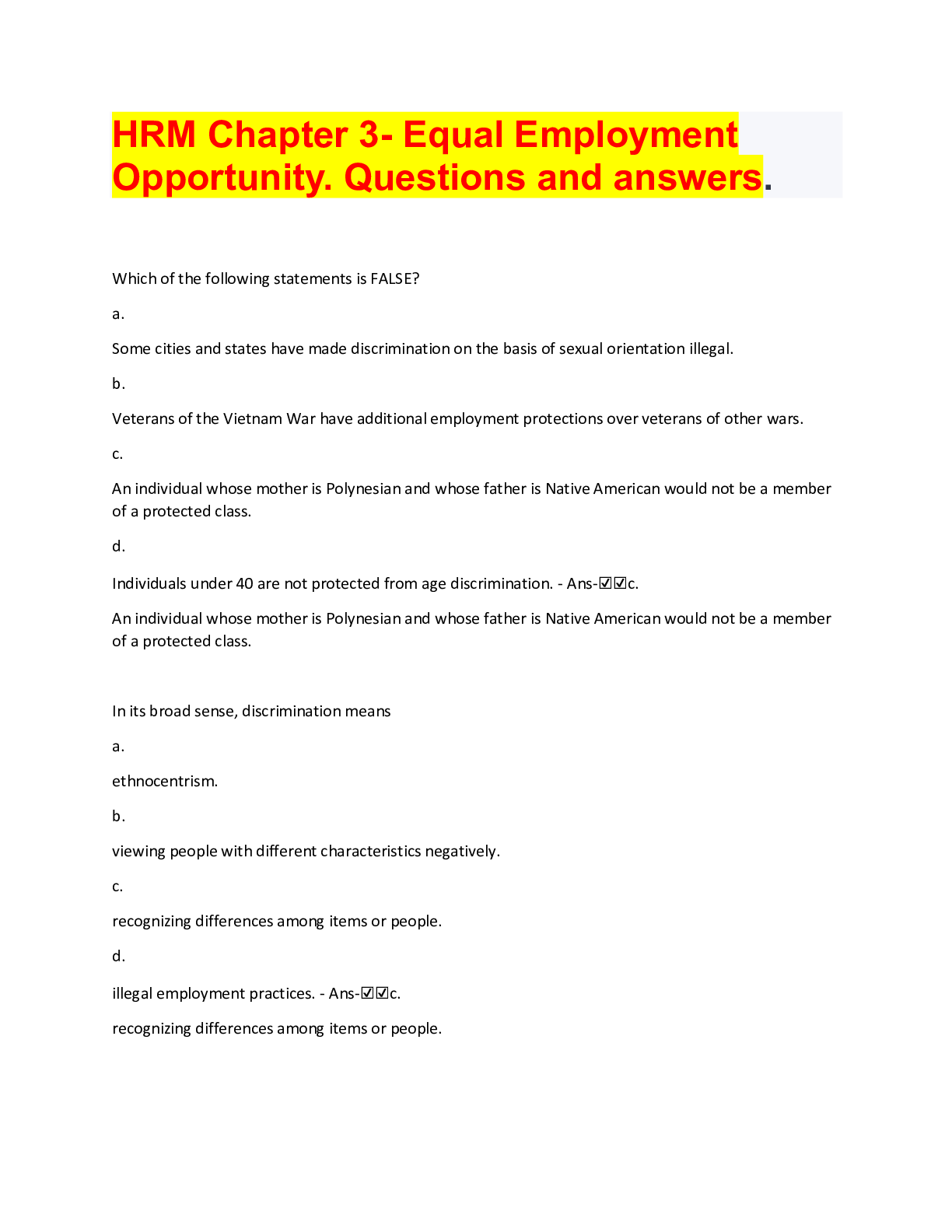
Which of the following statements is FALSE?
a.
Some cities and states have made discrimination on the basis of sexual orientation illegal.
b.
Veterans of the Vietnam War have additional employment protections over veterans of other wars.
c.
An individual whose mother is Polynesian and whose father is Native American would not be a member
of a protected class.
d.
Individuals under 40 are not protected from age discrimination. - Ans-☑☑c.
An individual whose mother is Polynesian and whose father is Native American would not be a member
of a protected class.
In its broad sense, discrimination means
a.
ethnocentrism.
b.
viewing people with different characteristics negatively.
c.
recognizing differences among items or people.
d.
illegal employment practices. - Ans-☑☑c.
recognizing differences among items or people.The most fundamental anti-discrimination employment law, the one that is considered the keystone for
following legislation, is the
a.
Fourteenth Amendment of the U.S. constitution.
b.
Civil Rights Act of 1964.
c.
Executive Order 11246.
d.
Equal Pay Act of 1963. - Ans-☑☑b.
Civil Rights Act of 1964.
Individuals who fall within a group identified for special treatment under equal employment laws and
regulations, are members of a/an
a.
oppressed minority.
b.
protected class.
c.
employment caste.
d.
special treatment class. - Ans-☑☑b.
protected class.
A large commercial landscaping service in the Southwest requires all Hispanic applicants for crew boss
positions to have a U.S. high school diploma. Native English speakers are not required to have a high
school diploma. The stated business purpose of this requirement is to insure that the Hispanic applicants
speak English well enough to perform the job. This is an example of
a.
disparate treatment.b.
a bona fide occupational requirement.
c.
disparate impact.
d.
a business necessity. - Ans-☑☑a.
disparate treatment.
Griggs v. Duke Power
a.
established the importance of proving discriminatory intent when an individual sues an employer for
discrimination.
b.
placed the burden of proof on the employer to show that the practice in question is actually a business
necessity.
c.
clarified that the employer's past practices were not relevant in proving a discrimination complaint.
d.
demonstrated that tests of intelligence are not discriminatory, even if they have a disparate impact on a
protected class. - Ans-☑☑b.
placed the burden of proof on the employer to show that the practice in question is actually a business
necessity.
Borderline Cafeterias, Inc., has discovered that most of its wait staff is white, while most of its kitchen
staff is minority. When interviewed by the local TV news anchor, the CEO of Borderline Cafeterias says,
"There has been no conscious or deliberate practice to staff the cafeterias in a discriminatory manner. It
just happened to turn out this way." The CEO's argument is an example of
a.
disparate treatment.
b.
blind discrimination.c.
disparate impact.
d.
discriminatory intent. - Ans-☑☑c.
disparate impact.
The landmark case that established the importance of disparate impact as a legal foundation of EEO law
is
a.
Adarand Constructors v. Pena.
b.
Griggs v. Duke Power.
c.
University of California at Davis v. Bakke.
d.
McDonnell Douglas v. Green. - Ans-☑☑b.
Griggs v. Duke Power.
In a legal determination of whether discrimination has occurred, the ____ is most important.
a.
psychological impact on the worker
b.
state jurisdiction in which the alleged discrimination occurred
c.
outcome of the practice on employees
d.
intent to discriminate of the employer - Ans-☑☑c.
outcome of the practice on employeesIf members of a protected class are under-represented in the workplace, the condition of ____ exists.
a.
discriminatory intent
b.
disparate treatment
c.
disparate impact
d.
statistical bias - Ans-☑☑c.
disparate impact
In Washington v. Davis
a.
since the reading comprehension test contained actual material that the applicants would have to learn
during a training program, the fact that fewer women and minorities passed the test did not result in
illegal discrimination.
b.
fewer women and minorities passed a reading comprehension test. If this test had been designed with
the intent to discriminate, this would be a case of disparate impact.
c.
if the police department had required a high school diploma as evidence of reading skills, instead of the
reading comprehension test, the police department would not have been vulnerable to a charge of
discrimination against women and minorities.
d.
the plaintiffs had the burden of proof to show that the reading comprehension test did not support a
business necessity. - Ans-☑☑a.
since the reading comprehension test contained actual material that the applicants would have to learn
during a training program, the fact that fewer women and minorities passed the test did not result in
illegal discrimination.
A practice necessary for safe and efficient organizational operations is called a/ana.
economic viability requirement.
b.
business necessity.
c.
prerogative of management.
d.
bona fide occupational qualification. - Ans-☑☑b.
business necessity.
To avoid a charge of retaliation against employees who file discrimination charges the organization must
do all of the following EXCEPT
a.
instruct supervisors that any discipline or warnings against an employee who has filed a discrimination
case should be verbal and not documented.
b.
take appropriate action if supervisors retaliate against employees who file a discrimination complaint.
c.
thoroughly investigate any claims of retaliation.
d.
train supervisors what retaliation consists of. - Ans-☑☑a.
instruct supervisors that any discipline or warnings against an employee who has filed a discrimination
case should be verbal and not documented.
Henry, an upper-level manager at a software design firm, is talking informally with his colleagues over
dinner. "The idea of quotas makes me uncomfortable," he says. "I think that we should just treat
everyone equally, regardless of how people vary from one another. A person is a person." Henry is
expressing the philosophy behind
a.
affirmative action programs.
b.quid pro quo theory of employment opportunity..
c.
the "blind to differences" approach.
d.
racist and sexist organizational practices. - Ans-☑☑c.
the "blind to differences" approach.
Ingrid is a recent immigrant from Denmark with a valid U.S. work permit. She has applied for work on
the wait staff at a Chinese restaurant near her home. Ingrid doesn't have a car, and this restaurant is
one of the few employers she can walk to. Ingrid was turned down for an opening at the restaurant,
although she has relevant job experience. Later, Ingrid noticed a Chinese man was hired for the job.
Ingrid should
a.
sue because this is sex discrimination.
b.
sue because this is national origin discrimination and violates the IRCA.
c.
not sue because this is an English-language-only workplace and Ingrid's English language skills are
minimal.
d.
not sue because Chinese origin is a bona fide occupational qualification in this case. - Ans-☑☑b.
sue because this is national origin discrimination and violates the IRCA.
A bona fide occupational qualification for the job of truck driver for a beer distributing company would
include all of the following EXCEPT
a.
possession of a commercial driver's license.
b.
a bachelor's degree in any field.
c.
the ability to lift a minimum of fifty pounds.d.
basic literacy. - Ans-☑☑b.
a bachelor's degree in any field.
Which of the following would be defined as retaliation under EEO laws?
a.
A hospital demotes a radiology technician who has complained about ethnic discrimination.
b.
An employer fires a supervisor who discriminates against a protected-class member.
c.
A dismissed employee files a false complaint of discrimination against his former employer with the
EEOC.
d.
The EEOC targets an employer with a history of unlawful discrimination. - Ans-☑☑a.
A hospital demotes a radiology technician who has complained about ethnic discrimination.
When does the burden of proof fall on the employer in a disparate impact or disparate treatment suit?
a.
when there is an Affirmative Action Plan in place
b.
when it is a class action suit of current and former employees
c.
when the case goes to court before a jury
d.
when the court rules that disparate impact or disparate treatment has occurred. - Ans-☑☑d.
when the court rules that disparate impact or disparate treatment has occurred.
Albert is an assistant store manager for a national discount retailer. When Albert was denied a
promotion to store manager he filed a claim based on religious discrimination with the EEOC, which was
eventually denied. After the claim, Albert was transferred to be the assistant store manager at a locationrequiring a 97-mile round trip commute that takes about four hours of travel time per day. His previous
worksite had been only 15 minutes from his home.
a.
Since Albert retained his position in the company as an assistant store manager and he kept the same
pay level, this is not retaliation.
b.
This action is ex post facto evidence of retaliation.
c.
The employer is not vulnerable to a charge of retaliation because Albert's charge of discrimination was
denied.
d.
This action could be considered retaliation. - Ans-☑☑d.
This action could be considered retaliation.
Costa Laguna Manufacturing follows a policy of hiring people based on their race, age, gender, and
national origin in order to make up for historical discrimination. This is an example of
a.
affirmative action.
b.
fair employment practices.
c.
historical restitution.
d.
the "blind to differences" approach. - Ans-☑☑a.
affirmative action.
Workers are protected by Title VII of the Civil Rights Act of 1964 against employment discrimination
based on all the following
[Show More]