"Statutes"-penal code - ✔✔Statutes give us certainty (can't be charged for a crime not in the statute and
it must have a punishment). Because law is out there it is knowable (never a defense). Law can be
proactive-look
...
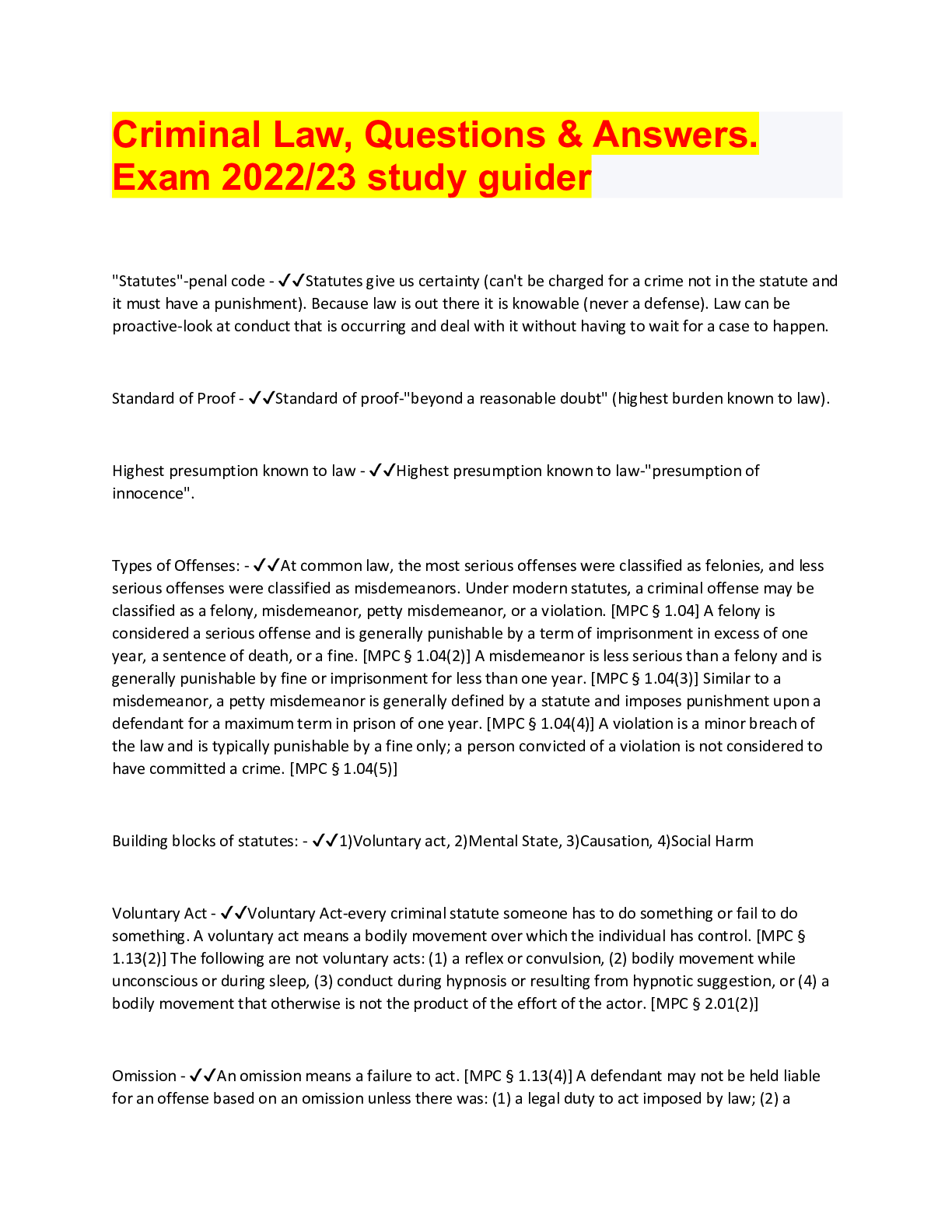
"Statutes"-penal code - ✔✔Statutes give us certainty (can't be charged for a crime not in the statute and
it must have a punishment). Because law is out there it is knowable (never a defense). Law can be
proactive-look at conduct that is occurring and deal with it without having to wait for a case to happen.
Standard of Proof - ✔✔Standard of proof-"beyond a reasonable doubt" (highest burden known to law).
Highest presumption known to law - ✔✔Highest presumption known to law-"presumption of
innocence".
Types of Offenses: - ✔✔At common law, the most serious offenses were classified as felonies, and less
serious offenses were classified as misdemeanors. Under modern statutes, a criminal offense may be
classified as a felony, misdemeanor, petty misdemeanor, or a violation. [MPC § 1.04] A felony is
considered a serious offense and is generally punishable by a term of imprisonment in excess of one
year, a sentence of death, or a fine. [MPC § 1.04(2)] A misdemeanor is less serious than a felony and is
generally punishable by fine or imprisonment for less than one year. [MPC § 1.04(3)] Similar to a
misdemeanor, a petty misdemeanor is generally defined by a statute and imposes punishment upon a
defendant for a maximum term in prison of one year. [MPC § 1.04(4)] A violation is a minor breach of
the law and is typically punishable by a fine only; a person convicted of a violation is not considered to
have committed a crime. [MPC § 1.04(5)]
Building blocks of statutes: - ✔✔1)Voluntary act, 2)Mental State, 3)Causation, 4)Social Harm
Voluntary Act - ✔✔Voluntary Act-every criminal statute someone has to do something or fail to do
something. A voluntary act means a bodily movement over which the individual has control. [MPC §
1.13(2)] The following are not voluntary acts: (1) a reflex or convulsion, (2) bodily movement while
unconscious or during sleep, (3) conduct during hypnosis or resulting from hypnotic suggestion, or (4) a
bodily movement that otherwise is not the product of the effort of the actor. [MPC § 2.01(2)]
Omission - ✔✔An omission means a failure to act. [MPC § 1.13(4)] A defendant may not be held liable
for an offense based on an omission unless there was: (1) a legal duty to act imposed by law; (2) aspecial relationship between the parties, such as between a parent and a child; (3) a duty to act that
arises out of contract requirement; or (4) a voluntary undertaking to provide assistance to a person in
peril. In addition, an individual will not be liable for failing to perform an act of which he is physically
incapable. [See MPC § 2.01(3)]
Mental State - ✔✔Mental State-concerned about what this person is thinking. Not enough to find
mental state but how bad it was. Needs to concur at the same time with voluntary act. Those without
mental state are strict liability claims.
Mental State
1)General v. specific intent crimes - ✔✔General v. Specific Intent Crimes
A general intent crime is one in which the defendant desired to commit the act that served as the actus
reus. A defendant who intends to do the act may be convicted of a general intent crime even if he did
not intend to cause the result. A specific intent crime is one in which the defendant not only intended to
commit the act that served as the actus reus, but something further, such as bringing about a particular
result. Specific intent crimes include: assault, burglary, embezzlement, false pretenses, first-degree
premeditated murder, forgery, inchoate crimes (attempt, conspiracy, and solicitation), larceny, and
robbery.
Strict liability - ✔✔A strict liability offense requires no proof of mens rea. Instead, it must be shown that
the defendant merely committed the prohibited act, regardless of his mental state.
Mental State
2)Model Penal Code Approach (MPC) - ✔✔Under the MPC, which has been adopted by many states, a
person is not guilty of an offense unless he acted (1) purposefully, (2) knowingly, (3) recklessly, or (4)
negligently with respect to each element of the crime. If a statute does not specify a required mental
state, the default mental state that must be met for commission of the crime is recklessness. In addition,
if a defendant acted with a higher degree of mental culpability than required by the statute, the mental
state element will be satisfied. [MPC § 2.02(1)-(5)]
MPC
1)Purposefully - ✔✔A person acts purposefully if it is his conscious object that his action causes a certain
result. [MPC § 2.02(2)(a)]
MPC2)Knowingly - ✔✔A person acts knowingly if he is aware that his conduct is of a specific nature or will
result in certain consequences. [MPC § 2.02(2)(b)] The test is subjective—whether the defendant
actually knew or believed that his actions would result in the specific consequences. Note that a
defendant who deliberately remains ignorant despite awareness of a high probability that the facts or
circumstances exist will still be found to have hand knowledge.
MPC
3)Recklessly - ✔✔A person acts recklessly when he consciously disregards a substantial and unjustifiable
risk that harm will result from his conduct. The risk must be of such a nature and degree that,
considering the nature and purpose of the actor's conduct and the circumstances known to him, its
disregard involves a gross deviation from the standard of conduct that a law-abiding citizen would
observe in the same situation. [MPC § 2.02(2)(c)]
MPC
4)Negligently - ✔✔A person acts negligently when he should be aware of a substantial and unjustifiable
risk that the circumstances exist or the prohibited act will result from his conduct. The risk must be of
such a nature and degree that the actor's failure to perceive it, considering the nature and purpose of
his conduct and the circumstances known to him, involves a gross deviation from the standard of care
that a reasonable person would observe in the defendant's situation. [MPC § 2.02(2)(d)]
Mental State
3)Transferred intent - ✔✔The doctrine of transferred intent allows for imposition of criminal liability
upon a defendant who intends to harm one person but actually causes harm to an unintended victim.
Causation - ✔✔Causation-(most important component) must cause the result (doesn't matter how bad
mental state is or if your involved in voluntary act). Direct cause-and proximate cause.
The prosecution must sufficiently prove that the defendant's criminal conduct was the cause-in-fact and
the proximate cause of the result.
Cause and fact - ✔✔A defendant's conduct is the cause-in-fact, or actual cause, of the resulting harm if
(1) "but for" the defendant's conduct, the harm would not have occurred or (2) the defendant's conduct
was a substantial factor in bringing about the resulting harm.
Proximate Cause - ✔✔A defendant's conduct must also be the proximate, or legal, cause of the resulting
harm, free of superseding causes or events. In other words, the harm must be a "natural and probable"consequence of the defendant's actions. A defendant's conduct may be the cause-in-fact but not the
proximate cause of the harm. Thus, the prosecution must show that the connection between the
defendant's conduct and the resulting harm are sufficiently closely related that it would be unfair not to
hold the defendant liable for the harm. Keep in mind that a victim's preexisting condition that
exacerbates the harm caused by the defendant's conduct will not break the causal chain.
Intervening Acts - ✔✔An unforseeable, intervening act breaks the causal connection between the
defendant's conduct and the resulting harm. Note that negligent medical treatment is generally deemed
to be a foreseeable consequence of harming a victim and will not cut off the defendant's criminal
liability; grossly negligent or reckless medical treatment will break the causal connection.
Social Harm - ✔✔Social Harm-harmful result. Trying to prevent people from losing their lives
unjustifiably, prevent people from taking others property without their consent.
Morally blameworthy - ✔✔Morally blameworthy. (Person fails to live up to the standards)-we as a
society condemn you.
Grand Jury - ✔✔Grand Jury only hears the prosecutor's evidence. Set up to make sure the charges are
accurate.
- ✔✔Guilty
Not Guilty (can never be charged for that crime again)
Hung Jury (jury simply can't decide) Prosecutor can charge again or let it go.
Two types of defenses: - ✔✔1) Case in Chief: Defendant will try to challenge prosecutor's evidence (all 4
components must be presented by the prosecutor)
Unconcsiousness - ✔✔Unconsciousness-does not necessarily arise from a mental disease or defect.
Although always containing a mental component in the form of loss of cognitive functioning, the causes
are diverse: epilepsy, concussion, gunshot wounds, somnambulism, coronary episodes, and certain brain
disorders. Additionally, these unconscious disorders tend to be acute, unlike most cases of insanity
which are typically chronic. Because cases of unconsciousness are temporary, they do not normally call
for institutionalization, which is the customary disposition following a successful insanity defense.
(Broad side attack against the voluntary act component-better to view this defense as eliminating the
voluntary act requirement rather than negating the mental component of crimes.) Only has to beintroduced as evidence. If a defendant was sufficiently apprised and aware of the condition and
experienced recurring episodes of loss of consciousness, then operating a vehicle or other potentially
destructive implement with knowledge of the potential danger, might well amount to reckless disregard
for the safety of others. The defense of unconsciousness must be distinguished from "blackouts" caused
by the voluntary ingestion of alcohol or nonprescription drugs. If due to alcohol or drugs the case must
be handled as an intoxication defense. Sleepwalking-look for evidence of consciousness
Insanity - ✔✔Insanity-arises from a mental disease or defect. Must have a diagnosed mental
disease/defect (affirmative defense-affirming but have an excuse) Many states do place "burden of
proof on defense".
Voluntary Act - ✔✔Voluntary Act-every criminal statute someone has to do something or fail to do
something.
Homicide - ✔✔Under the common law, criminal homicide may be classified as murder, voluntary
manslaughter, or involuntary manslaughter. Modern statutes have further stratified the classification
system, dividing murder into degrees based on the defendant's level of culpability. Under the MPC, a
person commits criminal homicide if he purposefully, knowingly, recklessly, or with criminal negligence,
causes the death of another human being. [See MPC § 210.1] Additionally, some states have codified in
statute the crime of vehicular homicide, which is an unintentional death caused by an individual driving
a car.
Common Law Murder - ✔✔Generally, murder is defined under the common law as the unlawful killing
of a human being with malice aforethought. Malice aforethought is a predetermination, or intent, at the
time of a killing to willfully take the life of another or cause that person grievous bodily harm or an
intent to willfully act in wanton disregard of the consequences to human life.
Malice Aforethought - ✔✔Malice aforethought is a predetermination, or intent, at the time of a killing
to willfully take the life of another or cause that person grievous bodily harm or an intent to willfully act
in wanton disregard of the consequences to human life.
Murder
Mens Rea - ✔✔The prosecutor's obligation to prove that the defendant acted with malice aforethought
is satisfied by showing that the defendant possessed:1) an intent to kill;
2) an intent to cause serious or grievous bodily injury;
3) a reckless indifference to the value of human life; or
4) an intent to commit a specific, enumerated felony (the felony murder doctrine).
Murder
Actus Reus - ✔✔The defendant's act or conduct must be proven to be the instrumentality that results in
a victim's death.
Murder
Cause and Effect, Proximate Cause - ✔✔The defendant's actions must be shown to be the actual and
legal cause of the victim's death. It is not necessary that the victim die immediately for the defendant to
be guilty of murder. Most jurisdictions require that the victim die within a year and a day of the
defendant's act. Historically, most jurisdictions concluded that death occurred when the victim's heart
stopped beating. However, cessation of brain activity, or brain death, is becoming more widely
recognized as the point of death.
Corpus Delecti - ✔✔Corpus delicti is a Latin term meaning "body of crime" that refers to the
requirement that the prosecution produce actual evidence that the crime has been committed before
the defendant may be convicted. An actual body need not be produced in order for a defendant to be
convicted of murder. Instead, death may be shown by circumstantial evidence.
Intent to Kill - ✔✔The requirement that the defendant act with malice aforethought will be satisfied if
the defendant actually intended to kill the victim.
Intent to cause serious bodily harm or grievous bodily harm. - ✔✔Even if the defendant did not intend
to kill the victim, the mental state of malice aforethought will be satisfied if the defendant intended to
cause grievous bodily harm to the victim.
Reckless indifference to the value of human life - ✔✔A defendant who acts with reckless indifference to
the value of human life, or a "depraved heart," may be found guilty of murder.Felony-Murder Doctrine - ✔✔A defendant may be charged with felony murder if a killing occurs during
the commission or attempted commission of a serious felony. Generally, most jurisdictions limit the
application of the doctrine to inherently dangerous crimes, namely those that, by their nature, involve a
high degree of peril to life such as robbery, burglary, rape, arson, assault and battery, and kidnapping.
However, some jurisdictions do not limit the applicable underlying felonies to the aforementioned list.
Keep in mind that the killing must occur during the course of the underlying felony or while the felon is
fleeing the scene; the felony-murder rule will not apply if the death occurs after the felon reaches a
place of temporary safety. Most states require that the death have been a foreseeable consequence of
the underlying felony, but courts tend to give this a broad construction.
Accomplice Liability - ✔✔A defendant and a co-felon who commit a felony during which a victim is killed
may both be charged with murder, despite the fact that one of them may not have actually committed
the killing. Jurisdictions differ regarding whether a defendant may be held liable if a death of a co-felon
results, such as from a resisting victim or a police officer. The majority rule is that the defendant will not
be guilty of felony murder for the death of a co-felon.
"In Furtherance test" - ✔✔A defendant may be convicted of felony murder where the evidence shows
that the killing was committed in furtherance of a common design or purpose held with another
perpetrator.
Common Law Manslaughter - ✔✔Manslaughter is the unjustifiable and inexcusable killing of a human
being without deliberation, premeditation, or malice. Manslaughter may be either voluntary or
involuntary.
Voluntary Manslaughter - ✔✔A charge of voluntary manslaughter may result if it is shown that the
defendant committed an intentional killing of a human being and there is (1) evidence of an objectively
reasonable provocation that caused defendant to kill the victim in the heat of passion (2) before there
was sufficient time for the defendant to "cool off," and (3) the defendant, in fact, did not cool off.
Voluntary Manslaughter
Adequate Provocation - ✔✔There must have been adequate provocation that caused the defendant to
act for a charge of murder to be reduced to voluntary manslaughter. The appropriate test is whether a
reasonable person in the same circumstances as the defendant would have also been provoked and
acted similarly. The quintessential example of adequate provocation is finding a spouse in bed with
someone else. Mere words are generally insufficient to constitute adequate provocation.Voluntary Manslaughter
Heat of Passion - ✔✔As a result of the provocation, the defendant must immediately act in the heat of
passion before he has had time to cool off. A defendant acts in the heat of passion if he acts impulsively
based upon some sort of extreme emotional disturbance.
Voluntary Manslaughter
Cooling-off Period - ✔✔The time period between the provocation and the defendant's act must be so
short that a reasonable person in the same situation would not have "cooled off" and regained
composure.
Involuntary Manslaughter - ✔✔Involuntary manslaughter is defined as the unintentional killing of a
human being without malice aforethought. Most jurisdictions require evidence that a defendant's
conscious disregard of a substantial and unjustifiable risk of which he was aware resulted in the death.
Misdemeanor Manslaughter - ✔✔Under the misdemeanor-manslaughter rule, a defendant may be
charged
with involuntary homicide for a killing that occurs during the commission
of a misdemeanor or a felony not serious enough to warrant a felonymurder conviction. Much like the felony-murder rule, a misdemeanormanslaughter charge is only available if the death was a reasonably
foreseeable consequence of committing the underlying crime
[Show More]


.png)