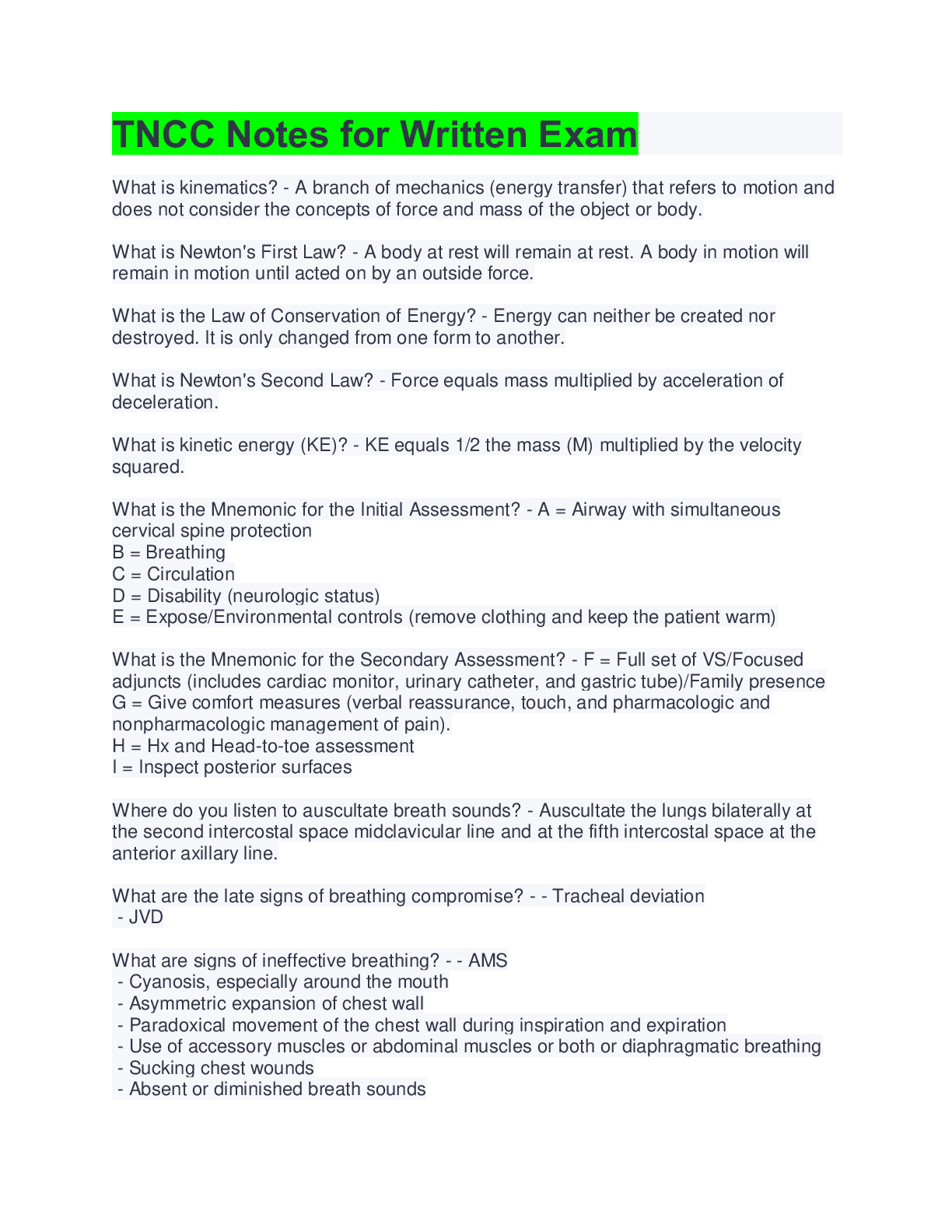
What is kinematics? - ✔✔A branch of mechanics (energy transfer) that refers to motion and does not
consider the concepts of force and mass of the object or body.
What is Newton's First Law? - ✔✔A body at rest will rema
...
What is kinematics? - ✔✔A branch of mechanics (energy transfer) that refers to motion and does not
consider the concepts of force and mass of the object or body.
What is Newton's First Law? - ✔✔A body at rest will remain at rest. A body in motion will remain in
motion until acted on by an outside force.
What is the Law of Conservation of Energy? - ✔✔Energy can neither be created nor destroyed. It is only
changed from one form to another.
What is Newton's Second Law? - ✔✔Force equals mass multiplied by acceleration of deceleration.
What is kinetic energy (KE)? - ✔✔KE equals 1/2 the mass (M) multiplied by the velocity squared.
What is the Mnemonic for the Initial Assessment? - ✔✔A = Airway with simultaneous cervical spine
protection
B = Breathing
C = Circulation
D = Disability (neurologic status)
E = Expose/Environmental controls (remove clothing and keep the patient warm)
What is the Mnemonic for the Secondary Assessment? - ✔✔F = Full set of VS/Focused adjuncts (includes
cardiac monitor, urinary catheter, and gastric tube)/Family presence
G = Give comfort measures (verbal reassurance, touch, and pharmacologic and nonpharmacologic
management of pain).
H = Hx and Head-to-toe assessment
I = Inspect posterior surfacesWhere do you listen to auscultate breath sounds? - ✔✔Auscultate the lungs bilaterally at the second
intercostal space midclavicular line and at the fifth intercostal space at the anterior axillary line.
What are the late signs of breathing compromise? - ✔✔- Tracheal deviation
- JVD
What are signs of ineffective breathing? - ✔✔- AMS
- Cyanosis, especially around the mouth
- Asymmetric expansion of chest wall
- Paradoxical movement of the chest wall during inspiration and expiration
- Use of accessory muscles or abdominal muscles or both or diaphragmatic breathing
- Sucking chest wounds
- Absent or diminished breath sounds
- Administer O2 via NRB or assist ventilations with a bag-mask device, as indicated
- Anticipate definitive airway management to support ventilation.
Upon initial assessment, what type of oxygen should be used for a pt breathing effectively? - ✔✔A tightfitting nonrebreather mask at 12-15 lpm.
What intervention should be done if a pt presents with effective circulation? - ✔✔- Insert 2 large caliber
IV's
- Administer warmed isotonic crystalloid solution at an appropriate rate
What are signs of ineffective circulation? - ✔✔- Tachycardia
- AMS
- Uncontrolled external bleeding
- Pale, cool, moist skin
- Distended or abnormally flattened external jugular veins- Distant heart sounds
What are the interventions for Effective/Ineffective Circulation? - ✔✔- Control any uncontrolled
external bleeding by:
- Applying direct pressure over bleeding site
- Elevating bleeding extremity
- Applying pressure over arterial pressure points
- Using tourniquet (last resort).
- Cannulate 2 large-caliber IV's and initiate infusions of an isotonic crystalloid solution
- Use warmed solution
- Use pressure bags to increase speed of IVF infusion
- Use blood administration tubing for possible administration of blood
- Use rapid infusion device based on protocol
- Use NS 0.9% in same tubing as blood product
- IV = surgical cut-down, central line, or both.
- Blood sample to determine ABO and Rh group
- IO in sternum, legs, arms or pelvis
- Administer blood products
- PASG (without interfering with fluid resuscitation)
How do you assess Mnemonic "D"? - ✔✔DISABILITY
A = Alert
V = Verbal
P = Pain
U = Unresponsive
- GCS
- PERRL?
- Determine presence of lateralizing signs including:
- Unilateral deterioration in motor movements or unequal pupils- Symptoms that help to locate area of injury in brain
What are the interventions for Disability? - ✔✔- If assessment indicates a decreased LOC, conduct
further investigation during secondary focused assessments
- If pt is not alert or verbal, continue to monitor for any compromise to ABC's
- If pt demonstrates signs of herniation or neurologic deterioration, consider hyperventilation.
What is assessed and intervened for Expose/Environmental Controls? - ✔✔- Remove clothing
- Ensure appropriate decontamination if exposed to hazardous material
- Keep pt warm
- Keep clothing for evidence
What is the first thing assessed under the Secondary Assessment? - ✔✔FULL SET VS / FOCUSED
ADJUNCTS / FAMILY PRESENCE
- ABCDE should be completed
- Labs, X-rays, CT, Foley,
- Family Presence
What is the second thing assessed under the Secondary Assessment? - ✔✔GIVE COMFORT MEASURES
- Talking to pt
- Pharmacologic/Nonpharmacologic pain management
- Observe for physical signs of pain
What is assessed under the Mnemonic "H"? - ✔✔HISTORY / HEAD-TO-TOE ASSESSMENT
- MIVT
- M = Mechanism of injury
- I = Injuries sustained
- V = Vital Signs
- T = Treatment- Pt generated information
- PMH
- Head-to-toe assessment
What is assessed under the Mnemonic "I"? - ✔✔INSPECT POSTERIOR SURFACES
- While maintaining C-spine, logroll pt with assistance to inspect back, flanks, buttocks and posterior
thighs.
- Palpate vertebral column for deformity and areas of tenderness
- Assess rectum for presence/absence of tone, presence of blood
What she be done after the Secondary Assessment? - ✔✔Reassess:
- Primary survey,
- VS
- Pain
- Any injuries
What are factors that contribute to ineffective ventilation? - ✔✔- AMS
- LOC
- Neurologic injury
- Spinal Cord Injury
- Intracranial Injury
- Blunt trauma
- Pain caused by rib fractures
- Penetrating Trauma
- Preexisting hx of respiratory diseases
- Increased age
What medications are used during intubation? - ✔✔LOAD Mnemonic:
L = LidocaineO = Opioids
A = Atropine
D = Defasiculating agents
What are the Rapid Sequence Intubation Steps? - ✔✔PREPARATION:
- gather equipment, staffing, etc.
PREOXYGENATION:
- Use 100% O2 (prevent risk of aspiration).
PRETREATMENT:
- Decrease S/E's of intubation
PARALYSIS WITH INDUCTION:
- Pt has LOC, then administer neuromuscular blocking agent
PROTECTION AND POSITIONING:
- Apply pressure over cricoid cartilage (minimizes likelihood of vomiting and aspiration
PLACEMENT WITH PROOF
- Each attempt NOT to exceed 30 seconds, max of 3 attempts. Ventilate pt 30-60 seconds between
attempts.
- After intubation, inflate the cuff
- Confirm tube placement w/exhaled CO2 detector.
POSTINTUBATION MANAGEMENT:
- Secure ET tube
- Set ventilator settings
- Obtain Chest x-ray
- Continue to medicate
- Recheck VS and pulse oxtimetry
What is a Combitube? - ✔✔A dual-lumen, dual-cuff airway that can be placed blindly into the esophagus
to establish an airway. If inadvertently placed into trachea, it can be used as a temporary ET tube. There
are only two sizes: small adult and larger adult.What is a Laryngeal Mask Airway? - ✔✔Looks like an ET tube but is equipped with an inflatable,
elliptical, silicone rubber collar at the distal end. It is designed to cover the supraglottic area.
ILMA, does not require laryngoscopy and visualization of the chords.
What is Needle Cricothyrotomy - ✔✔Percutaneous transtracheal ventilation. (temporary)
Complications include:
- inadequate ventilation causing hypoxia
- hematoma formation
- esophageal perforation
- aspiration
- thyroid perforation
- subcutaneous emphysema
What is Surgical Cricothyrotomy? - ✔✔Making an incision in cricothyroid membrane and placing a
cuffed endo or trach tube into trachea. This is indicated when other methods of airway management
have failed and pt cannot be adequately ventilated and oxygenated.
Complications include:
- Aspiration
- Hemorrhage or hematoma formation or both
- Lac to trachea or esophagus
- Creation of a false passage
- Laryngeal stenosis
How do you confirm ET Tube/Alternative Airway Placement? - ✔✔- Visualization of the chords
- Using bronchoscope to confirm placement
- Listening to breath sounds over the epigastrum and chest walls while ventilating the pt
- CO2 detector- Esophageal detection device
- Chest x-ray
How do you inspect the chest for adequate ventilation? - ✔✔Observe:
- mental status
- RR and pattern
- chest wall symmetry
- any injuries
- patient's skin color (cyanosis?)
- JVD or tracheal deviation? (Tension pneumothorax)
What are you looking for when auscultating lung sounds? - ✔✔Absence of BS:
- Pneumothorax
- Hemothorax
- Airway Obstruction
Diminished BS:
- Splinting or shallow BS may be a result of pain
What are you looking for when percussing the chest? - ✔✔Dullness:
- hemothorax
Hyperresonance
- Pneumothorax
What are you looking for when palpating the chest wall, clavicles and neck? - ✔✔- Tenderness
- Swelling
- subcutaneous emphysema
- step-off deformities
= These may indicate: esophageal, pleural, tracheal or bronchial injuries.Palpate trachea above suprasternal notch. Tracheal deviation may indicate a tension pneumothorax or
massive hemothorax.
What is the DOPE mnemonic? - ✔✔D - Displaced tube
O - Obstruction: Check secretions or pt biting tube
P - Pneumothorax: Condition may occur from original trauma or barotrauma from ventilator
E - Equipment failure: pt may have become detached from equipment or there's a kink in the tubing
Explain Hypovolemic Shock. - ✔✔Most common to affect a trauma pt cause by hypovolemia..
Hypovolemia, a decrease in amount of circulating blood volume, may result from significant loss of
whole blood because of hemorrhage or from loss of semipermeable integrity of cellular membrane
leading to leakage of plasma and protein from intravascular space to the interstitial space (as in a burn).
Some causes:
- Blood loss
- Burns, etc.
Explain Cardiogenic Shock. - ✔✔Syndrome that results from ineffective perfusion caused by ineffective
perfusion caused by inadequate contractility of cardiac muscle.
Some causes:
- MI
- Blunt cardiac injury
- Mitral valve insufficiency
- dysrhythmias
- Cardiac Failure
Explain Obstructive Shock. - ✔✔Results from inadequate circulating blood volume because of an
obstruction or compression of great veins, aorta, pulmonary arteries, or heart itself.
Some causes:- Cardiac tamponade (may compress the heart during diastole to such and extent that atria cannot
adequately fill, leading to decreased stroke volume).
- Tension pneumothorax may lead to inadequate stroke volume by displacing inferior vena cava and
obstructing venous return to right atrium.
- Air embolus may lead to obstruction of pulmonary artery and subsequent obstruction to right
ventricular outflow during systole, with resulting obstructive shock
Explain Distributive Shock. - ✔✔Results from disruption in SNS control of the tone of blood vessels,
which leads to vasodilation and maldistribution of blood volume and flow. (Neurogenic and Septic
Shock). Neurogenic shock may result from injury to spinal cord in cervical or upper thoracic
[Show More]