CHAPTER 1—INTRODUCTION TO COST ACCOUNTING
MULTIPLE CHOICE
1. The business entity that converts purchased raw materials into finished goods by using labor,
technology, and facilities is a:
a. Manufacturer.
b. Merchan
...
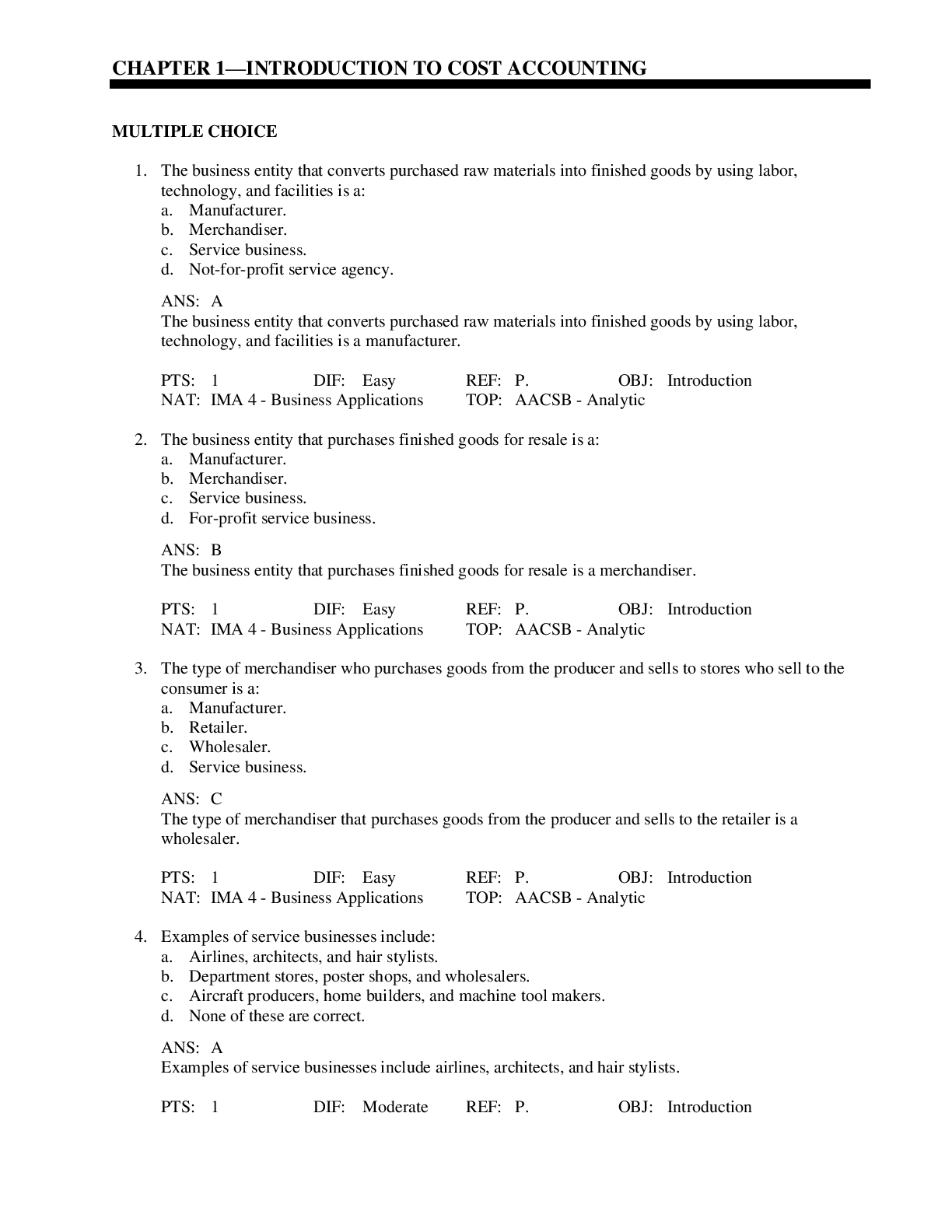
CHAPTER 1—INTRODUCTION TO COST ACCOUNTING
MULTIPLE CHOICE
1. The business entity that converts purchased raw materials into finished goods by using labor,
technology, and facilities is a:
a. Manufacturer.
b. Merchandiser.
c. Service business.
d. Not-for-profit service agency.
ANS: A
The business entity that converts purchased raw materials into finished goods by using labor,
technology, and facilities is a manufacturer.
PTS: 1 DIF: Easy REF: P. OBJ: Introduction
NAT: IMA 4 - Business Applications TOP: AACSB - Analytic
2. The business entity that purchases finished goods for resale is a:
a. Manufacturer.
b. Merchandiser.
c. Service business.
d. For-profit service business.
ANS: B
The business entity that purchases finished goods for resale is a merchandiser.
PTS: 1 DIF: Easy REF: P. OBJ: Introduction
NAT: IMA 4 - Business Applications TOP: AACSB - Analytic
3. The type of merchandiser who purchases goods from the producer and sells to stores who sell to the
consumer is a:
a. Manufacturer.
b. Retailer.
c. Wholesaler.
d. Service business.
ANS: C
The type of merchandiser that purchases goods from the producer and sells to the retailer is a
wholesaler.
PTS: 1 DIF: Easy REF: P. OBJ: Introduction
NAT: IMA 4 - Business Applications TOP: AACSB - Analytic
4. Examples of service businesses include:
a. Airlines, architects, and hair stylists.
b. Department stores, poster shops, and wholesalers.
c. Aircraft producers, home builders, and machine tool makers.
d. None of these are correct.
ANS: A
Examples of service businesses include airlines, architects, and hair stylists.
PTS: 1 DIF: Moderate REF: P. OBJ: Introduction
NAT: IMA 4 - Business Applications TOP: AACSB - Reflective
5. ISO 9000 is a set of international standards for:
a. determining the selling price of a product.
b. cost control.
c. quality management.
d. planning,
ANS: C
ISO 9000 is a set of international standards for quality management.
PTS: 1 DIF: Easy REF: P. OBJ: Introduction
NAT: IMA 3A - Strategic Planning TOP: AACSB - Analytic
6. Unit cost information is important for making all of the following marketing decisions except:
a. Determining the selling price of a product.
b. Bidding on contracts.
c. Determining the amount of advertising needed to promote the product.
d. Determining the amount of profit that each product earns.
ANS: C
Unit cost information is used in determining selling price, bidding on contracts and determining
product profitability, but would not have a bearing on determining how much the product would need
to be advertised.
PTS: 1 DIF: Moderate REF: P. OBJ: 1
NAT: IMA 3B - Strategic Marketing TOP: AACSB - Analytic
7. The process of establishing objectives or goals for the firm and determining the means by which they
will be met is:
a. controlling.
b. analyzing profitability.
c. planning.
d. assigning responsibility.
ANS: C
The process of establishing goals and objectives for a firm is planning. Controlling, analyzing
profitability and assigning responsibility are functions that take place after the planning process to
determine whether or how successfully goals have been obtained.
PTS: 1 DIF: Easy REF: P. OBJ: 1
NAT: IMA 2A - Budget Preparation TOP: AACSB - Analytic
8. Control is the process of monitoring the company’s operations to determine whether the company’s
objectives are being achieved. Effective control is achieved through all of the following except:
a. periodically measuring and comparing company results.
b. assigning responsibility for costs to employees responsible for those costs.
c. constantly monitoring employees to ensure they do exactly as they are told.
d. taking necessary corrective action when variances warrant doing so.
ANS: C
While periodically measuring and comparing company results, assigning responsibility for those
results to employees and taking necessary corrective action are all part of control; it does not include
constantly monitoring employees to make sure they are following directions.
[Show More]