ATI Respiratory Review 2022
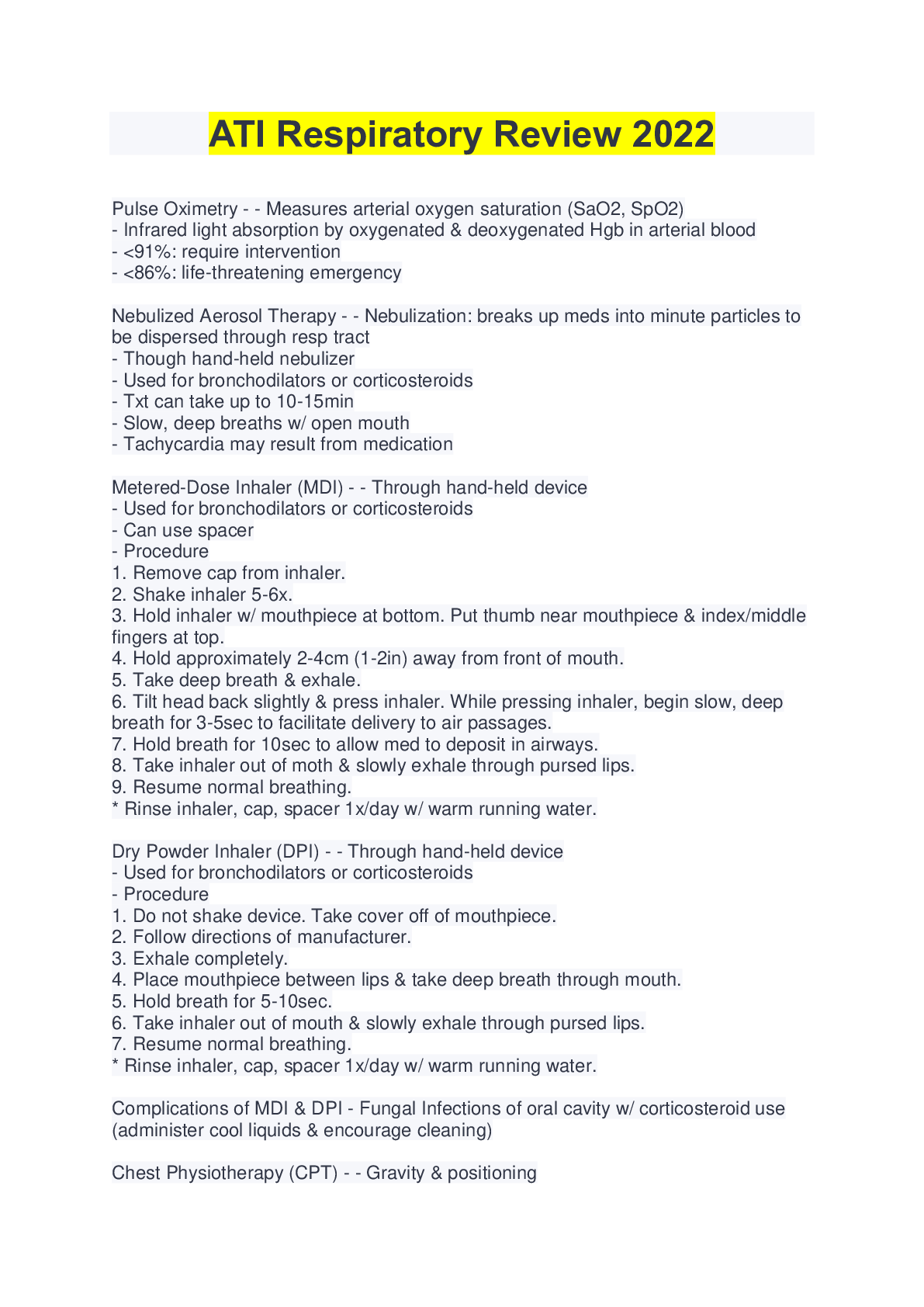
Pulse Oximetry - - Measures arterial oxygen saturation (SaO2, SpO2)
- Infrared light absorption by oxygenated & deoxygenated Hgb in arterial blood
-
ATI Respiratory Review 2022
Pulse Oximetry - - Measures arterial oxygen saturation (SaO2, SpO2)
- Infrared light absorption by oxygenated & deoxygenated Hgb in arterial blood
- <91%: require intervention
- <86%: life-threatening emergency
Nebulized Aerosol Therapy - - Nebulization: breaks up meds into minute particles to
be dispersed through resp tract
- Though hand-held nebulizer
- Used for bronchodilators or corticosteroids
- Txt can take up to 10-15min
- Slow, deep breaths w/ open mouth
- Tachycardia may result from medication
Metered-Dose Inhaler (MDI) - - Through hand-held device
- Used for bronchodilators or corticosteroids
- Can use spacer
- Procedure
1. Remove cap from inhaler.
2. Shake inhaler 5-6x.
3. Hold inhaler w/ mouthpiece at bottom. Put thumb near mouthpiece & index/middle
fingers at top.
4. Hold approximately 2-4cm (1-2in) away from front of mouth.
5. Take deep breath & exhale.
6. Tilt head back slightly & press inhaler. While pressing inhaler, begin slow, deep
breath for 3-5sec to facilitate delivery to air passages.
7. Hold breath for 10sec to allow med to deposit in airways.
8. Take inhaler out of moth & slowly exhale through pursed lips.
9. Resume normal breathing.
* Rinse inhaler, cap, spacer 1x/day w/ warm running water.
Dry Powder Inhaler (DPI) - - Through hand-held device
- Used for bronchodilators or corticosteroids
- Procedure
1. Do not shake device. Take cover off of mouthpiece.
2. Follow directions of manufacturer.
3. Exhale completely.
4. Place mouthpiece between lips & take deep breath through mouth.
5. Hold breath for 5-10sec.
6. Take inhaler out of mouth & slowly exhale through pursed lips.
7. Resume normal breathing.
* Rinse inhaler, cap, spacer 1x/day w/ warm running water.
Complications of MDI & DPI - Fungal Infections of oral cavity w/ corticosteroid use
(administer cool liquids & encourage cleaning)
Chest Physiotherapy (CPT) - - Gravity & positioning
- Percussion, vibration, postural drainage
- Loosens up respiratory secretions & moves them into central airways to be
removed by coughing, suctioning
Contraindications of CPT - - Decreased cardiac reserves
- Pulmonary embolism
- Increased ICP
CPT Pre-Procedure Nursing Care - - Schedule Tx 1hr before or 2hr after meals & at
bedtime (decrease vomiting/aspiration)
- Administer bronchodilator med or nebulizer Tx 30min-1hr before postural drainage
CPT Intra-Procedure Nursing Care - - Hand hygiene & privacy
- Proper positioning to promote drainage from specific areas
1. Apical section of upper lobes: Fowler's
2. Posterior section of upper lobes: Side-lying
3. Right lobe: Left side w/ pillow under chest
4. Left lobe: Trendelenburg
- Apply manual percussion to break up secretions
- Have pt cough after each set of vibrations
- Maintain position for 10-15min
- Stop if faint or dizzy
CPT Post-Procedure Nursing Care - - Auscultate lungs
- Assess amount, color, character of expectorated secretions
- Document
Complications of CPT - Hypoxia
- Monitor respiratory status
- Discontinue w/ dyspnea
Oxygen Therapy - - Increases oxygen concentration of air being breathed
- Humidification: moistens airways, promoting loosening & mobilization of pulmonary
secretions & prevents drying & injury of respiratory structures
- Use w/ hypoxemia
Early Signs of Hypoxemia - - Tachypnea
- Tachycardia
- Restlessness
- Pallor of skin & mucous membranes
- Elevated BP
- Symptoms of respiratory distress (accessory musle use, nasal flaring, tracheal
tugging, adventitious lung sounds)
Late Signs of Hypoxemia - - Confusion, stupor
- Cyanosis of skin & mucous membranes
- Bradypnea
- Bradycardia
- Hypotension
- Cardiac dysrhythmias......