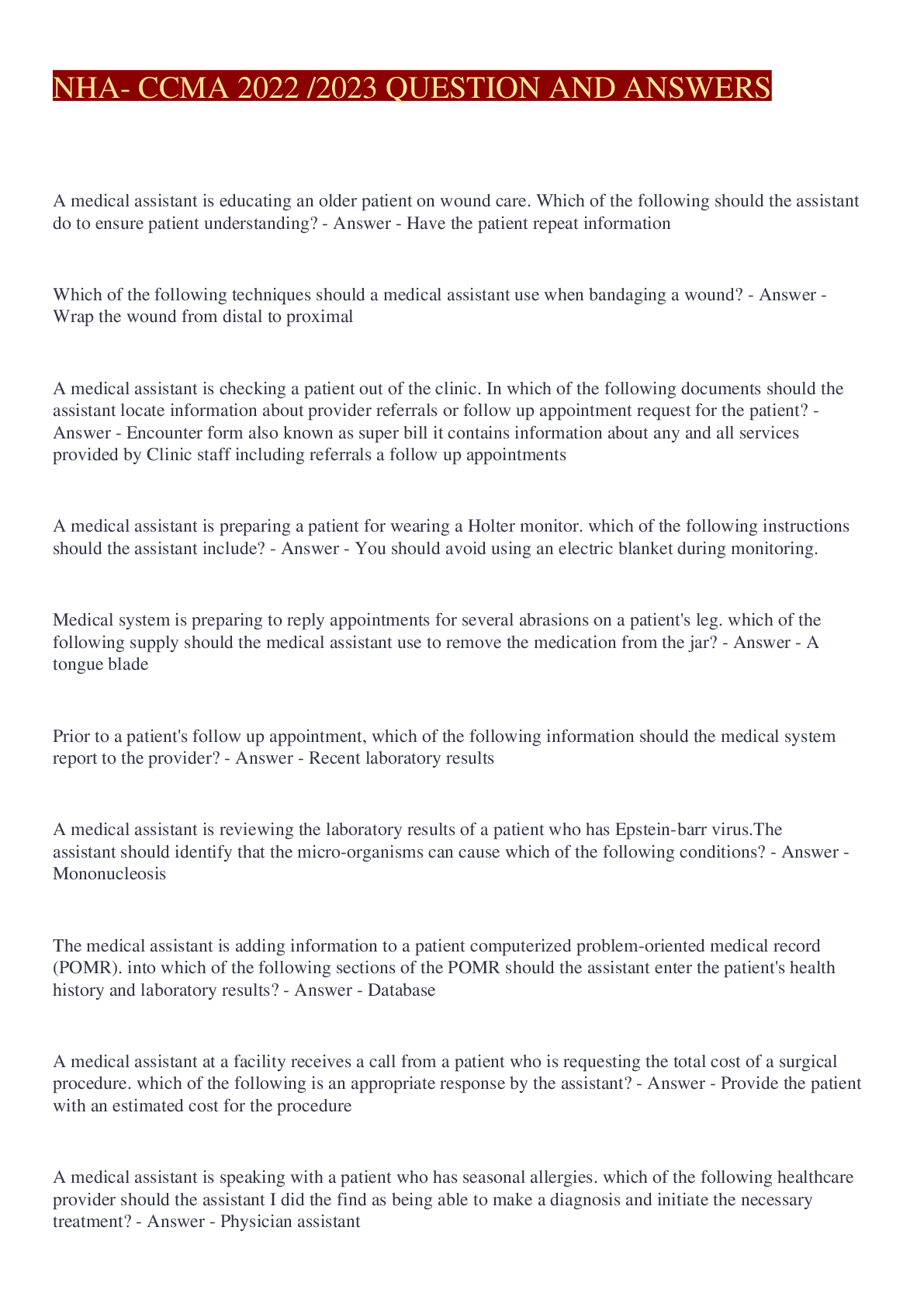
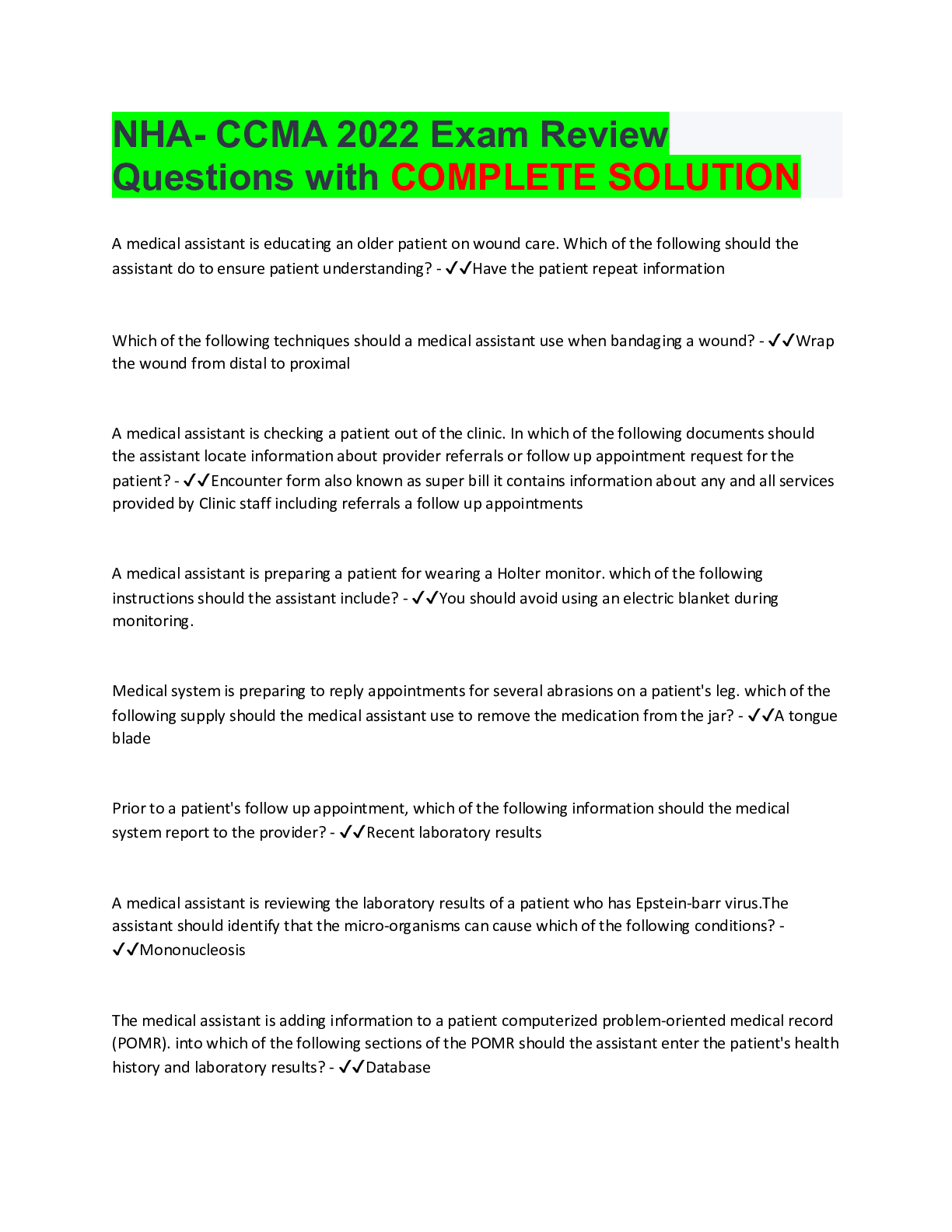
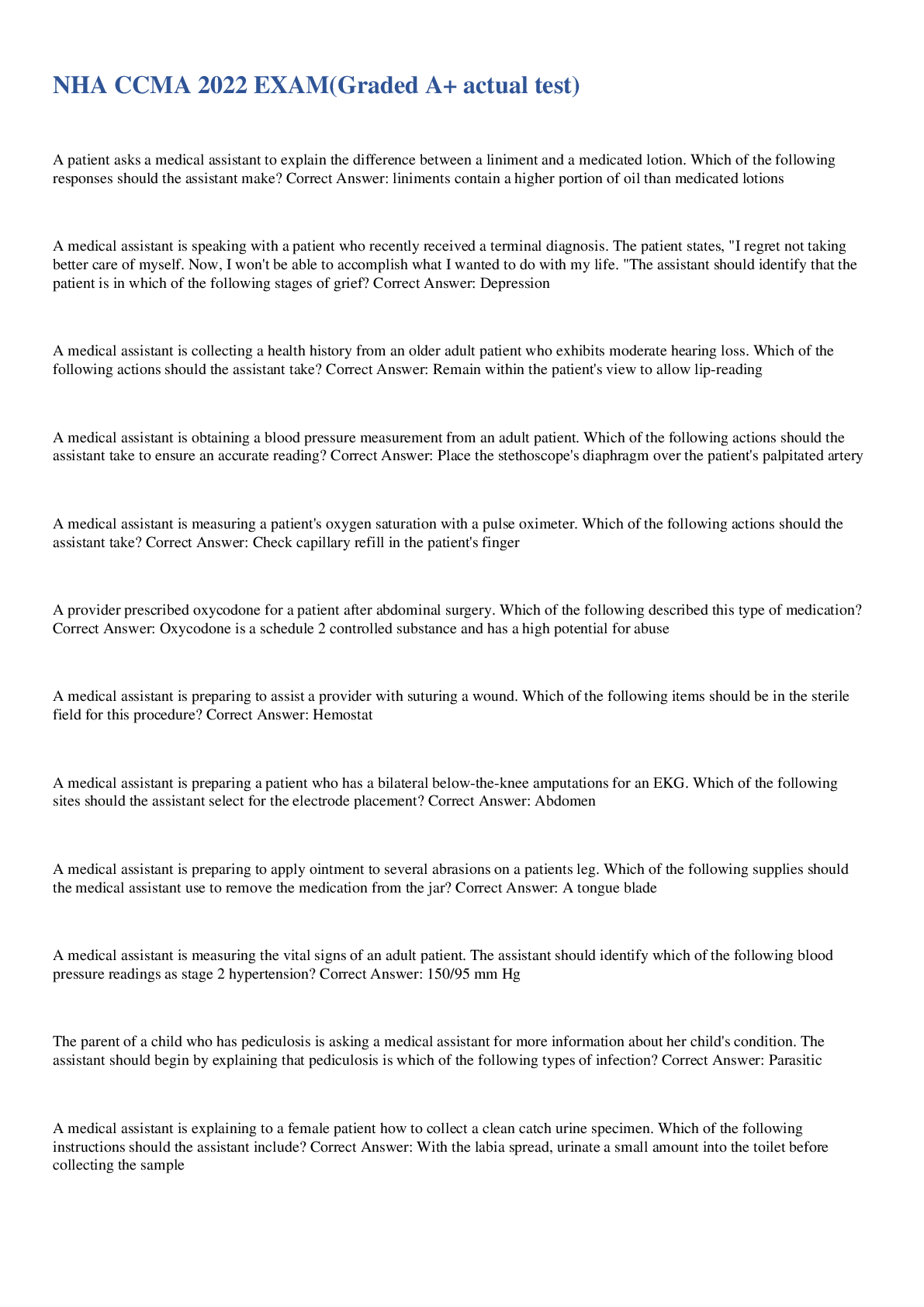
*NURSING > STUDY GUIDE > NHA CCMA Study Guide/ NHA certification Study Guide for CCMA 2022 (All)
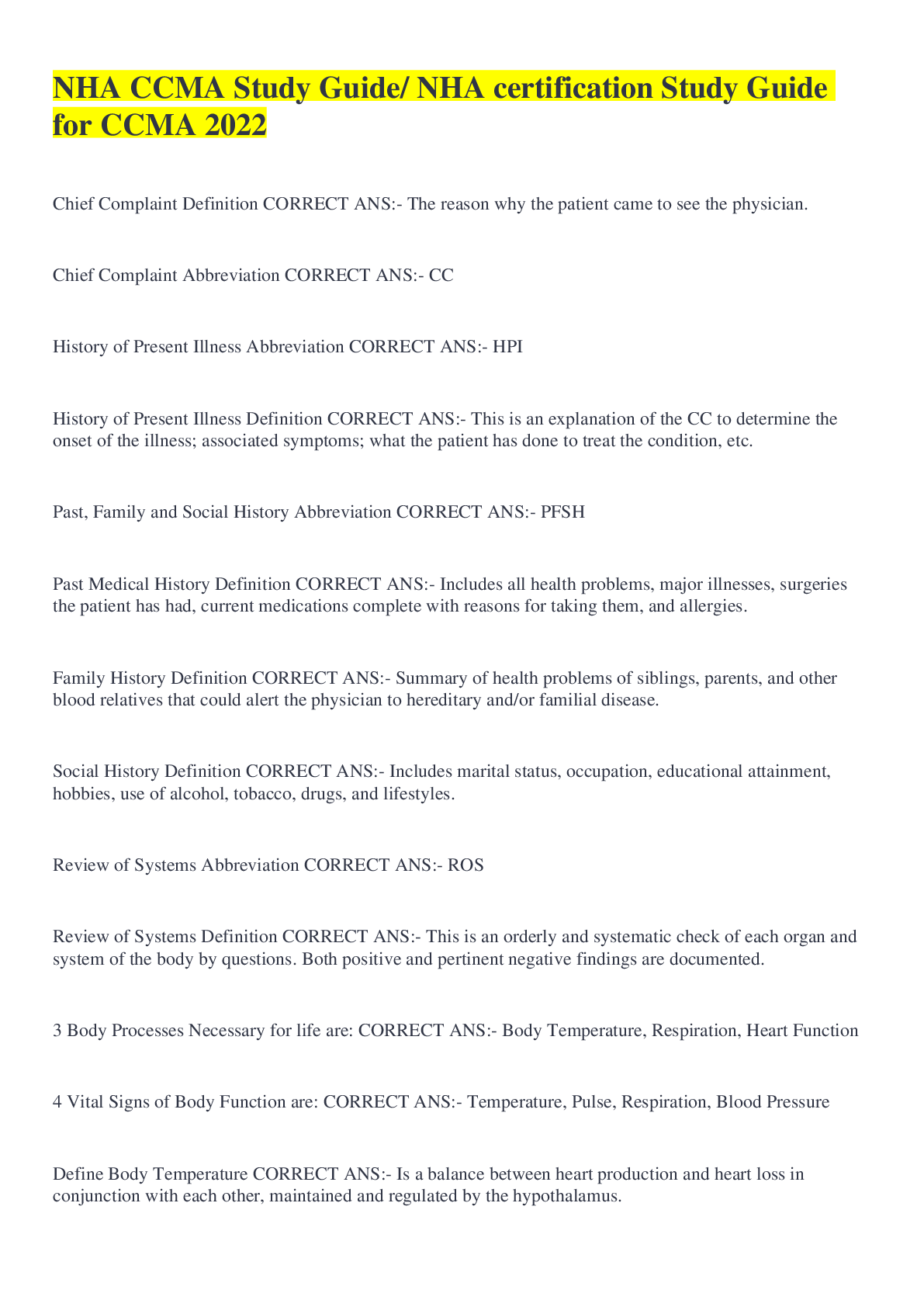
NHA CCMA Study Guide/ NHA certification Study Guide for CCMA 2022 Chief Complaint Definition CORRECT ANS:- The reason why the patient came to see the physician. Chief Complaint Abbreviation CORREC ... T ANS:- CC History of Present Illness Abbreviation CORRECT ANS:- HPI History of Present Illness Definition CORRECT ANS:- This is an explanation of the CC to determine the onset of the illness; associated symptoms; what the patient has done to treat the condition, etc. Past, Family and Social History Abbreviation CORRECT ANS:- PFSH Past Medical History Definition CORRECT ANS:- Includes all health problems, major illnesses, surgeries the patient has had, current medications complete with reasons for taking them, and allergies. Family History Definition CORRECT ANS:- Summary of health problems of siblings, parents, and other blood relatives that could alert the physician to hereditary and/or familial disease. Social History Definition CORRECT ANS:- Includes marital status, occupation, educational attainment, hobbies, use of alcohol, tobacco, drugs, and lifestyles. Review of Systems Abbreviation CORRECT ANS:- ROS Review of Systems Definition CORRECT ANS:- This is an orderly and systematic check of each organ and system of the body by questions. Both positive and pertinent negative findings are documented. 3 Body Processes Necessary for life are: CORRECT ANS:- Body Temperature, Respiration, Heart Function 4 Vital Signs of Body Function are: CORRECT ANS:- Temperature, Pulse, Respiration, Blood Pressure Define Body Temperature CORRECT ANS:- Is a balance between heart production and heart loss in conjunction with each other, maintained and regulated by the hypothalamus. Thermometers CORRECT ANS:- Are used to measure temperature using the Fahrenheit and Centigrade or Celsius scale. Temperature Sites CORRECT ANS:- Mouth, Rectum, Ear (Tympanic Membrane), and the axilla (underarm). Normal Temperature Range for Rectal CORRECT ANS:- 98.6F to 100.6F 37.0C to 38.1C Normal Temperature Range for Oral CORRECT ANS:- 97.6F to 99.6F 36.5C to 37.5C Normal Temperature Range for Axillary CORRECT ANS:- 96.6F to 98.6F 35.9C to 37.0C Normal Temperature Range for Tympanic Membrane CORRECT ANS:- 98.6 F 37 C Define Febrile CORRECT ANS:- Presence of Fever Define Afebrile CORRECT ANS:- Absence of Fever Define Fever CORRECT ANS:- Elevated body temperature beyond normal range. Intermittent Fever CORRECT ANS:- Fluctuating fever that returns to or below baseline then rises again. Remittent Fever CORRECT ANS:- Fluctuating fever that remains elevated; it does not return to baseline temperature. Continuous Fever CORRECT ANS:- A fever that remains constant above the baseline; it does not fluctuate. Oral Temperature CORRECT ANS:- Is the most common method of measurement. Oral Temperature is not taken from what patients: CORRECT ANS:- -infants and children less than six years old -patients who has had surgery or facial, neck, nose, or mouth injury -those receiving oxygen -those with nasogastric tubes -patients with convulsive seizure -hemiplegic patients [Show More]
Last updated: 3 years ago
Preview 1 out of 62 pages
Buy this document to get the full access instantly
Instant Download Access after purchase
Buy NowInstant download
We Accept:
Can't find what you want? Try our AI powered Search
Connected school, study & course
About the document
Uploaded On
Jul 16, 2022
Number of pages
62
Written in
All
This document has been written for:
Uploaded
Jul 16, 2022
Downloads
0
Views
111
Scholarfriends.com Online Platform by Browsegrades Inc. 651N South Broad St, Middletown DE. United States.
We're available through e-mail, Twitter, Facebook, and live chat.
FAQ
Questions? Leave a message!
Copyright © Scholarfriends · High quality services·