LAW 2410 COMP TEST MCQ with complete solutions
Question 1
Debbie is jogging, when a chartered bus swerves onto the sidewalk where she is jogging and heads
straight for her. The bus driver is so preoccupied with the pa
...
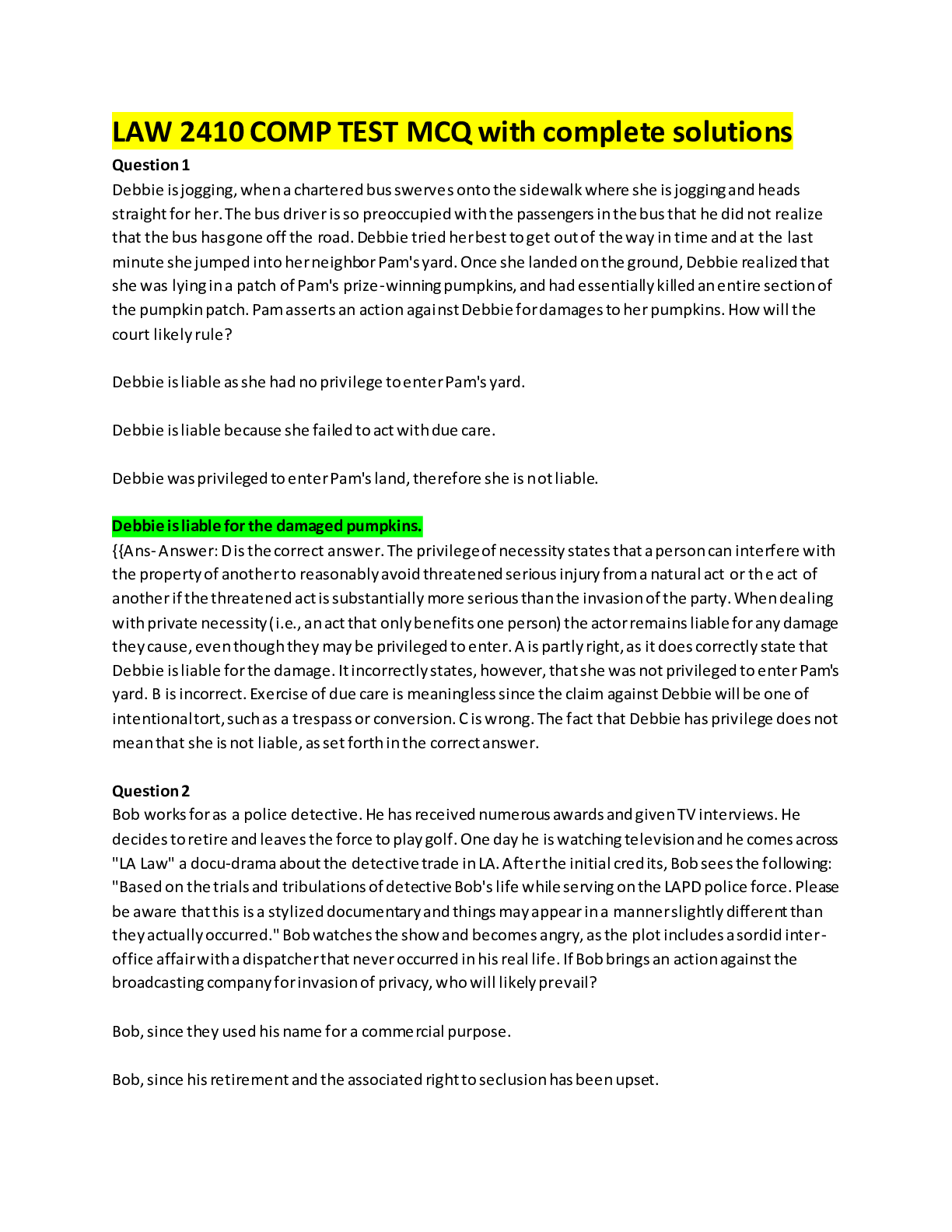
LAW 2410 COMP TEST MCQ with complete solutions
Question 1
Debbie is jogging, when a chartered bus swerves onto the sidewalk where she is jogging and heads
straight for her. The bus driver is so preoccupied with the passengers in the bus that he did not realize
that the bus has gone off the road. Debbie tried her best to get out of the way in time and at the last
minute she jumped into her neighbor Pam's yard. Once she landed on the ground, Debbie realized that
she was lying in a patch of Pam's prize-winning pumpkins, and had essentially killed an entire section of
the pumpkin patch. Pam asserts an action against Debbie for damages to her pumpkins. How will the
court likely rule?
Debbie is liable as she had no privilege to enter Pam's yard.
Debbie is liable because she failed to act with due care.
Debbie was privileged to enter Pam's land, therefore she is not liable.
Debbie is liable for the damaged pumpkins.
{{Ans- Answer: D is the correct answer. The privilege of necessity states that a person can interfere with
the property of another to reasonably avoid threatened serious injury from a natural act or the act of
another if the threatened act is substantially more serious than the invasion of the party. When dealing
with private necessity (i.e., an act that only benefits one person) the actor remains liable for any damage
they cause, even though they may be privileged to enter. A is partly right, as it does correctly state that
Debbie is liable for the damage. It incorrectly states, however, that she was not privileged to enter Pam's
yard. B is incorrect. Exercise of due care is meaningless since the claim against Debbie will be one of
intentional tort, such as a trespass or conversion. C is wrong. The fact that Debbie has privilege does not
mean that she is not liable, as set forth in the correct answer.
Question 2
Bob works for as a police detective. He has received numerous awards and given TV interviews. He
decides to retire and leaves the force to play golf. One day he is watching television and he comes across
"LA Law" a docu-drama about the detective trade in LA. After the initial credits, Bob sees the following:
"Based on the trials and tribulations of detective Bob's life while serving on the LAPD police force. Please
be aware that this is a stylized documentary and things may appear in a manner slightly different than
they actually occurred." Bob watches the show and becomes angry, as the plot includes a sordid interoffice affair with a dispatcher that never occurred in his real life. If Bob brings an action against the
broadcasting company for invasion of privacy, who will likely prevail?
Bob, since they used his name for a commercial purpose.
Bob, since his retirement and the associated right to seclusion has been upset.
Bob, as he was portrayed in a false light.
The broadcasting company, as the show when taken as a whole, was complimentary to Bob's life.
{{Ans- Answer: C is the best answer. Invasion of privacy based on a publication of facts that place the
plaintiff is a false light, requires a showing of the following elements: 1) publication of facts about the
plaintiff by the defendant placing the plaintiff in a false light in the public eye; 2) the "false light" must
be something objectionable to a reasonable person under the circumstances; and 3) malice on the
defendant's part where the published matter is in the public interest. Facts will be found to place a
plaintiff in a false light if they showcase: 1) views that the he does not hold, or 2) actions that he did not
take. The alleged sexual affair with a dispatcher did not take place and would be objectionable to a
reasonable person under the circumstances. This meets the requirement for false light invasion of
privacy (A) is incorrect. The case for invasion of privacy based on the use of a person's name, requires a
showing of unauthorized use by the defendant of their picture or name for commercial advantage.
Typically, this is the use of a name or image in the sale of a product by the defendant. Here, Bob's name
is only in the credits and no facts indicate that it was used to boost sales etc. (B) is incorrect. The case for
invasion of privacy based on an intrusion upon the plaintiffs affairs or seclusion needs proof of one the
following: 1) the act of prying or intruding upon the affairs or seclusion of the plaintiff by the defendant;
2) the intrusion must be something that would be objectionable to a reasonable person; or 3) the thing
to which there is an intrusion or prying must be "private." Here, there are no facts indicating that the
broadcasting channel invaded Bob's private affairs by creating sex scenes that he objected to. (D) is
incorrect because if Bob's privacy has been invaded, then the defense that the program as a whole was
complimentary is not valid.
Question 3
Lance manufactures ladders. Each ladder is labeled with a warning: "If over 200 pounds, do not use this
ladder." Federal regulations require that ladders of this type be tested to support at least 200 pounds.
Barbara, who is redecorating her house, has been dieting for years and weighs 210. She borrowed a
ladder made by Lance from her neighbor, Nell. When Barbara climbed up on the ladder, it collapsed and
she was badly injured. If Barbara sues Lance for her injuries, who will prevail?
Lance, because Barbara assumed the risk by using the ladder despite the warning.
[Show More]