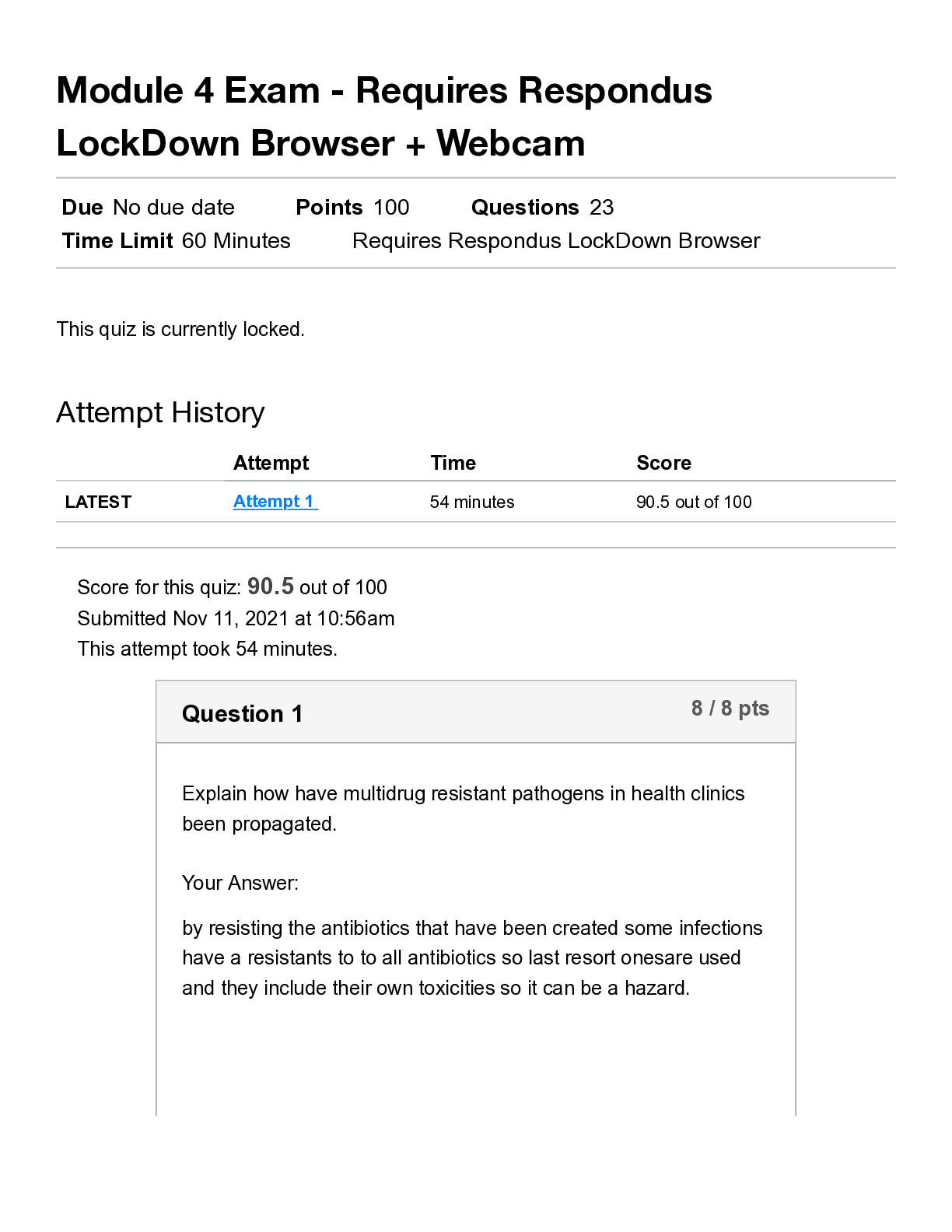
Explain how have multidrug resistant pathogens in health clinics
been propagated.
by resisting the antibiotics that have been created some infections
have a resistants to to all antibiotics so last resort onesare used
...
Explain how have multidrug resistant pathogens in health clinics
been propagated.
by resisting the antibiotics that have been created some infections
have a resistants to to all antibiotics so last resort onesare used
and they include their own toxicities so it can be a hazard.
For many years, the first course of treatment for illness
was antibiotics. Health providers would use these
drugs regardless of being able to diagnose illnesses as
bacterial, viral, or something altogether different. Over
time, the overuse of antibiotics led to bacteria that
accrued mutations leading to resistance. Eventually
more pathogenic bacteria arose with the same
resistance, and standard antibiotic treatment no longer
worked.
Question 2 5 / 5 pts
Your Answer:
When the bacteria are cultured but separated by a filter so that
they cannot directly touch, one of the bacterial strains can grow
well on minimal medium. What type of genetic transmission
occurred in this experiment? Explain how you know.
transduction, because bacteria can be transfer genetic material
with the absense of contact which if filter paper is blocking bacteria
cells but some still grow that is the process
Transduction occurred in this experiment because the
bacteria did not require direct contact to transmit
genetic material.
Question 3 2.5 / 8 pts
Your Answer:
Does spontaneous mutation positively or negatively affect
evolution? Briefly explain your answer.
positively because its great for genetic research and we have the
ability to use selection when it comes to finding the proper
bacterial colonies for mutation growth. this is a great affect
because this can be used to fine more cures for different things
Spontaneous mutations positively affect evolution
because the mutations that make the organism better
able to function or tolerate its environment help it to
survive longer than its wild-type counterparts. The
longer-lived organisms are likely to produce more
offspring than those with short survival times. Thus, an
advantageous mutation will be passed on to future
generations, and if it truly enhances survival, it will
eventually become the normal (wild-type) gene.
need to answer in the frame of evolution, which is
increasing biological fitness
Question 4 2 / 2 pts
True or False: A bacterium that can grow well on minimal medium
is an example of a prototroph.
Corrrreecctt!! True
False
Question 5 10 / 10 pts
Match each of the following terms with the correct description:
En
[Show More]