California State University, Northridge
IS 312 All Quizzes
SAMPLE QUESTIONS
Question 1
Question text
By using the Geographic Perspective in Geographic Analysis
Select one:
a. We can study the Earth's physical s
...
California State University, Northridge
IS 312 All Quizzes
SAMPLE QUESTIONS
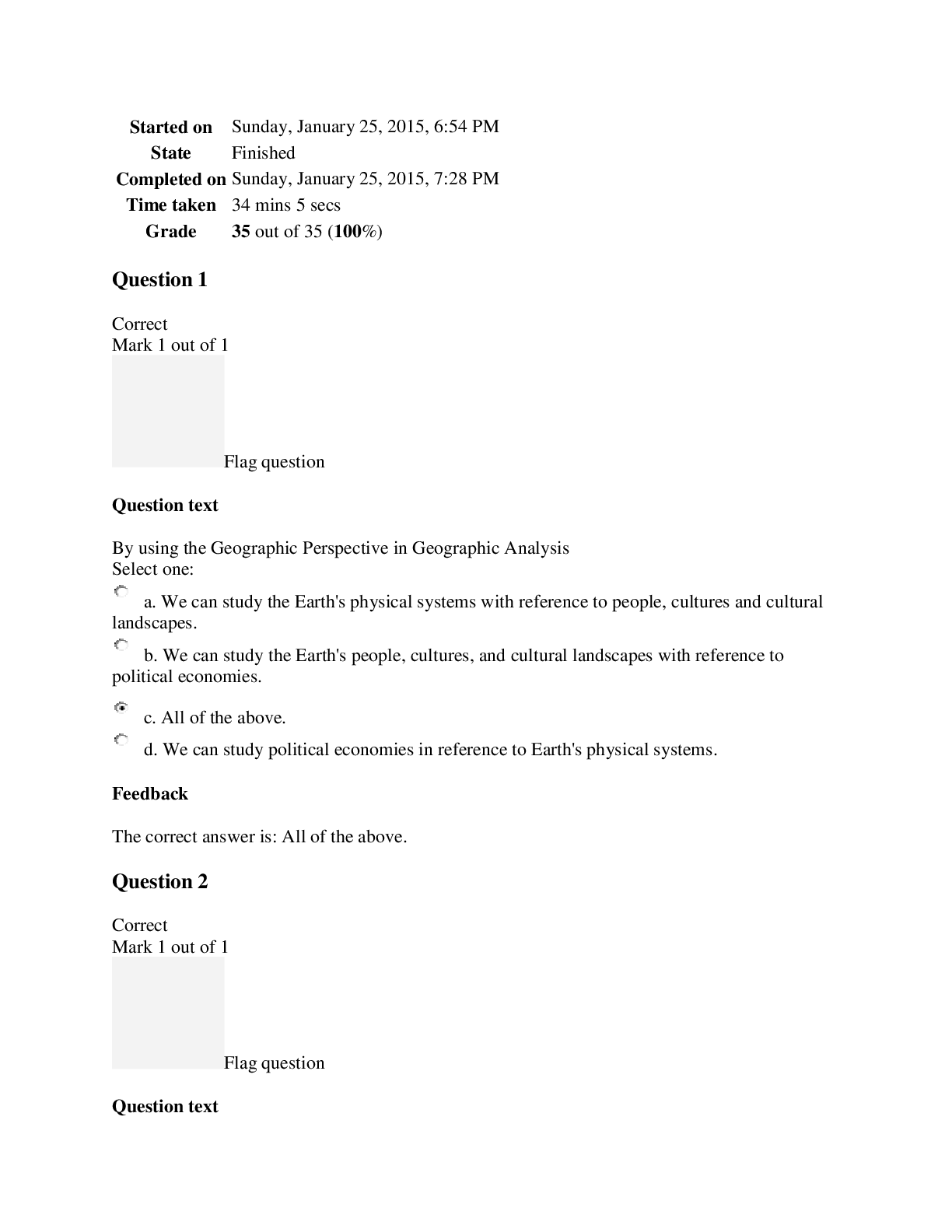
Question 1
Question text
By using the Geographic Perspective in Geographic Analysis
Select one:
a. We can study the Earth's physical systems with reference to people, cultures and cultural
landscapes.
b. We can study the Earth's people, cultures, and cultural landscapes with reference to
political economies.
c. All of the above.
d. We can study political economies in reference to Earth's physical systems.
Question 2
Question text
Geography in the past was deeply connected to exploration, today it is ________.
Select one:
a. A study of interconnectedness
b. Still based on exploration
c. A study of cartography
d. a technical discipline related solely to the use of GIS
Question 3
Question text
A presidential republic, such as the United States, has what characteristics?
Select one:
a. The president and the executive branch are separate
b. The executive and legislative branches of government are linked
c. The judicial and the legislative branches are linked
d. The executive and legislative branches of government are separate
Question 4
Question text
By current research, aboriginal people first came to the North American continent about when?
Select one:
a. 140,000 to 500,000 years ago
b. 1,400,000 to 5,000,000 years ago
c. 14,000 to 50,000 years ago
d. 1,400 to 5,000 years ago
Question
Question text
A region created by a shared set of links or spatial interactions is called what?
Select one:
a. A perceptual region
b. A core region
c. A formal region
d. A functional region
Question 6
Question text
The longest peaceful international border in the world is shared by
Select one:
a. Canada and Alaska
b. The continental United States and Mexico
c. Canada and Greenland
d. Canada and the continental United States
Question 7
Question text
People who speak English are known as what?
Select one:
a. Anglophones
b. Engophones
c. Francophones
d. Americans
Question 8
Question text
At the time of American independence in 1789, the population of the United States was
dominated by
Select one:
a. Africans
b. Western Europeans
c. Eastern Europeans
d. Native Americans
Question 9
Question text
The world's largest island is what?
Select one:
a. Greenland
b. Japan
c. Australia
d. Great Britain
Question 10
Question text
During the 19th and early 20th centuries the majority of immigrants to the United States were
from what part of the world?
Select one:
a. Western Europe
b. Africa
c. Eastern and Southern Europe
d. Latin America and Asia
Question 11
Question text
What country in North America has the largest total number of immigrants of any country in the
world?
Select one:
a. Canada
b. Greenland
c. None of the above
d. The United States
Question 12
Question text
Garreau's Nine Nations of North America are examples of what type of region?
Select one:
a. Landform
b. Functional
c. Formal
d. Agricultural
Question 13
Question text
The combined area of Canada and the United States covers about what percent of the world's
land area?
Select one:
a. 5%
b. 40%
c. 25%
d. 13%
Question 14
Question text
Looking at the map (1.10) what part of North America is associated with sugarcane farming?
Select one:
a. Idaho
b. California
c. Texas
d. Florida
Question 1
Question text
Looking at the map (1.10) what crop, besides corn, is grown in the Corn Belt?
Select one:
a. Hay
b. Tobacco
c. Soybeans
d. Wheat
Question 16
Question text
Joel Garreau, in his book Nine Nations of North America divided the continent based on what
characteristic?
Select one:
a. Cultural characteristics
b. Landforms
c. All of the above
d. Political divisions
Question 17
Question text
Most immigrants from Latin America and Asia have arrived in the United States when?
Select one:
a. Since the 1960s
b. Since the 1990s
c. Around American independence
d. In the 19th and early 20th century
Question 18
Question text
France and Britain both vied for control of what part of North America?
Select one:
a. Canada
b. Greenland
c. The United States
d. Alaska
Question 19
Question text
Which country has the highest rate of immigration (as a percentage of population) in the world?
Select one:
a. Canada
b. Greenland
c. Both A and B
d. The United States
Question 20
ion text
North America is the world's ________.
Select one:
a. Fourth largest continent
b. Third largest continent
c. Second largest continent
d. First largest continent
Question 21
Question text
The word Geography comes from the words for "earth" and "writing" in what language?
Select one:
a. Greek
b. Latin
c. French
d. German
Question 22
Question text
An area of near uniformity in one or more characteristics is called what?
Select one:
a. A core region
b. A perceptual region
c. A formal region
d. A functional region
Question 23
Question text
Which country in North America was the last to achieve independence from colonial rule?
Select one:
a. The United States
b. Canada
c. Greenland
d. Mexico
Question 24
Question text
In terms of cultural diversity for North America (Canada and the United States), which of the
following is true?
Select one:
a. As a whole, Canada and the United States is probably the most diverse region on Earth.
b. As a whole, Canada and the United States is probably not the most diverse region on
Earth.
c. The United States is the most culturally diverse region on Earth while Canada is not.
d. Canada is probably the most culturally diverse region on Earth, while the United States is
Question 25
Question text
Francophones are people who speak what language?
Select one:
a. French
b. English
c. Frankish
d. German
Question 26
Question text
According to the lecture, the U.S. covers nearly
Select one:
a. 10.6 million square miles
b. 1.1 million square miles
c. 3.6 million square miles
d. 5 million square miles
e. 2.5 million square miles
Question 27
Question text
According to the lecture the greatest portion of the United States at the same
latitude as
Select one:
a. The Sahara Desert
b. Australia
c. Brazil
d. The Mediterranean Sea
e. Russia
Question 28
Question text
According to the lecture, which of the following is IN
Select one:
a. The Western Uplands consist of rolling hills and low mountains
b. the population density of North America is around 42
c. The US has a tropical rainforest climate
d. The Ohio and Missouri Rivers drain into the Mississippi River
e. the latitudinal location of the US provides a wide variety of climates
Question 29
Question text
According to the lecture, what state gets the HIGHEST average precipitation?
Select one:
a. Washington
b. Arizona
c. California
d. Florida
e. Louisiana
Question 30
Question text
According to the lecture, the population density of the U.S. is _________sq/mile.
Select one:
a. 104
b. 30
c. 42
d. 6
e. 77
Question 31
uestion text
For question #31 go here:
http://geography.about.com/od/lists/u/basics.htm
The largest Urban Agglomeration is
Select one:
a. Mexico City
b. Los Angeles, California
c. Tokyo
d. Mumbai, India
e. New York City
Question 32
Question text
For #32, go here:
http://geography.about.com/od/lists/u/basics.htm
Which one of the following is NOT one of the four traditions of geography?
Select one:
a. Earth-Science Tradition
b. Spatial Tradition
c. Ecological Tradition
d. Areal Studies Tradition
e. Man-Land Tradition
Question 33
Question text
For question #33, go here:
http://geography.about.com/od/lists/u/basics.htm
Currently, the United States population represents___________% of the worlds
population
Select one:
a. 3.1
b. 6.4
c. 2.2
d. 4.5
e. 8.8
Question 34
Question text
For question #34, go here:
http://geography.about.com/od/lists/u/basics.htm
The Father of geography is
Select one:
a. Eratosthenes
b. William Morris Davis
c. Alexander Von Humboldt
d. Ptolemy
e. Marco Polo
Question 35
Question text
For question #35, go here:
http://geography.about.com/od/lists/u/basics.htm
The three points of the Bermuda Triangle are
Select one:
a. The Bahamas, Haiti, Tampa
b. The Virgin Islands, Devils Island, Bermuda
c. Africa, Europe, North America
d. Bermuda, Cuba, Jamaica
e. Bermuda, Miami, Puerto Rico
Bermu
[Show More]