5 Components of Management Planning - ANSWER Planning
Organizing
Staffing
Directing
Controlling
Planning - ANSWER Determining an organization objectives & how to accomplish them
Types of Planning - ANSWER Strat
...
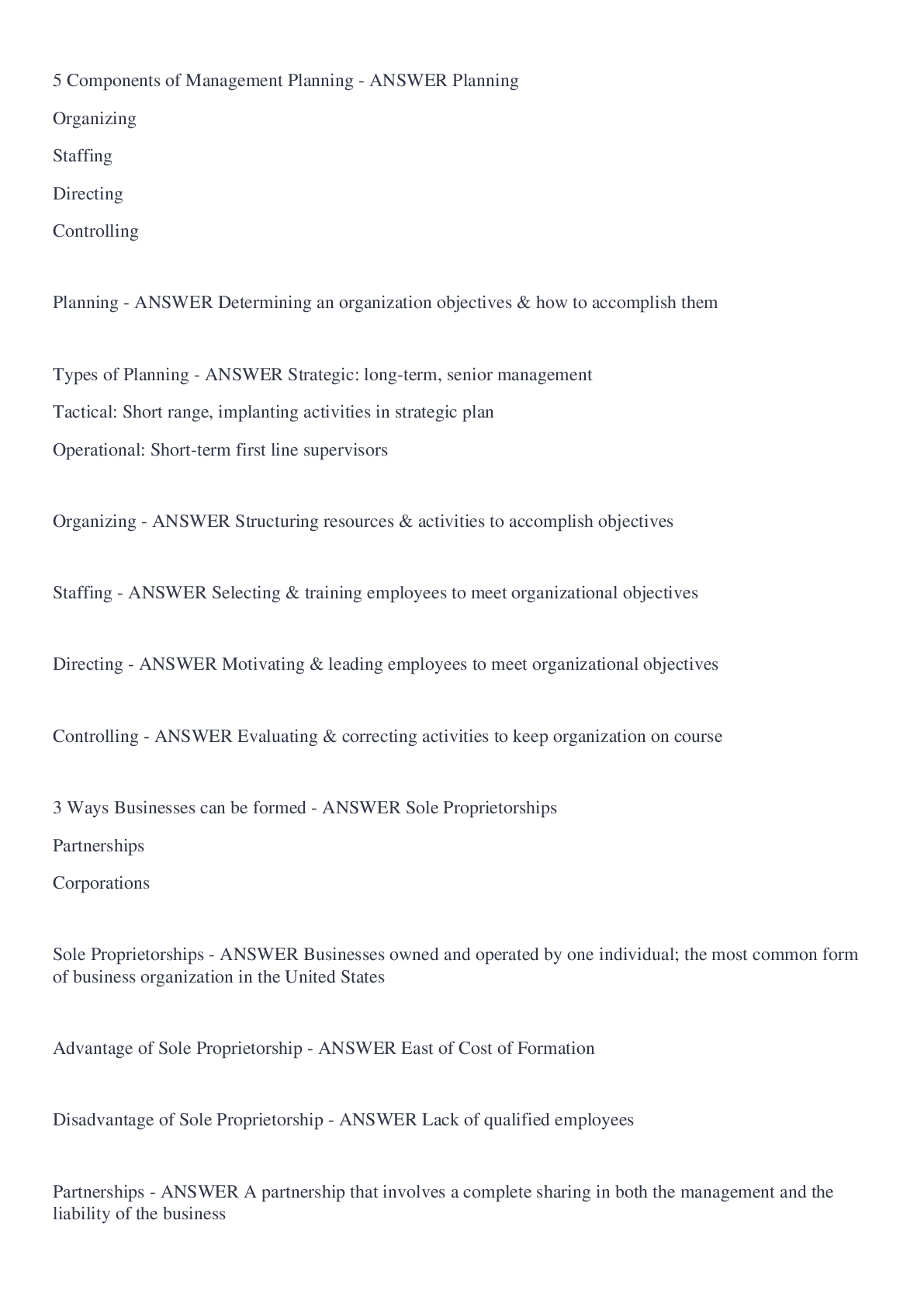
5 Components of Management Planning - ANSWER Planning
Organizing
Staffing
Directing
Controlling
Planning - ANSWER Determining an organization objectives & how to accomplish them
Types of Planning - ANSWER Strategic: long-term, senior management
Tactical: Short range, implanting activities in strategic plan
Operational: Short-term first line supervisors
Organizing - ANSWER Structuring resources & activities to accomplish objectives
Staffing - ANSWER Selecting & training employees to meet organizational objectives
Directing - ANSWER Motivating & leading employees to meet organizational objectives
Controlling - ANSWER Evaluating & correcting activities to keep organization on course
3 Ways Businesses can be formed - ANSWER Sole Proprietorships
Partnerships
Corporations
Sole Proprietorships - ANSWER Businesses owned and operated by one individual; the most common form of business organization in the United States
Advantage of Sole Proprietorship - ANSWER East of Cost of Formation
Disadvantage of Sole Proprietorship - ANSWER Lack of qualified employees
Partnerships - ANSWER A partnership that involves a complete sharing in both the management and the liability of the business
Advantage of Partnership - ANSWER Ease of Organization
Disadvantage of Partnership - ANSWER Unlimited Liability
Corporations - ANSWER A legal entity, created by the state, whose assets and liabilities are separate from its owners'
Advantage of a Corporation - ANSWER Limited Liability
Disadvantage of a Corporation - ANSWER Double Taxation
Organizational Culture - ANSWER A firm's shared values, beliefs, traditions, philosophies, rules, and role models for behavior
Organizational Structure - ANSWER The arrangement or relationship or positions within an organization
Departmentalization - ANSWER The grouping of jobs into working units usually called departments, units, groups, or divisions
Functional - ANSWER The grouping of jobs that perform similar functional activities, such as finance, manufacturing, marketing, and human resources.
Product - ANSWER The organization of jobs in relation to the products of the firm
Geographical - ANSWER The grouping of jobs according to geographic location, such as state, region, country, or continent
Customer - ANSWER The arrangement of jobs around the needs of various types of customers
Business Ethics - ANSWER Principles and standards that determine acceptable conduct in business
Social Responsibility - ANSWER A business's obligation to maximize its positive impact and minimize its negative impact on society
Codes of Ethics - ANSWER Formalized rules and standards that describe what a company expects of its employees
Business - ANSWER Individuals or organization who try to earn a profit by providing products that satisfy people's needs
Profit - ANSWER The difference between what it costs to make and sell a product and what a customer pays for it
Nonprofit - ANSWER Organizations that may provide goods or services but do not have the fundamental purpose of earning profits
Inputs - ANSWER Capacity: max amount
Labor-force: unique
Inventory: Don't run out of supplies
Facilities: Location
Outputs - ANSWER Quality
Innovation
Responsiveness
Efficiency
Product Life Cycle - ANSWER Intro
Growth
Maturity
Decline
Intro - ANSWER Consumer awareness and acceptance of the product are limited, profits are negative
Growth - ANSWER Sales increase rapidly and profits peak, then start to decline
Maturity - ANSWER Start to increase at maturity then the sales curve peaks and starts to decline while profits continue to decline
Decline - ANSWER Sales continue to fall rapidly
Mayo - ANSWER Hawthorne Studies: Being paid attention to matters
Maslow - ANSWER Hierarchy of Needs: Physiological, Security, Social, Esteem, Self-Actualization, un met needs matter
Herzberg - ANSWER 2 Factor Theory: Hygiene factors absence motivates
McGregor - ANSWER Theory X & Y: X forced to work, Y: wants to work
Adams - ANSWER Equity Theory: fairness matters
Vroom - ANSWER Expectancy Theory: Belief in attainment of reward matters
Ouchi - ANSWER Theory Z: employee participation matters
Price Skimming - ANSWER Charging the highest possible price that buyers who want the product will pay
Penetration Price - ANSWER A low price designed to help a product enter the market and gain market share rapidly
Price - ANSWER A value placed on an object exchanged between a buyer and a seller
Place - ANSWER Making products available to customers in the quantities desired
Product (Marketing) - ANSWER Is a complex mix of tangible and intangible attributes that provide satisfaction and benefits
Promotion - ANSWER A persuasive form of communication
Income Statement - ANSWER A financial report that shows an organization's profitability over a period of time
Revenue - ANSWER Is the total amount of money received from the sale of goods or services as well as from other business activities
Expenses - ANSWER Are the costs incurred in the day-to-day operations of an organization
Net Income - ANSWER Is the total profit or loss after all expenses including taxes have been deducted from revenue
Balance Sheet - ANSWER A snapshot of an organization's financial position at a given moment
Assets - ANSWER All assets accounts are listed in descending order of liquidity
Liabilities - ANSWER Total assets must be financed either through borrowing or through owner investments
Owners' Equity - ANSWER Includes the owners' contributions to the organization along with income earned by the organization
The Statement of Cash Flows - ANSWER Explains how the company's cash changed from the beginning of the accounting period to the end
Cash from operating activities - ANSWER Combining changes in the revenue, expense, current assets accounts, and liability accounts
Cash from investing activities - ANSWER Changes in the long-term or fixed asset accounts
Cash from financing activities - ANSWER Changes in the long-term liability accounts in owners' equity
Short-term working capital - ANSWER short-term working capital, manage short term assets & liabilities
Long-term capital planning - ANSWER long-term capital planning, analyzing needs & selecting projects assets to
Capital Structure - ANSWER Decisions to raise money via debt and equity
Profitability Ratios - ANSWER Net income/sales
Asset Utilization Ratios - ANSWER sales/total assets
Liquidity Ratios - ANSWER Current assets-inventory/current liabilities
Debt Utilization Ratios - ANSWER operating income/interest
Per Share Data - ANSWER net income/# of shares outstanding
Push Strategy - ANSWER an attempt to motivate intermediaries to push the product down to their customers
Pull Strategy - ANSWER The use of promotion to create customer demand for a product so that consumers exert pressure on marketing channel members to make it available
Components of Promotion - ANSWER Advertising: paid from of non-personal communication
Personal Selling: Direct, two-way communication with buyers (most flexible)
Publicity: through mass media (news story form)
Sales Promotion: direct inducements offering added value or some other incentive for buyers
[Show More]