What is the approximate rotation period of the sun? - ANSWER 25 days (equator)
36 days (poles)
What is the approximate mean density of the Sun? - ANSWER 1410 kg/m3
What is the approximate surface temperature of t
...
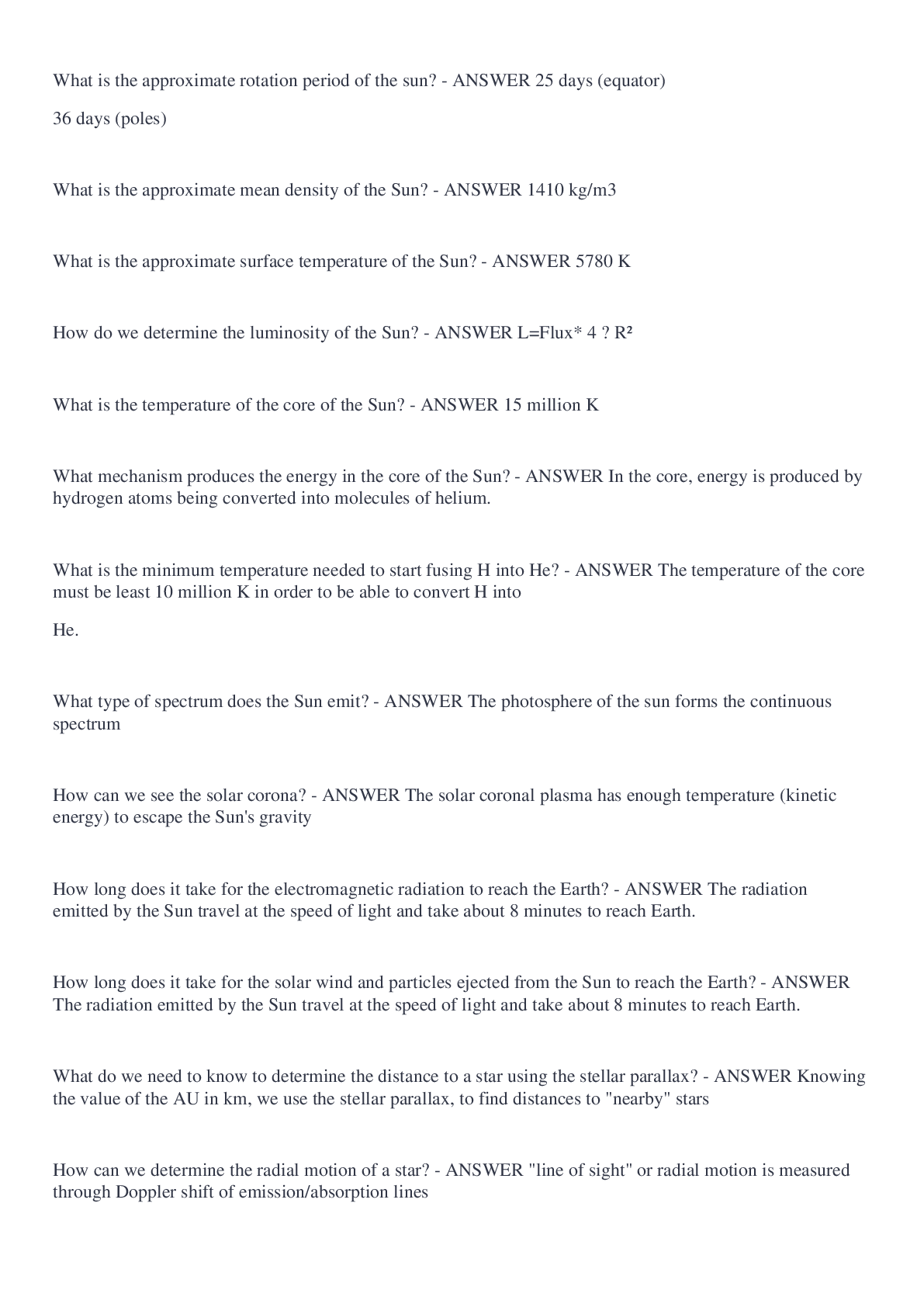
What is the approximate rotation period of the sun? - ANSWER 25 days (equator)
36 days (poles)
What is the approximate mean density of the Sun? - ANSWER 1410 kg/m3
What is the approximate surface temperature of the Sun? - ANSWER 5780 K
How do we determine the luminosity of the Sun? - ANSWER L=Flux* 4 π R²
What is the temperature of the core of the Sun? - ANSWER 15 million K
What mechanism produces the energy in the core of the Sun? - ANSWER In the core, energy is produced by hydrogen atoms being converted into molecules of helium.
What is the minimum temperature needed to start fusing H into He? - ANSWER The temperature of the core must be least 10 million K in order to be able to convert H into
He.
What type of spectrum does the Sun emit? - ANSWER The photosphere of the sun forms the continuous spectrum
How can we see the solar corona? - ANSWER The solar coronal plasma has enough temperature (kinetic energy) to escape the Sun's gravity
How long does it take for the electromagnetic radiation to reach the Earth? - ANSWER The radiation emitted by the Sun travel at the speed of light and take about 8 minutes to reach Earth.
How long does it take for the solar wind and particles ejected from the Sun to reach the Earth? - ANSWER The radiation emitted by the Sun travel at the speed of light and take about 8 minutes to reach Earth.
What do we need to know to determine the distance to a star using the stellar parallax? - ANSWER Knowing the value of the AU in km, we use the stellar parallax, to find distances to "nearby" stars
How can we determine the radial motion of a star? - ANSWER "line of sight" or radial motion is measured through Doppler shift of emission/absorption lines
How can we determine the transverse motion of a star? - ANSWER "transverse" motion is perpendicular to the line of sight
What are the two axes of the HR diagram? - ANSWER Luminosity and temperature
Where are the low and high temperature stars located in the HR diagram? - ANSWER Low-temperature stars are located to the right and high-temperature stars are located to the left.
Where is a large radius and small radius star located in the HR diagram? - ANSWER small radius stars are located on the bottom left and large radius stars are located on the top right.
What is the spectroscopic parallax? - ANSWER The spectral analysis provides information to determine the temperature of the star or the spectral classification. If we know the
temperature for a main sequence star then we can deduce the luminosity
Steps to determine the distance d using spectroscopic parallax: - ANSWER Measure the flux, determine the surface
temperature (or spectral classification), use the HR diagram to determine the luminosity, use the equation: Flux = Luminosity/ 4^d 2
How can you determine the luminosity L of a star (in solar units) respect to the Sun? - ANSWER Lstar= (Rstar/Rsun)^2 * (Tstar/Tsun)^4 * Lsun
What parameters does mass of a star determine? - ANSWER Luminosity, radius, surface temperature, lifetime, evolutionary phases.
A star of smaller mass lives a shorter or a longer life respect to a large mass star? - ANSWER A star with a smaller mass lives a longer lifetime.
How long will take for the Sun to convert all the H into He until all the H is used up? - ANSWER In the Sun's core, the conversion of
H to He will take about 10 billion years.
What is the temperature necessary to fuse He? - ANSWER Helium begins to fuse into Carbon at >108 K (100 million K).
Temperature necessary to fuse Carbon? - ANSWER It will need to
reach a temperature of 600 million K to ignite
carbon
How long will the Sun stay in the main sequence? - ANSWER 10 billion years
At what point in the star evolution it will move off the main sequence? - ANSWER When the core hydrogen is used up and it begins to fuse helium.
To what region in the HR diagram will be Sun move once it has used all the H? - ANSWER sub-giant branch
When the Sun moves off the main sequence, does surface temperature increases or decreases? What
happens to the diameter ? - ANSWER When a star moves off the main sequence, the hot shell causes the outer layers to expand and cool.
Why can the sun not fuse carbon? - ANSWER Solar mass stars cannot squeeze and heat the
core enough to ignite Carbon.
What happens to the Sun once it use all the H and He and ends up with a core of carbon? - ANSWER With no more production of energy in
the core, the carbon core continues to
contract and heat and collapses into a white dwarf.
What is a planetary nebula? - ANSWER The expanding emission line nebula heated by intense radiation from the hot white dwarf
What is a white dwarf? What is the chemical element that compose a white dwarf? - ANSWER A white dwarf is a small very dense star that is typically the size of a planet. It is composed of composed of carbon and oxygen and the outside is hydrogen and helium.
Why can a star more massive than the Sun fuse heavier elements such as carbon, oxygen, neon? - ANSWER Because gravity squeezes and heats the
core. The temperature increases enough to be able to ignite Carbon and then other elements.
What happens when a massive star try to fuse iron? - ANSWER Creating elements heavier than Iron requires energy, so the star collapses and becomes a neutron star.
What is the final object resulting from the collapse of a star of one solar mass? - ANSWER White dwarf and planetary nebula
Final object of a star with more than 1.4 solar masses but less than 3 solar masses? - ANSWER neutron star
Final object for a star with more than 3
solar masses? - ANSWER BLACK HOLE
Size of a white dwarf? Size of a neutron star? Size of a black hole? - ANSWER A white dwarf is about the size of Earth. A neutron star is not much bigger than a small city. Stellar-mass black holes are typically in the range of 10 to 100 solar masses, while the supermassive black holes at the centers of galaxies can be millions or billions of solar masses.
What basic principle can be applied to understand why a neutron star rotates fast and why it has an intense magnetic field? - ANSWER When the star collapses into a neutron star, the plasma (electrically charged ) that make up the core of the star carries and intensify the magnetic field
What is a pulsar? - ANSWER The central object (core of star) is a rotating
neutron star with a strong magnetic field.
What would happens to the Earth's orbit if the Sun could collapse into a black hole? - ANSWER Nothing because the Earth will be at the same distance and it will feel the same gravitational attraction from the Sun at 1 AU.
Why can light emitted at the event horizon or inside the event horizon not escape a black hole? - ANSWER The escape velocity becomes equal to the speed of light. The trajectory of a light beam will be so distorted. Nothing can get out including light.
How it is possible to estimate the mass of the supermassive black hole in the center of the Milky Way? - ANSWER Newton version of Kepler 3rd
Law! MBH = a^3/P^2
What is the relationship between the two parameters that makes the Cepheids and RR Lyrae useful to measure distances? - ANSWER The relationship between
the pulsation period and its luminosity. We plot the pulsation period and then we measure these periods and find the luminosity. Using the luminosity we find the distance.
How was Hubble able to determine the distance to the Andromeda galaxy? - ANSWER Cepheid variables and derived the distance
local group of galaxies - ANSWER Hubble found that galaxies outside the Local Group are all moving away from us
What should happen to the rotational curve of the MW beyond the visible disk if no dark matter was
present? - ANSWER The rotational curve reveals the presence of
"invisible" matter . That unseen matter is only detected by its gravitational effect on stars or object inside the orbit of those objects.
Does the velocity follow a Keplerian curve beyond the 15 kpc distance? - ANSWER No, due to the dark matter problem
What is the evidence of dark matter in the outer part (beyond 15 kpc) of the MW? - ANSWER It doesn't follow the Keplerian curve
•Do we know what dark matter is? - ANSWER Dark matter cannot be detected by the light it emits and is only detected by gravitational attraction but there is a lot of dark mass in the outer part of the galaxy (about 2/3)
What are the possible candidates to explain the existence of dark matter? - ANSWER White dwarf stars, very low mass stars (red dwarfs), brown dwarfs, neutron stars and black holes, Massive Compact Halo Objects (MACHOs), Exotic sub-atomic particles- Weakly Interacting Massive Particles (WIMPs)
How do we know that there is a black hole in the center of our galaxy? - ANSWER Because the stars of our galaxy are revolving around an object that is not emitting light
What method can be used to determine the mass of the black hole in the center of the MW? - ANSWER Using Kepler's third law we can find the mass using the orbital period of a star around the black hole and how far the star is from the black hole.
How many solar masses is estimated to have the supermassive black hole in the center of the MW? - ANSWER 4.1 million solar masses
Which type of galaxies are more massive? - ANSWER Giant ellipticals are bigger in size and more massive than spirals.
Dust and gas in an elliptical galaxy? - ANSWER Ellipticals contain little or no gas and dust
Dust and gas in a spiral galaxy? - ANSWER Yes
Where can we find formation of new stars? In an elliptical galaxy? In a spiral galaxy? - ANSWER Usually in spirals in the spiral arms.
Is the "tuning fork" an evolutionary sequence in galaxies? - ANSWER No, galaxies do not appear to evolve from one galaxy to another.
How can we use the Hubble law to determine distances to far away galaxies? - ANSWER Redshift and Hubble's Law - measuring distances to objects far, far away. V = Ho D
What do we need to measure in those galaxies to determine their distance and apply Hubble law? - ANSWER The velocities, which can be measured from the cosmological red shift of the emission/absorption lines
How can we explain the large luminosity of a quasar and what was the unknown emission lines in the spectrum of a quasar? - ANSWER The unfamiliar lines of a quasar were normal Hydrogen lines being seen at much higher redshifts than any of Hubble's galaxies, thus luminosity is due to the massive distance.
What method can be used to determine the mass of the black hole in a quasar? - ANSWER To estimate the mass use Newton's version of Kepler 3rd Law
How can we estimate the age of the Universe? - ANSWER The age is calculated by measuring the distances and radial velocities of other galaxies, most of which are flying away from our own at speeds proportional to their distances.
Does the Universe has a center? - ANSWER No
How are the wavelengths of light emitted by galaxies affected by the expansion of space? - ANSWER As the Universe expanded, the wavelength of
radiation from the Big Bang also expanded, i.e.
it became redshifted and thus cooled off.
On a small scale, such as the Local Group, are galaxies showing cosmic redshift? What
force is involved in the local group that keeps galaxies together? - ANSWER Instead of expanding along with the rest of the universe because the gravitational attraction between the two is stronger. In fact, the entire Local Group is collapsing under the gravitational attraction, and in about 3 billion years, the Milky Way and Andromeda will collide.
What is the temperature of the CMB? In which part of the spectrum (wavelength) peaks
the CMB emission? - ANSWER The spectrum of this background radiation is of a blackbody with a temperature of 2.7 K. Orginally gamma waves but now peaked in radio/microwaves
What happened to the radiation that
now is in the microwave range? - ANSWER The radiation has been
redshifted by the
expansion of the
Universe
What is Dark energy? - ANSWER In 1998, astronomers found that the universe may actually be accelerating. The repulsive effect that caused the acceleration is called "Dark Energy"
Why it has been necessary to postulate the presence of Dark Energy? - ANSWER ?
What are the names of the two points in the celestial sphere where the Sun crosses the celestial
equator? - ANSWER Autumnal and Vernal Equinox
Declination of the Sun for summer and winter solstice? - ANSWER +23.5, -23.5
Where is the Sun respect to the Moon when it is full Moon. Where is the Sun when it is new Moon? - ANSWER Full Moon: blocked by earth
New Moon: Behind moon and earth
Where is the Moon respect to the Sun's position for a lunar eclipse? For a solar eclipse? - ANSWER Solar: New moon
Lunar: full moon
Why we don't see a solar or lunar eclipse every month? - ANSWER Eclipses occur only when the Moon crosses the ecliptic (5 degrees) while it is a new or full moon
Why are there annular solar eclipses? - ANSWER The moon's orbit around Earth is an ellipse.
What causes the seasons? - ANSWER The seasons are caused by Earth's 23.5 degrees tilted axis.
Is it the changing distance of the Earth to the Sun? - ANSWER Earth is closer to the sun during winter in the north hemisphere and further from the sun during summer in the north hemisphere.
What is the value of the tilt angle of the rotational axis of the Earth respect to the perpendicular to
the orbital plane? - ANSWER 23.5 degrees
What is the Earth's precession? What causes the Earth's precession? - ANSWER Earth's precession is that it is slowly spinning down like a top, this is due to gravity that causes Earth's axis to slowly precede
What is the effect of the precession in the position of the star Polaris? - ANSWER It will change how we see the star in the sky
What is the duration of the precession cycle - ANSWER 26,000 years
What is stellar parallax? - ANSWER Stellar parallax the apparent shift of position of any nearby star against the background of distant objects.
How can we use stellar parallax to calculate distance to a nearby star? - ANSWER If we measure the angle of displacement of the object and we know the length of the baseline (Earth diameter) we can calculate the distance to the object. The amount of parallax is inversely proportional to an object's distance
How was retrograde motion explained in the geocentric model? - ANSWER Using Epicycles (small circles around earth) and Deferents (large circles around earth)
How do we explain the retrograde motion of Mars under the heliocentric model? - ANSWER The planet appeared to undergo retrograde motion when the Earth approaches and overtakes the planet into its orbit
What was Tyco Brahe's contribution to astronomy? - ANSWER He built instruments to make detailed observations of space without using a telescope.
What are the 3 Kepler 's laws of planetary motion? - ANSWER -1st Law (shapes): Planets orbit the Sun in elliptical orbits. (Perihelion: shortest distance from the sun & Aphelion: largest distance from the sun)
-2nd Law: The line connecting a planet with the Sun sweep equal areas in equal times. When close to the sun, it moves much faster
When farther from the sun, moves slower
-3rd Law: p² = a³. The square of a planet's orbital period is proportional to the cube of its semimajor axis. Modified 3rd law by Newton: p² = a³/M, M=(m1+m2)
What are the 3 Newton's law a motion? - ANSWER If one of the masses is larger, the gravitational force is larger, and vice versa. The further the distance the less gravitational force on the object. A. If two objects pulled with same force, one with GREATER mass will accelerate LESS
B. If two identical objects are pulled with different forces, the one pulled with greater force will accelerate more
What are four important discoveries Galileo did with his telescope and how some of them supported the
heliocentric model - ANSWER -The moon has mountains and craters
-The sun has imperfections such as sun spots, and based on the fact that these spots were in different positions by day means the sun rotates
-Discovered the 4 moons of Jupiter, and they orbit Jupiter just like our moon orbits Earth. This supports notion that Earth is NOT center of universe
-Venus shows a complete cycle of phases. Similar to monthly changes of our moon
Concept of mass and weight. How your mass change if you are on the Moon? How is your
weight change is you are on the Moon? - ANSWER -Mass does not equal weight
-Mass does not change ever, weight does
Moon's force of gravity is 1/6th that of Earth. If you weigh 100 lbs. on Earth, you would weigh 16 lbs on the moon
How do we determine the value in km of the AU? - ANSWER 1 AU= distance from the Earth to sun = 150 million km= 93 million miles
We determine this using radar (bounced light off of venus and times how long it took to get back)
Why do astronomers build bigger telescopes? Any advantage of having bigger telescopes? - ANSWER They are capable of greater resolution and seeing farther. Both the light-collecting area and the angular resolution are increased by a larger lens or mirror.
What is the objective of a reflecting telescope? Of a refracting telescope? - ANSWER A reflecting telescope focuses light with mirrors which forms an image. A refracting telescope focuses light with lenses, the lends bends the light to create an image.
What is the focal length of a telescope? - ANSWER The focal length of a telescope is the equivalent distance from the lens or mirror to the plane where the image forms.
What is the dependence of the diameter of a telescope with the light gathering power? - ANSWER Telescopes with larger lenses or mirrors have a larger collecting power and will act as a light bucket.
What is the dependence of the diameter with the angular resolution of a telescope? - ANSWER Telescopes with larger lenses or mirrors are able of taking photos with greater resolution and detail.
If the separation between two stars in a binary system is much smaller than the resolution of the telescope, will you be able to see those two star separated? Why? - ANSWER No, it will look like a single image because of the diffraction of light (an airy disk).
Can you see the craters on the moon with the naked eye? Why? - ANSWER No, the turbulence in terrestrial atmosphere blocks sign, not enough resolution.
What is the magnification of the telescope? - ANSWER The magnification of a telescope is how many times bigger an object looks through a telescope compared to how it looks with the naked eye
How can you calculate the magnification? - ANSWER The magnification of a telescope is the ratio M = Ft/Fe
(Ft) is the equivalent distance from the lens or mirror to the plane where the image forms
(Fe) is the distance between the lens of the eyepiece and the point where the image forms
Using high magnification, does it improve the resolution of a telescope? - ANSWER No, increasing magnification does not increase resolution.
What happens to a pixel when it is hit by photons - ANSWER The charge in each pixel is read by the electronics controlled by a computer and stored as an array of numbers
How does a CCD store an image in a computer? - ANSWER The charge in each pixel is read and stored as an array of numbers in a computer where it is then displayed as an image.
Images taken by IR, UV, X-rays or Gamma-ray telescopes can be represented by colors. Are those colors the colors that we can see with our eyes? What do the colors mean? - ANSWER Different wavelengths are assigned different colors. Images at some wavelengths can be at radio, UV, X-rays or Gamma-rays.
What happens to the image of a star taken by a ground-based telescope when several short exposure are taking? - ANSWER It becomes distorted, which results in a variation in both brightness and apparent position.
Do stars twinkle? Do planets twinkle? Why? - ANSWER Stars twinkle but planets usually don't. The twinkle comes from the addition of constructive interference or subtraction of destructive interference.
Why are telescopes for the x rays and gamma rays need to be in space? - ANSWER Only the longer wavelengths of radio and the visible light pass easily through Earth's atmosphere. • We need telescopes high in the atmosphere to observe in the IR part of the spectrum • To extend the observations into the UV, X-Ray and Gamma ray it is necessary to have telescopes in space
What is the configuration of the positions of the Sun and Moon for the spring tides? For neap
tides? - ANSWER Spring tides occur at new and full moon. The tidal forces of the Sun and the Moon reinforce each other. Neap tides occur at the first quarter and third quarter moon when the Sun and the
Moon tidal forces act at 90 degrees from each other
How many high tides are there in 24 hours period? Why? - ANSWER The Earth develops two bulges. A consequence of this is that every 24 hours there are two high tides and two low tides.
Why is the tidal effect of the Sun is smaller than the tidal effect of the Moon? - ANSWER The tidal effect is smaller due to the small differential gravitational force
How do we know about the Earth's interior? How are the P and S waves used? - ANSWER Seismology. Earth's interior structure is probed by studying how seismic waves travel through it. P waves (Pressure) can travel through the liquid (outer) core but they are deflected by the core and S waves (Shear) travel in the mantle but not through the liquid core
Equations for the escape velocity and the molecular velocity - ANSWER Vsec=11.2sqrtM/R and Vmol=0.157sqrtT/W
What is the minimum ratio of escape velocity to mean molecular velocity so gases are retained in the
atmosphere of a planet? - ANSWER The ratio of escape velocity/molecular velocity = 11.2/0.6 = 18.7
Which gases may leave an atmosphere faster? Why? - ANSWER Hotter gas, faster motion; The gas molecular velocity depends on the temperature, higher temperatures, higher velocities
What causes the depletion of ozone in the atmosphere? - ANSWER A groups of chemicals known as CFCs, choroflourocarbons are very efficient to combine with the ozone molecule (O3) and are
destroying the ozone molecule. The molecule of CFC contains carbon, chlorine and fluorine.
What is the ozone hole and where it is located - ANSWER The ozone hole is a hole in our ozone layer, the hole is a prominent feature of the ozone layer over the Antarctica.
How can we explain the large density of the core of the Earth and the terrestrial planets? - ANSWER The "jump" in density between the mantle and the core is caused by different materials in the mantle and core. The core has denser material such as nickel and iron
What is differentiation? - ANSWER The Earth was molten, allowing higher-density material (nickel, iron) to sink to the core. The material in the core is still at a high temperature, about 5,000K.
Name the three main greenhouse gasses present in the atmosphere of the Earth - ANSWER The three main greenhouse gasses
in the terrestrial atmosphere are CO₂,
H₂O vapor, and Methane.
Name the two main gases in the atmosphere of the Earth - ANSWER nitrogen (78%)
oxygen (21%)
Why the Moon has been able to preserve the impact of craters? - ANSWER Because there is no atmosphere
Why the Moon does not have an atmosphere? - ANSWER Escape velocity
What are the lunar maria (mare) and what caused them? - ANSWER Lunar Maria is darker areas resulting from
earlier lava flow.
How do we explain the presence of Earth's magnetic field - ANSWER The relatively fast rotation of the planet
The electrically conducting metal core
What causes the terrestrial aurora? Describe the process that produces an aurora - ANSWER Charged particles are ejected from the Sun. In a
solar flare a large of them are ejected. They collide with the Earth's magnetosphere. The particles enter the magnetic field and are directed by the Earth's magnetic field toward the poles.
How do Earth's magnetic field and the ozone layer protect life on Earth? - ANSWER Protect us from the sun's harmful UV rays
What are the theories for the formation of the Moon? Which is the most accepted one? - ANSWER Both the Earth and the Moon formed together from the same material of the proto planetary disk
The moon formed somewhere else and was captured by the Earth
Impact theory: (most accepted) Glancing collision between a Mars-sized body (Mars
diameter is about ½ of Earth diameter) and the molten Earth. The Mars-size body was formed somewhere else. There was an exchange of material.
How is the size of Earth compared with Venus, Mars and Mercury? - ANSWER Earth is the largest, but roughly the same size as Venus and larger than Mars and Mercury
What is the problem for determining the rotational period of Mercury and Venus? How is the rotational
period determined? - ANSWER Hard to make out references points to determine if it completed a rotation because of angle in the sky. Determined by using the doppler effect to measure rotational period.
How dense is Venus atmosphere compared to Earth? Atmospheric pressure compared to Earth? - ANSWER Venus is way more dense because of the very thick atmosphere.
What is the main gas in the atmosphere of Venus? - ANSWER carbon dioxide
What is the composition of the clouds of Venus? - ANSWER sulfuric acid droplets
What causes the high temperature in Venus atmosphere? - ANSWER The thick atmosphere
What are the main difference between terrestrial planets and Jovian planets? - ANSWER Terrestrial planets are small with high densities and rocky surfaces ,while jovian planets are large with low densities and gaseous surfaces. In the solar system, Mars, Mercury, Earth and Venus are terrestrial planets, while Jupiter, Saturn, Uranus and Neptune are jovian planets. (Size, mass, density, distance from the Sun, number of moons or satellite)
Which of the terrestrial planets does not have an atmosphere? - ANSWER Mercury
Main differences between the north and south hemisphere in Mars - ANSWER Mars has lowlands, few craters and younger in the north and highlands and many craters and older in the south
Mars is called the Red planet. What gives the red color to the surface of Mars? - ANSWER This color is due to the presence of iron oxide dust, a.k.a. rust.
Origin of Valles Marineris - ANSWER It has been recently suggested that Valles Marineris is a large tectonic "crack" in the Martian crust. Most researchers agree that this formed as the crust thickened in the Tharsis region to the west, and was subsequently widened by erosion.
Which planet has the largest volcanoes in the solar system? - ANSWER Mars
What is unusual regarding the axial tilt of Venus? - ANSWER Rotates backwards
Which is the less dense of the Jovian planets? What is its density? - ANSWER Saturn is least dense at 687 kg/m^3
What is the Great Red spot? Where is it located in the disk of the planet? - ANSWER The Great Red Spot is a persistent anticyclonic storm on the planet Jupiter, 22° south of the equator
Which of the Jovian planets have the strongest magnetic field? - ANSWER Jupiter
•What explains the blue color in the atmospheres of Uranus and Neptune? - ANSWER Due to the presence of methane in the atmosphere
Have we ever witnesses the collision of the comet with a Jovian planet? - ANSWER Yes
[Show More]