Financial Resource Activity Examination of Yellow Leaf, Inc 1
Financial Resource Activity Examination of Yellow Leaf, Inc.
Western Governors University
Mark Brann – Student # 000363150
FINANCIAL RESOURCE ACTIVITY EXA
...
Financial Resource Activity Examination of Yellow Leaf, Inc 1
Financial Resource Activity Examination of Yellow Leaf, Inc.
Western Governors University
Mark Brann – Student # 000363150
FINANCIAL RESOURCE ACTIVITY EXAMINATION OF YELLOW LEAF, INC 2
The following treatise covers key financial issues relating to the popular women's retail outlet,
Yellow Leaf, Inc. Yellow Leaf was duly incorporated on December 31, 2011, domiciled in St.
Louis, Missouri, with four stores located near it's Missouri headquarters. This report intends to
illustrate management's efforts to reach it's integrated objectives for the fiscal year, 2014, and
the resultant systemized and realized monetary outcome. Key components of the financial year
shall be examined, specifically with an eye toward liquidity, activity, profitability, and coverage
ratios in pragmatic effort to illustrate the company's quality effectiveness utilization strategies
thus employed. As C.E.O. Gordon Lindenwood is fond of saying, "Turn a leaf and watch us
grow."
FINANCIAL RESOURCE ACTIVITY EXAMINATION OF YELLOW LEAF, INC 3
Capacity, Usage, and a Quest for Results
Yellow Leaf, Inc. finished fiscal year 2014 with total sales revenue of $2,919,800, gross
profits reigning in $2,163,800, and a bottom line net income of $819,218. Not bad for a store
with only minimal funding half a decade earlier. Key ratios play an important part in looking
back as well forward in relation to this bright, flashy upstart company. We shall examine four
primary ratio laden areas of importance and relate an independent articulation of the results, as
well as an even-handed summary of our thoughts and recommendations for this threadbare
Mainstreet mini-giant.
Liquidity Examined – Current Ratio
Current ratios are utilized to assist both management and outside stakeholders to form a
realized measure of how able-bodied a company is in regard to countering short-term debt. It
poses as a snapshot of current assets held on the balance sheet and how assets may (or may not)
be employed to satisfy current debt and/or payables. A current ratio that greatly exceeds its
industry average is oftentimes considered a detriment as management may not be utilizing assets
to their fullest capacity. Also worth noting is that even if a company holds a high current ratio,
other factors are needed to form a coherent picture of liquidity. For example, a company with a
high working capital ratio may also hold elevated accounts receivable, a dilemma where slow or
low paying customer remuneration may hinder repayment of current liabilities owed. For the
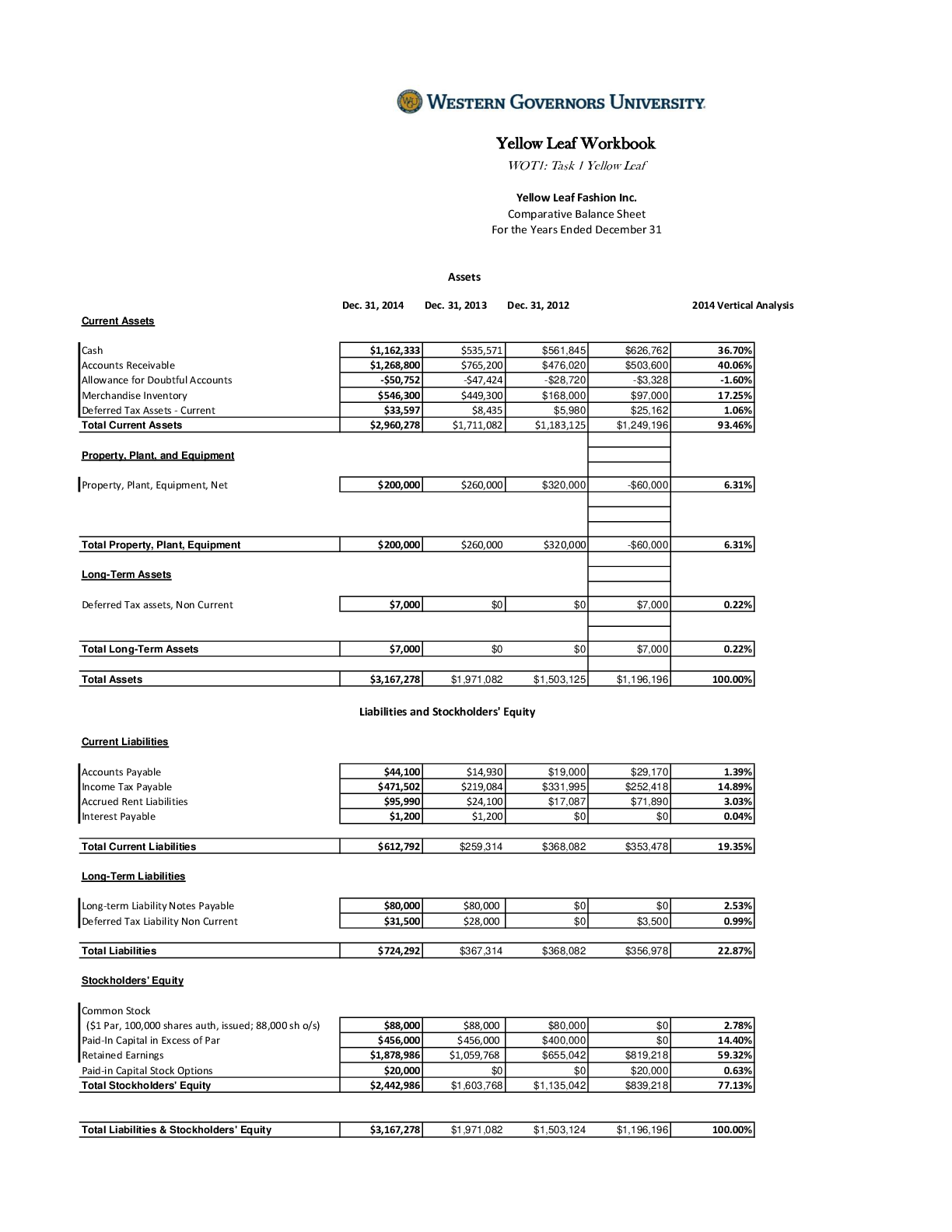
year ending December, 2014, Yellow Leaf's current ratio stands at 4.8308. A ratio less than 1.0
indicates a company's short term debts are greater than its current assets. On the surface Yellow
Leaf's current ratio appears positive, however accounts receivable for 2014 stands at $1,268,800
while year end cash totals $1,162,333. Accounts receivable since 2012 have nearly doubled each
year indicating the company relies heavily upon financed customer accounts. Cash inflow was
FINANCIAL RESOURCE ACTIVITY EXAMINATION OF YELLOW LEAF
[Show More]