What are the general principles of nursing informatics?
(ANS-
-Integrates nursing science with multiple information and analytical sciences to identify, manage, define, and communicate data, information, knowledge, w
...
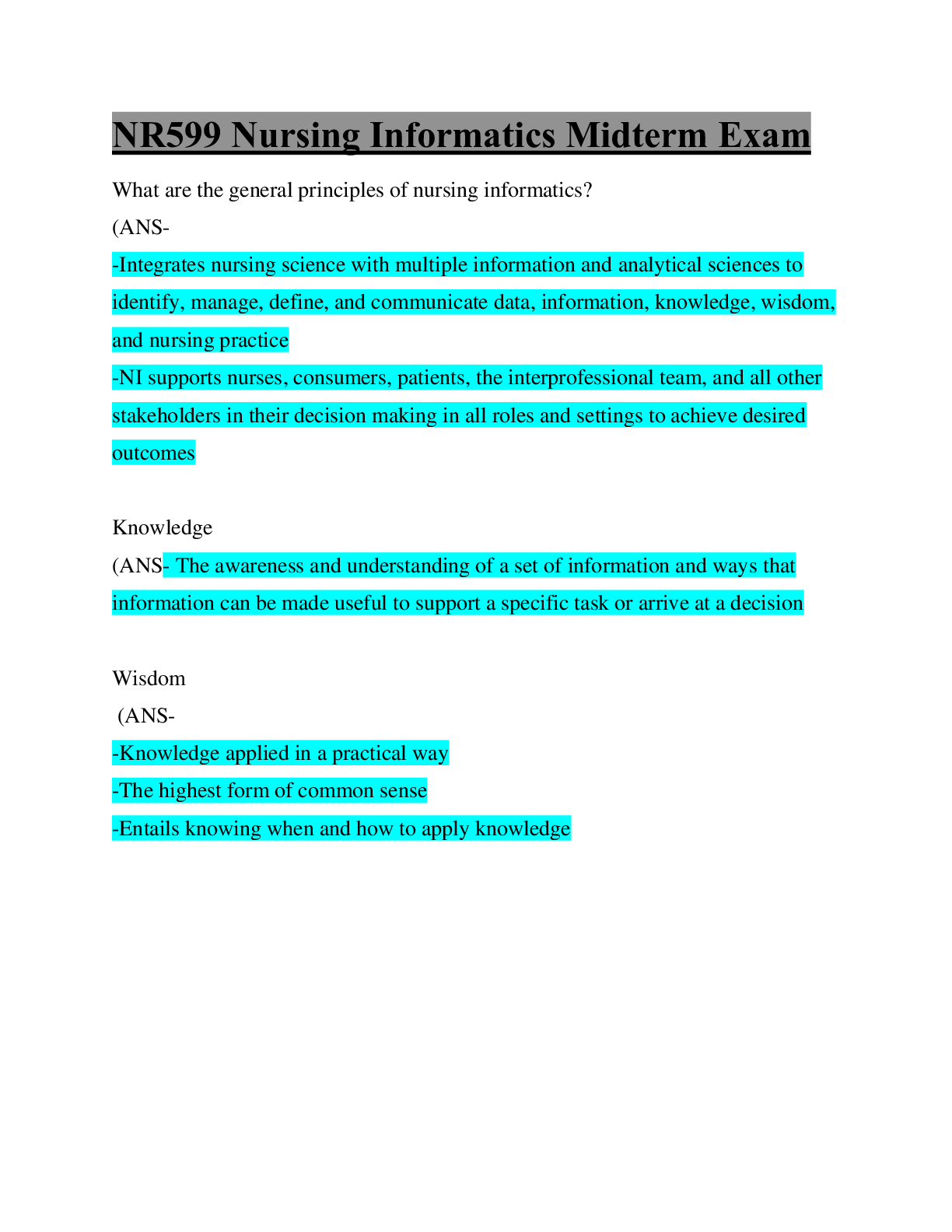
What are the general principles of nursing informatics?
(ANS-
-Integrates nursing science with multiple information and analytical sciences to identify, manage, define, and communicate data, information, knowledge, wisdom, and nursing practice
-NI supports nurses, consumers, patients, the interprofessional team, and all other stakeholders in their decision making in all roles and settings to achieve desired outcomes
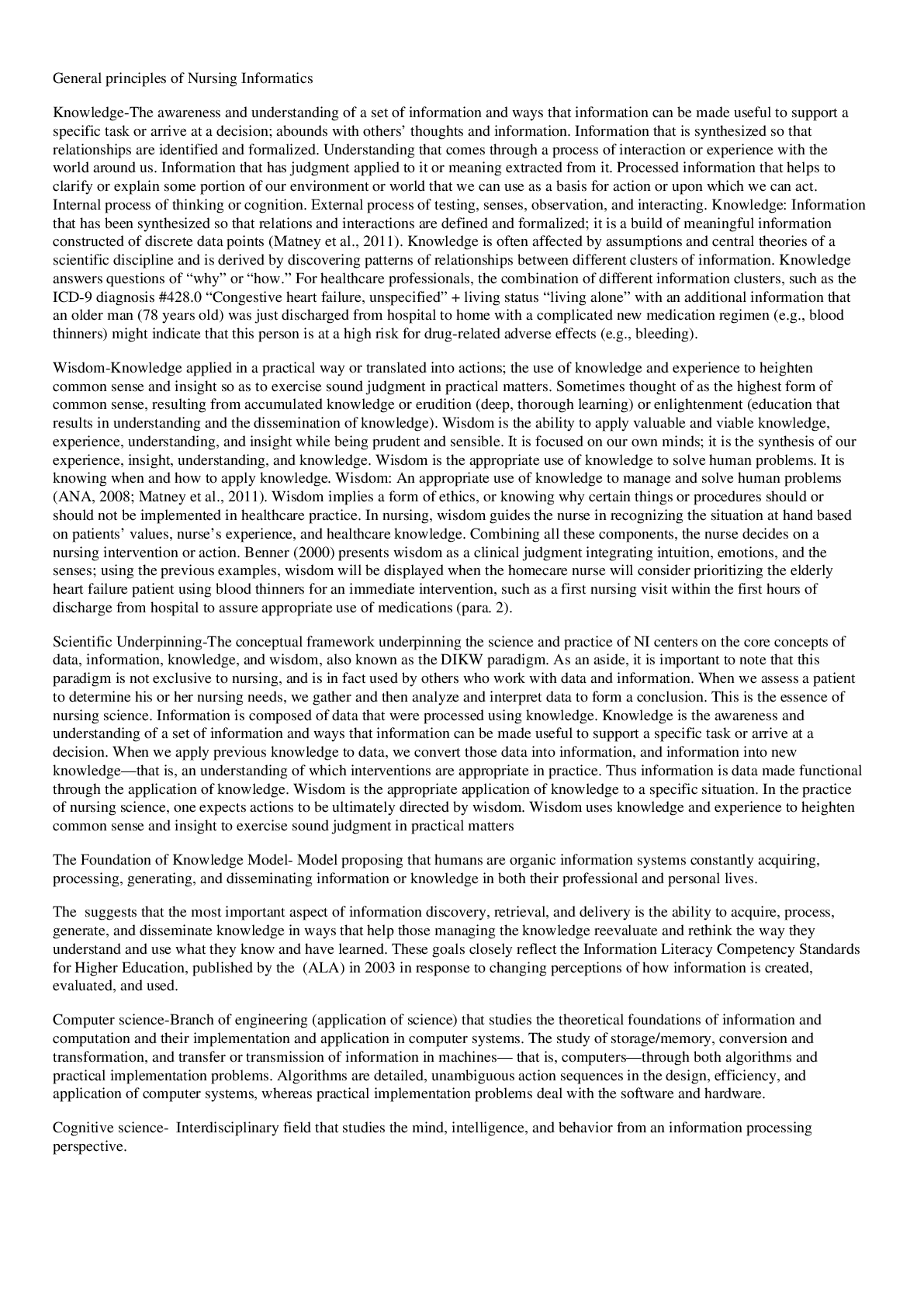
Knowledge
(ANS- The awareness and understanding of a set of information and ways that information can be made useful to support a specific task or arrive at a decision
Wisdom
(ANS-
-Knowledge applied in a practical way
-The highest form of common sense
-Entails knowing when and how to apply knowledge
Scientific Underpinning
(ANS-
-The foundation of nursing science through research data, evidence, and idea creation
-The scientific underpinnings of practice provide the basis of knowledge for advanced nursing practice. These scientific underpinnings include sciences such as biology, physiology, psychology, ethics, and nursing.
The Foundation of Knowledge Model
(ANS- A model proposing that humans are organic information systems constantly acquiring, processing, generating, and disseminating information or knowledge in both their professional and personal lives
Computer Science
(ANS-
-Studies the theory, underpinning information, and computation and their implementation and computer systems
-Computers enable nurses to quickly access important information about your health or illness and your treatment plan from your electronic health record. Nurses can access information such as your laboratory test and x-ray results and health reports from other health-care team members to give you the best care possible.
Cognitive Science
(ANS-
-How the human mind works from an information processing perspective
-Cognitive science is the interdisciplinary, scientific study of the mind and its processes. It examines the nature, the tasks, and the functions of cognition (in a broad sense). Cognitive scientists study intelligence and behavior, with a focus on how nervous systems represent, process, and transform information.
Information Science
(ANS-
-The retrieval and management of information, as well as human computer interaction
-Information science is an academic field which is primarily concerned with analysis, collection, classification, manipulation, storage, retrieval, movement, dissemination, and protection of information.
Standard Terminology
(ANS- Structured, controlled languages developed to represent concepts in a given domain in a clear fashion that conveys the exact same meaning for data, information, and knowledge across settings, regions, and even different countries
Why is standard terminology important?
(ANS-
-Contribute to the development of knowledge because they ensure that all professionals share the same understanding or meaning of a given concept;
-Key to development of EHRs
-Support the collection of data that provide more information which could increase patient outcomes and decrease health care costs
Nomenclature
(ANS- Refers to a system of rules and procedures for adding names used in an art or science, such as nursing
Classification Systems
(ANS- Systems that capture categories, which are then used to determine costs or outcomes but are insufficient in detail for clinical documentation purposes
Data Sets
(ANS- Refers to a named collection of data consisting of individual information organized in a prescribed fashion
Taxonomy
(ANS-
-The scientific study of how living things are classified
-Uses classification according to a predetermined system, with the resulting catalog used to provide a conceptual framework for discussion, analysis, or information retrieval
Which two STs are used for reimbursement purposes?
(ANS-
1. The International Statistical Classification of Diseases and Related Health Problems (ICD)
2. Current Procedural Terminology (CPT)
The International Statistical Classification of Diseases and Related Health Problems (ICD)
(ANS- Maintained by the World Health Organization (WHO) and provides a description and a classification for known diseases and injuries. Every condition has a unique code up to 6 characters long
Current Procedural Terminology (CPT)
(ANS-
-The standardized classification system for reporting medical procedures and services
-Provides unique billing codes for services rendered
-List that is owned and maintained by the American Medical Association
-CPT codes have been developed via a committee process rather than a basis in evidence
What are the two informatics competencies?
(ANS-
1. Generalist
2. Nurse specialist
[Show More]