Lewis: Medical-Surgical Nursing~Chapter 20
Document Content and Description Below
A 42-year-old patient is recovering from anesthesia in the post anesthesia care unit (PACU). On admission to the PACU, the blood pressure (BP) is 124/70. Thirty minutes after admission, the blood pressure falls to 112/60
...
[Show More]
Last updated: 3 years ago
Preview 1 out of 8 pages
Instant download

Buy this Document to get the Full Access Instantly
Provided by Students Who Aced it
We Verify Document Content to Gurantee Accuracy
Reviews( 0 )
Document information
Connected school, study & course
About the document
Uploaded On
Aug 02, 2022
Number of pages
8
Written in
All

Additional information
This document has been written for:
Uploaded
Aug 02, 2022
Downloads
0
Views
77
Topic Tags
Related Subjects & Courses
Explore similar study resources and related concepts.
Recommended For You
Get more on EXAM »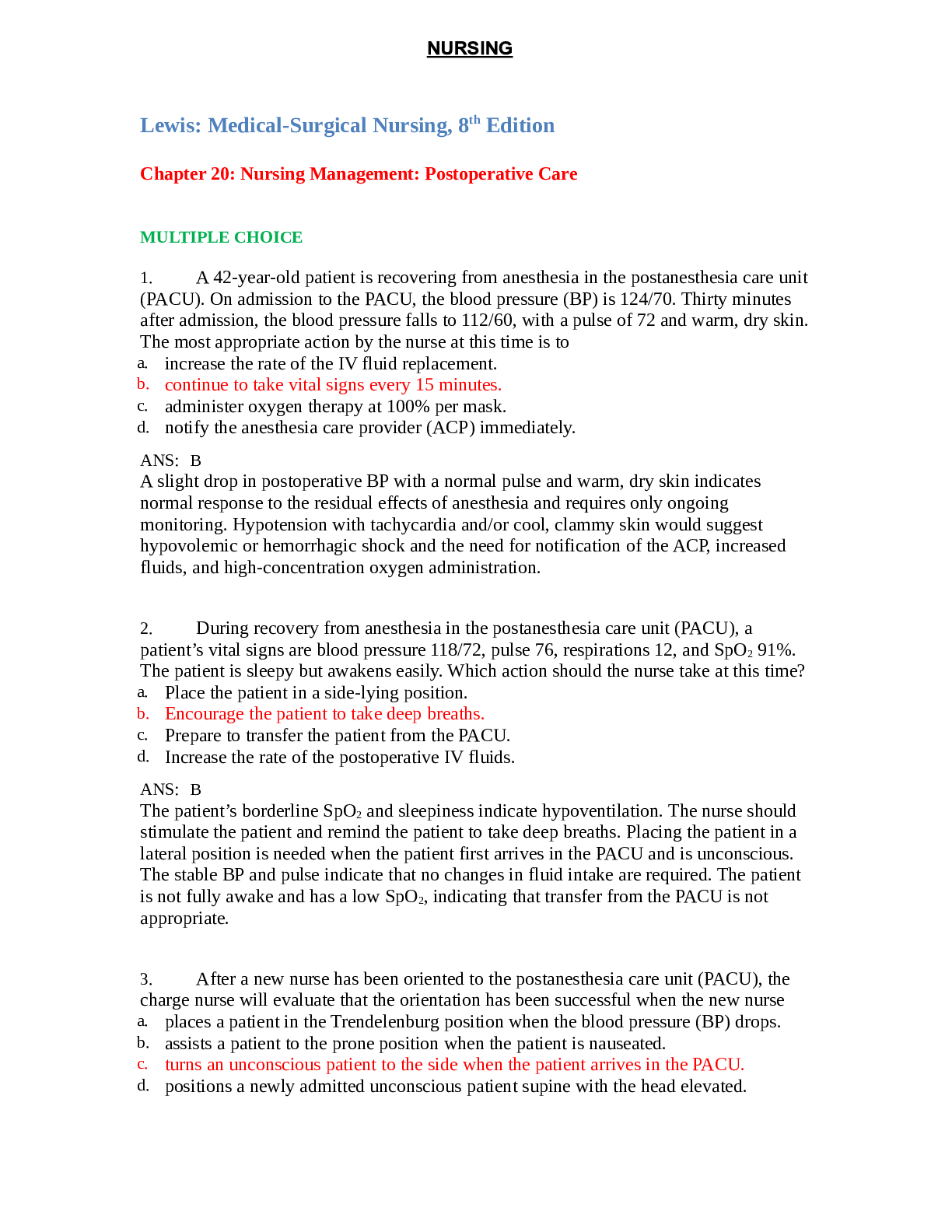
$11
383 Pages
Lewis: Medical-Surgical Nursing, 8th Edition Chapter 20: Nursi...
$12.5
15 Pages
BIOS 260 Chapter 20 Questions and Answers (Verified Answers)

$14
36 Pages
TEST BANK Chapter 20: Heart and Neck Vessels PHYSICAL EXAMINAT...

$11
12 Pages
Chapter 19- Nursing Management of Pregnancy at RiskPregnancy &...
$6.5
5 Pages
Chapter 8- Cancers of the Female Reproductive Tract: Test Bank...
.png)
$10
14 Pages
Chapter 20: Peripheral Vascular System and Lymphatic System Ja...
$14
13 Pages
NURS 807- Bates’ Guide to Physical Examination and History Tak...

$11.5
11 Pages
Chapter 20: Falls ALL ANSWERS 100% CORRECT SPRING FALL- 2022 L...

$2.5
13 Pages
Chapter 20 Concepts of Care for Patients With Cancer Ignatavic...
$6
6 Pages
NURS 6501 / NURS6501: Advanced Pathophysiology - Chapter 20 St...
$15
13 Pages
Chapter 20: NURS 340 Preparation For The Nclex Questions and A...

$10
21 Pages
Pharmacology Exam 4 Review: Chapter 20 Anxiolytics and Hypnoti...

$10
35 Pages
N443 – Study Guide Test 3 Chapter 20 - Nursing Care of the Chi...

$6.5
15 Pages
Chapter 20: Lipid Metabolism Exam, questions and answers Bioc...
More related documents below