Pharmacology Proctored ATI Study Guide
Chapter 1: Pharmacokinetics and Routes of Administration
• Absorption (depends on route)
§ Route of admin affects the rate and amount of absorption
o Oral:
§ GI pH an
...
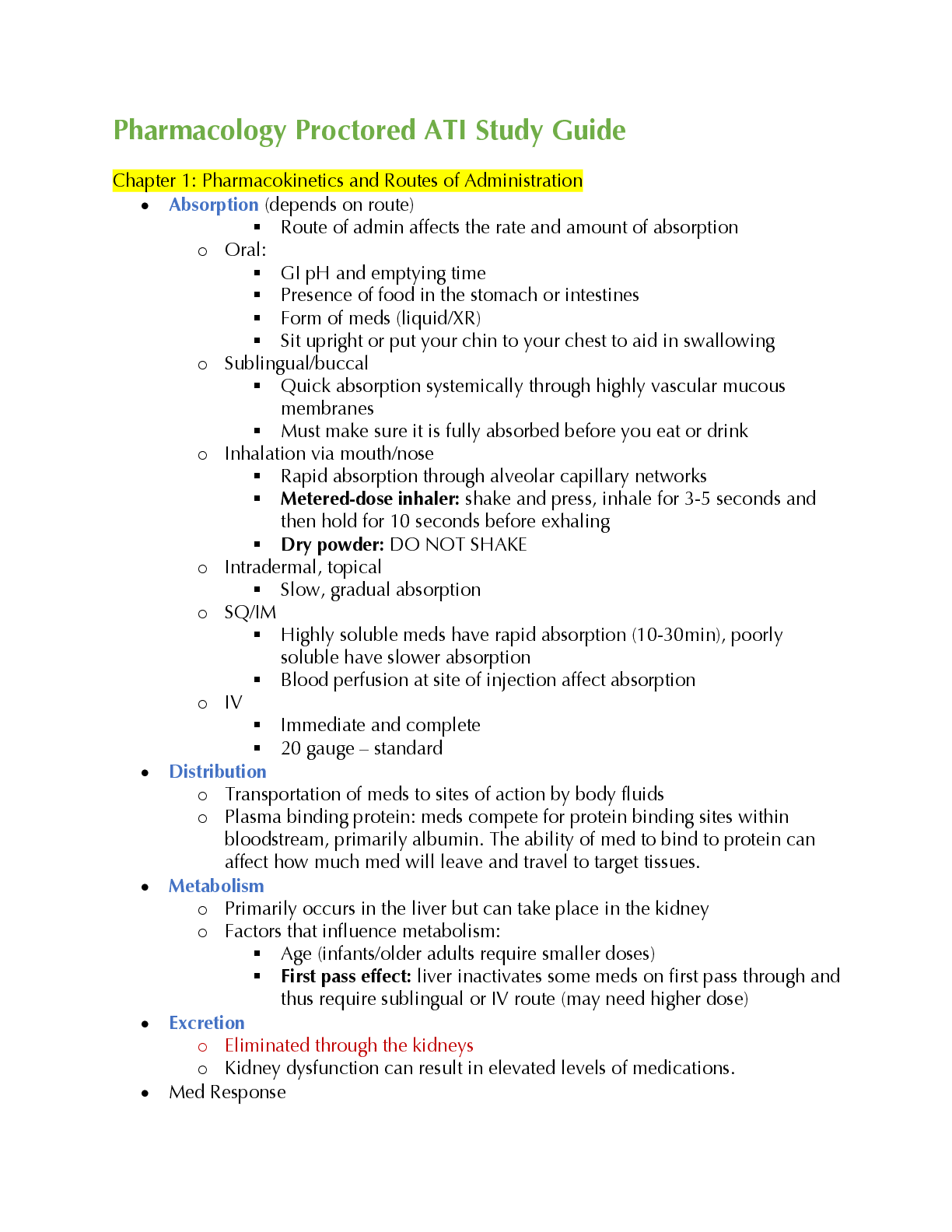
Pharmacology Proctored ATI Study Guide
Chapter 1: Pharmacokinetics and Routes of Administration
• Absorption (depends on route)
§ Route of admin affects the rate and amount of absorption
o Oral:
§ GI pH and emptying time
§ Presence of food in the stomach or intestines
§ Form of meds (liquid/XR)
§ Sit upright or put your chin to your chest to aid in swallowing
o Sublingual/buccal
§ Quick absorption systemically through highly vascular mucous
membranes
§ Must make sure it is fully absorbed before you eat or drink
o Inhalation via mouth/nose
§ Rapid absorption through alveolar capillary networks
§ Metered-dose inhaler: shake and press, inhale for 3-5 seconds and
then hold for 10 seconds before exhaling
§ Dry powder: DO NOT SHAKE
o Intradermal, topical
§ Slow, gradual absorption
o SQ/IM
§ Highly soluble meds have rapid absorption (10-30min), poorly
soluble have slower absorption
§ Blood perfusion at site of injection affect absorption
o IV
§ Immediate and complete
§ 20 gauge – standard
• Distribution
o Transportation of meds to sites of action by body fluids
o Plasma binding protein: meds compete for protein binding sites within
bloodstream, primarily albumin. The ability of med to bind to protein can
affect how much med will leave and travel to target tissues.
• Metabolism
o Primarily occurs in the liver but can take place in the kidney
o Factors that influence metabolism:
§ Age (infants/older adults require smaller doses)
§ First pass effect: liver inactivates some meds on first pass through and
thus require sublingual or IV route (may need higher dose)
• Excretion
o Eliminated through the kidneys
o Kidney dysfunction can result in elevated levels of medications.
• Med Response
For More Nursing Materials Visit: WWW.qwivy.COM
WWW.qwivy.COM
1 / 4
o Maintain plasma levels between minimum effective concentration and the
toxic concentration:
• Therapeutic index (TI)
o High TI has a wide safety margin.
o Low TI requires monitoring of serum levels; higher risk of toxicity
o Tough levels: obtain immediately before next dose.
• Half-life
o Time it takes a medication level to drop in the body by 50%.
o Short vs long half-life: long half-life has greater risk for med accumulation in
body.
• Agonist: enhance/produces an action
• Antagonist: blocks the action
• Routes of admin:
o Oral/Enteral:
§ 90 degrees upright
§ do not mix with large amounts of food
§ lean chin in to help facilitate swallowing
o Sublingual/buccal
§ Keep med in place until completely dissolved
o Transdermal
§ Wash skin with soap and water then dry it thoroughly before placing
patch. Place patch on hairless area and rotate sites to prevent
irritation.
o Drops:
§ Place drop in center of sac.
§ Avoid placing directly on cornea.
§ If blink repeat process.
§ Apply gentle pressure with finger and a clean facial tissue on the
nasolacrimal duct for 30-60 seconds to prevent systemic absorption.
o Ears:
§ Have client lay on unaffected side.
§ Up and out for adults
§ Down and back for children
o Inhalation:
§ MDI
• Shake vigorously 5-6 times
• Take a deep breath and then exhale
• Slow deep breath for 3-5 seconds from MDI
• Hold breath for 10 seconds after
§ DPI
• DO NOT SHAKE DEVICE
• Place mouthpiece between lips and take a deep breath
• Hold breath for 5-10 seconds
For More Nursing Materials Visit: WWW.qwivy.COM
WWW.qwivy.COM
2 / 4
o NG/Gastrostomy tubes
§ To prevent clogging flush tube before and after each med with 15-
30ml of warm sterile water.
o Suppositories:
§ Left lateral sims position.
§ Remain flat or left lateral for 5 min after insertion.
o Intradermal:
§ Used for allergy testing
§ Used for tb testing
§ Small amount of solution (no more than 0.1ml)
§ 10-15-degree angle bevel up.
o Z-track: for iron
Chapter 2: Safe Med Admin and Error Reduction
• Types of Prescriptions:
o Routine/standard: regularly scheduled meds
o Single/one time: asap or a specific time
o Stat: once and immediately
o PRN: as needed
o Standing: specific circumstances or specific units: ex: heparin protocol
• Taking a phone prescription:
o Have 2nd nurse on line if possible
o Read-back prescription
o Verify and sign within 24 hours
• Med rec:
o Take place at admission, transfer of clients, and discharge.
• RIGHTS OF SAFE MED ADMIN:
o Right client
o Right med
o Right dose
o Right time
o Right route
o Right documentation
o Right client education
o Right to refuse
o Right assessment
o Right evaluation
• Evaluation
o Report all errors and implement corrective measures immediately
§ Complete incident report within time frame the facility specifies
(usually 24 hours) and it should include
• Client id, name and dose of med, time and place of incident,
accurate and objective account of event, who you notified,
what actions you took, your signature.
[Show More]