CFA 46: Security Market Indices | 100% Correct Answers
Document Content and Description Below
A security market index represents the:
risk of a security market.
security market as a whole.
security market, market segment, or asset class. - ✔✔C is correct. A security market
index represents the value of a give
...
[Show More]
Last updated: 3 years ago
Preview 1 out of 11 pages
Instant download

Buy this Document to get the Full Access Instantly
Provided by Students Who Aced it
We Verify Document Content to Gurantee Accuracy
Reviews( 0 )
Document information
Connected school, study & course
About the document
Uploaded On
Aug 09, 2022
Number of pages
11
Written in
All

Additional information
This document has been written for:
Uploaded
Aug 09, 2022
Downloads
0
Views
140
Topic Tags
Recommended For You
Get more on EXAM »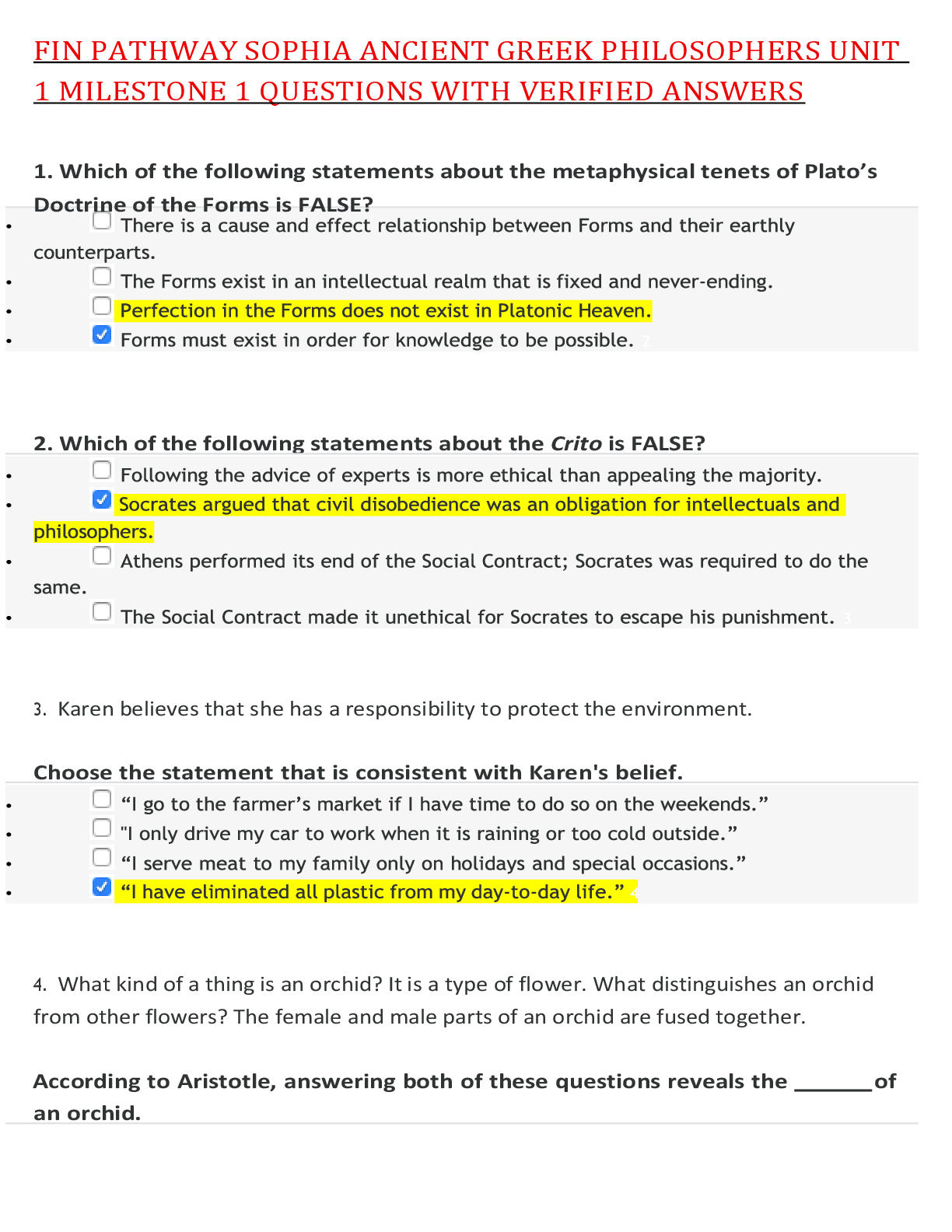
$19
163 Pages
TEST BANK for Options, Futures, and Other Derivatives, Global...

$29
1056 Pages
Principles of Corporate Finance 14th Edition By Richard Breale...
$25
67 Pages
Finance for Non-Financial Managers, 7th Canadian Edition Pierr...
$24
775 Pages
Finance Applications and Theory, 6th Edition Marcia Cornett, T...
$29
1057 Pages
Principles of Corporate Finance 14th Edition By Richard A. B...

$29
345 Pages
eBook [PDF] Principles of Corporate Finance 14th Edition By Ri...
$19
391 Pages
Solution Manual for Principles of Corporate Finance 14th Editi...
$24
709 Pages
Principles Of Corporate Finance 14th Edition By Richard Brealy...
$22
708 Pages
PRINCIPLES OF CORPORATE FINANCE 14TH EDITION BY RICHARD BREALY...
$19
40 Pages
SOLUTION MANUAL Principles Of Corporate Finance 14th Edition B...
$19.5
541 Pages
SOLUTION MANUAL FOR Principles Of Corporate Finance 14th Editi...

$22
1650 Pages
Test Bank for Principles of Corporate Finance 14th Edition by...
More related documents below