Genetics Exam 3
1. Which of the following statements regarding transcription is true?
A. RNA is only synthesized in a 5’ 3’ direction.
B. Transcription requires the association of ribosomes with messenger RNA.
C. R
...
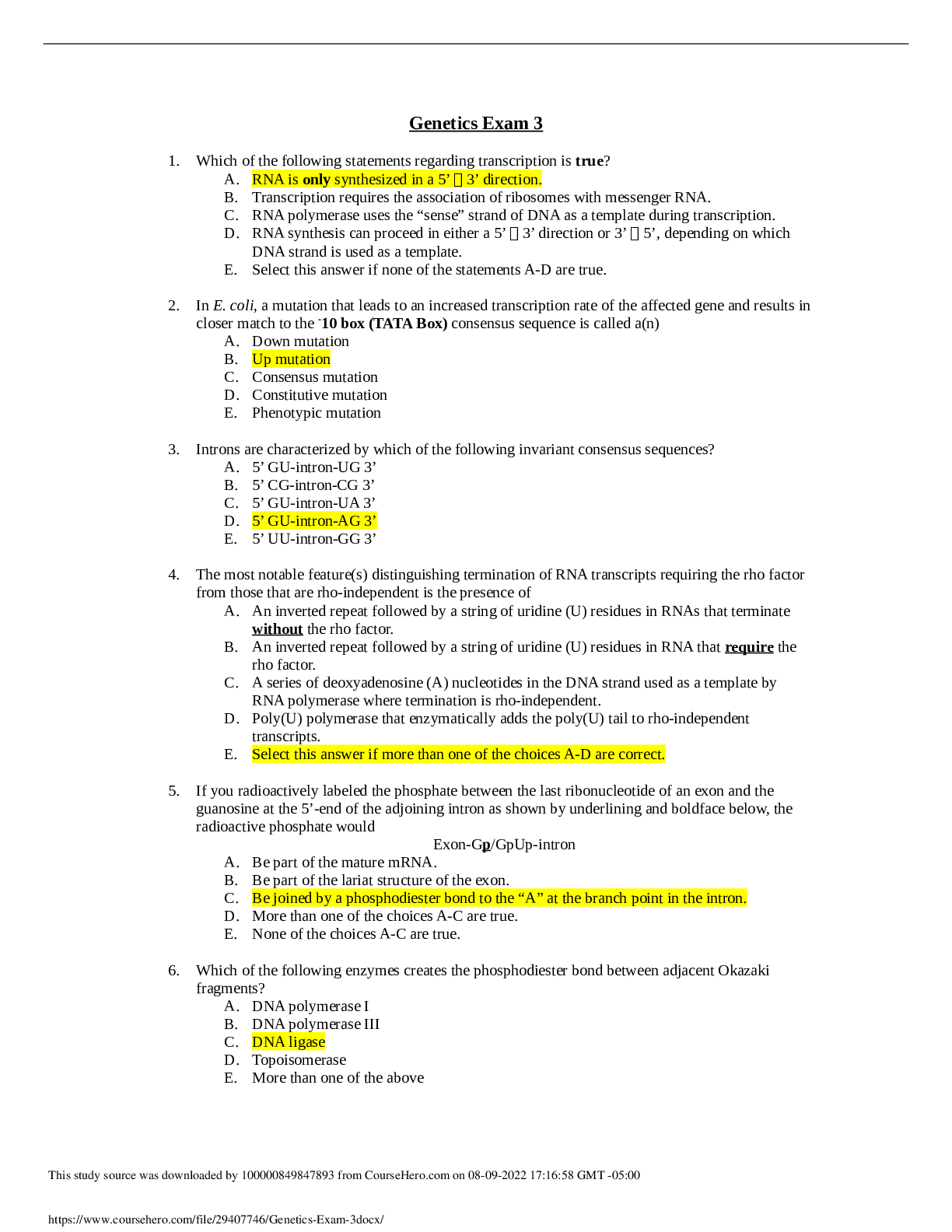
Genetics Exam 3
1. Which of the following statements regarding transcription is true?
A. RNA is only synthesized in a 5’ 3’ direction.
B. Transcription requires the association of ribosomes with messenger RNA.
C. RNA polymerase uses the “sense” strand of DNA as a template during transcription.
D. RNA synthesis can proceed in either a 5’ 3’ direction or 3’ 5’, depending on which
DNA strand is used as a template.
E. Select this answer if none of the statements A-D are true.
2. In E. coli, a mutation that leads to an increased transcription rate of the affected gene and results in
closer match to the -10 box (TATA Box) consensus sequence is called a(n)
A. Down mutation
B. Up mutation
C. Consensus mutation
D. Constitutive mutation
E. Phenotypic mutation
3. Introns are characterized by which of the following invariant consensus sequences?
A. 5’ GU-intron-UG 3’
B. 5’ CG-intron-CG 3’
C. 5’ GU-intron-UA 3’
D. 5’ GU-intron-AG 3’
E. 5’ UU-intron-GG 3’
4. The most notable feature(s) distinguishing termination of RNA transcripts requiring the rho factor
from those that are rho-independent is the presence of
A. An inverted repeat followed by a string of uridine (U) residues in RNAs that terminate
without the rho factor.
B. An inverted repeat followed by a string of uridine (U) residues in RNA that require the
rho factor.
C. A series of deoxyadenosine (A) nucleotides in the DNA strand used as a template by
RNA polymerase where termination is rho-independent.
D. Poly(U) polymerase that enzymatically adds the poly(U) tail to rho-independent
transcripts.
E. Select this answer if more than one of the choices A-D are correct.
5. If you radioactively labeled the phosphate between the last ribonucleotide of an exon and the
guanosine at the 5’-end of the adjoining intron as shown by underlining and boldface below, the
radioactive phosphate would
Exon-Gp/GpUp-intron
A. Be part of the mature mRNA.
B. Be part of the lariat structure of the exon.
C. Be joined by a phosphodiester bond to the “A” at the branch point in the intron.
D. More than one of the choices A-C are true.
E. None of the choices A-C are true.
6. Which of the following enzymes creates the phosphodiester bond between adjacent Okazaki
fragments?
A. DNA polymerase I
B. DNA polymerase III
C. DNA ligase
D. Topoisomerase
E. More than one of the above
7. Which of the following is true concerning RNA polymerase from E. coli?
A. The complete enzyme (holoenzyme) is a complex composed of six polypeptide subunits.
B. The core enzyme contains the sigma subunit.
C. In vitro, the core enzyme synthesizes RNA, but does not initiate transcription at the
correct place on the DNA template.
D. Alternative sigma subunits are used by the cell to transcribe specific sets of genes under
adverse conditions such as thermal stress (“heat shock”).
E. Select this answer if more than one of the choices A-D are true.
8. Eukaryotic mRNAs are capped at the 5’ end. Which of the following is FALSE concerning this
“cap” structure?
A. A guanine nucleotide forms an unusual bond that has a 5’ to 5’ linkage with three
phosphates instead of the usual phosphodiester bond.
B. A methyl (-CH3) group is added to 7-nitrogen of the guanine that forms the cap.
C. The cap structure is required for translation.
D. Capped mRNAs frequently also have a methyl group added to the 2’-OH on the ribose
sugar of base attached to the cap nucleotide.
E. Select this answer if choices A-D are all true concerning the 5’ cap.
9. In the E. coli RNA polymerase, which polypeptide is responsible to binding to the -10 and -35
consensus sequences?
A. The alpha subunits
B. The beta subunits
C. The sigma factor
D. The licensing factors
E. Single-strand binding protein
10. In an R-looping experiment, single-stranded DNA from a gene of interest was hybridized to
mRNA that was isolated from the cytoplasm of human cells. A single smooth uninterrupted
DNA/RNA hybrid was observed using the electron microscope. This indicates that
A. The gene probably contains only one intron.
B. The gene probably does not contain an intron.
C. The gene probably contains several exons.
D. The gene probably contains at least two introns.
E. The hybridization conditions were NOT favorable for annealing the DNA and RNA
molecules.
11. Enhancer sequences
A. Have only been found, thus far, in prokaryotic cells.
B. Do not actually stimulate transcription. Rather, they function to help stabilize the mRNA.
C. Increase the efficiency of transcription by directly interacting with RNA polymerase.
D. Have a highly conserved consensus sequence.
E. Have been found both upstream and downstream of the promoter.
12. When the translation machinery encounters a “stop” codon:
A. Special “stop” tRNAs that lack an amino acid recognize the stop codon.
B. Translation is terminated by release factors (proteins) that recognize the stop codon.
C. Translation terminates because the small ribosomal subunit dissociates and is targeted for
proteolytic degredation.
D. It triggers addition of a poly(A) tail to the mRNA.
E. The 5’ cap is removed, destabilizing the translation complex.
13. The genetic code is said to be redundant because
A. Most of the amino acids are specified by more than one codon each.
B. The code is nearly identical among prokaryotic and eukaryotic organisms.
C. Some stop codons also specify amino acids.
D. Frameshift mutations rarely affect the amino acid sequence of the polypeptide.
E. Select this answer if none of the choices A-D are correct.
14. The product of the lacZ gene
A. Induces expression of the lac operon in the presence of both glucose and lactose.
B. Induces expression of the lac operon when lactose is absent, but glucose is present.
C. Is called the lac repressor, which binds to the operator region in the absence of lactose.
D. Is required for transport of lactose across the cell membrane.
E. Is β -galactosidase, which is required for the breakdown of lactose and formation of
allolactose.
15. C-value refers to
A. The fraction of cytosine residues in eukaryotic nuclear DNA.
B. The total mass of DNA in the haploid genome of a specific species.
C. The unusual buoyant densities (determined by CsCl density gradient centrifugation) of
nuclear DNA from certain eukaryotic species.
D. The mass of DNA found within the chloroplasts of green plants.
E. Select this answer if none of the choices A-D are correct.
16. Which of the following is true concerning DNA replication in bacterial cells when compared to
eukaryotic cells?
A. There is one origin of replication on each chromosome of a eukaryotic cell whereas a
bacterial chromosome usually has several origins of replication.
B. The rate of DNA synthesis (nucleotides per second) is much faster in bacterial cells than in
eukaryotic cells.
C. In eukaryotic cells, a specific origin of replication often initiates DNA replication several
times during the same cycle of DNA replication.
D. Bacterial genomes are replicated by a mechanism called “rolling circle replication”.
E. Select this answer if more than one of the choices A-D is true.
17. What is the function of eukaryotic RNA polymerase II?
A. Transcription of genes encoding ribosomal RNA.
B. Transcription of genes resulting in messenger RNA.
C. Transcription of genes encoding transfer RNA.
D. Transcription of genes encoding small nuclear RNA.
E. Initiation of transcription, but not elongation.
18. Which of the following is false concerning the telomeres of eukaryotic chromosomes?
A. The telomeres are composed of numerous long (usually 1,000-2,000 bp) repeating DNA
sequences.
B. Stimulators of telomerase activity are being investigated as possible anticancer
therapeutics.
C. Telomerase activity is typically active in rapidly dividing cells and in many cancer cells.
D. Telomeres are the structures that surround the centromere of a eukaryotic chromosome.
E. Select this answer if more than one of the choices A-D are false.
19. Which of the following is not required for replication and stable inheritance in eukaryotic
chromosomes?
A. RNA Polymerase II
B. Centromeres
C. Telomeres
D. Origins of replication
E. Choose this answer if all of the choices A-D are required.
20. The lariat-shaped intermediate that forms during the removal of an intron is due to formation of
phosphodiester bonds with an “A” located about 30 nucleotides upstream of the 3’ end of the
intron. This “A” has and extra phosphodiester bond on the __________ carbon.
A. 5’
B. 3’
C. 1’
D. 2’
E. 4’
21. Which of the following mutations would probably cause constitutive (continuous) expression of a
bacterial operon? Mutations in
A. An enhancer sequence that prevented binding of the appropriate transcriptional activator.
B. A repressor protein (such as the lac repressor) that was unable to bind to the operator
region.
C. The deletion of the -10 box (TATA Box) consensus sequence in the promoter.
D. An enhancer sequence that moved it 200 bp upstream from its unusual position.
E. Select this answer if none of the choices A-D are correct.
22. DNA Polymerase I from E. coli was the first DNA polymerase to be purified. This enzyme has a
unique enzymatic activity that has not been found with any other DNA polymerase in E. coli. That
unique activity is __________ (hint: it is used to remove the RNA primers during DNA
replication).
A. 3’ to 5’ exonuclease
B. 5’ to 3’ polymerase
C. Reverse transcriptase
D. 5’ to 3’ exonuclease
E. 3’ to 5’ polymerase
23. Occasionally DNA polymerase III will add an incorrect nucleotide to the end of a growing DNA
chain. The presence of a mismatched nucleotide will activate the polymerase’s __________, which
is one type of proofreading.
A. Mismatch repair system
B. 5’ to 3’ exonuclease
C. 3’ to 5’ exonuclease
D. Restriction endonuclease
E. Select this answer if none of the choices A-D are correct.
24. Which of the following major classes of RNA in eukaryotic cells is not properly paired with the
location in the cell where it carries out its cellular function?
A. Ribosomal RNA (rRNA) is found in the nucleus.
B. Transfer RNA (tRNA) is found in the cytoplasm.
C. Small nuclear RNA (snRNA) is found in the nucleus.
D. Small nucleolar RNA (sno RNA) is found in the nucleolus.
E. Select this answer if all of the choices A-D are properly paired.
25. Which of the following is (are) considered a secondary structure of proteins?
A. Hairpins
B. Helix-turn-helix domains
C. Stem-loops
D. β -pleated sheets
E. Zinc fingers
26. Which of the following is correct for the one letter amino acid abbreviations for the following
polypeptide: alanine, proline, glutamine, glycine, leucine, phenylalanine, arginine, tyrosine,
tryptophan, asparagine, lysine.
A. APQGLFRYWNK
B. APYGTRLKFNT
C. APGQWNKLFRY
D. APGNTRKLYRY
E. APYQHNKLFRR
27. Some organisms that are morphologically and physiologically less complex than humans actually
have larger genomes. This phenomenon is known as the
A. Transformation effect
B. C-value paradox
C. Hypochromic effect
D. Excessive replication conundrum
E. Dosage compensation paradox
28. Isoforms (also called variants) are different polypeptides that are produced from the same premRNA in eukaryotic cells. These polypeptides are usually the result of
A. Transcription by RNA Polymerase I instead of RNA Polymerase II.
B. Alternative splicing of the pre-mRNA by telomerase.
C. Alternative splicing of the exons of the pre-mRNA.
D. Alternative tRNA anticodons that recognize different codons and, thus, change the amino
acid sequence of the polypeptide.
E. None of the above because isoforms are only made in prokaryotic cells.
29. The Shine-Dalgarno consensus sequence functions as
A. The location on the 5’ untranslated region (5’UTR) of a bacterial mRNNA where the small
ribosomal subunit associates with the mRNA.
B. The signal for RNA polymerase to terminate transcription in eukaryotic cells.
C. The site for spliceosome splicing of pre-mRNA into mature mRNA in eukaryotic cells.
D. The attachment site for the 7-methyl-guanosine “cap” on the 5’ end of eukaryotic mRNAs.
E. The acceptor site for addition of the proper amino acid to the tRNA.
30. Which of the following is false concerning formation of aminoacyl-tRNA?
A. The reaction is catalyzed by a class of enzymes known as aminoacyl-tRNA synthetases.
B. The “charging” of the amino acid onto the tRNA requires ATP.
C. There is one aminoacyl-tRNA synthetase for each of the 61 sense codons.
D. The amino acid is added to the 3’ end of the tRNA.
E. Select this answer if two or more of choices “A-D” are false.
31. Which of the following mutations in the amino acid sequence would probably have the most
detrimental effect on the functionality of the protein?
A. Leucine to valine
B. Lysine to arginine
C. Aspartate to glutamate
D. Alanine to isoleucine
E. Methionine to proline
32. Which of the following statements is TRUE?
A. An inducible gene is transcribed when the inducer molecule is absent.
B. A repressible gene is controlled by a repressor protein that stimulates transcription.
C. When a structural gene is under negative inducible control, a mutation that causes the
repressor protein to be irreversibly bound to the operator will lead to constitutive
expression of the operon.
D. For a gene under positive repressible control, transcription of the gene is prevented in the
presence of the activator protein.
E. For a gene under positive inducible control, a small inducer molecule is required to allow
the activator protein to bind to the DNA.
33. Okazaki fragments are
A. Composed entirely of RNA.
B. Completely degraded by the 5’ to 3’ exonuclease activity of DNA polymerase III.
C. Synthesized only on the lagging strand of DNA.
D. Are synthesized on both the leading and lagging DNA strands.
E. Now known to have been an experimental artifact.
34. The TATA-binding protein (TBP) binds to the TATA box sequence in eukaryotic promoters. What
is its function in transcriptional initiation?
A. It blocks access of RNA polymerase to the promoter, until removed by general
transcription factors.
B. It is required for release of the sigma subunit.
C. It modifies histones so nucleosomes can be removed from DNA for transcription.
D. It bends and partly unwinds DNA at a promoter.
E. It recognizes the promoter for genes transcribed by RNA Polymerase III.
35. During elongation of a polypeptide chain,
A. The tRNA moves from one codon of the mRNA to the next codon.
B. The ribosome moves toward the 3’ end of the mRNA.
C. The growing polypeptide chain is passed from the tRNA in the A site to the amino acid
present in the P site.
D. tRNAs enter the empty P site.
E. Answers “B” and “C” are both correct.
36. The following diagram represents DNA that is part of the RNA-coding sequence of a transcription
unit. The bottom strand is the template strand. What is the sequence of the RNA that results from
transcription of this DNA?
5’-A T A G G C G A T G C C A-3’
3’-T A T C C G C T A C G G T-5’
A. 5’-A U A G G C G A U G C C A-3’
B. 5’-U A U C C G C U A C G G U-3’
C. 5’-A T A G G C G A T G C C A-3’
D. 5’-A C C G U A G C G G A U A-3’
E. 5’-U G G C A U C G C C U A U-3’
37. Which of the following statements is false?
A. Most proteins in human mitochondria are encoded by nuclear genes.
B. Yeast and some plants have mitochondrial genomes that are considerably larger than the
mitochondrial genome of humans.
C. There are a number of human genetic diseases that tend to occur later in life that are
associated with damage to mitochondrial DNA.
D. Mitochondrial DNA in animals is inherited almost exclusively from the mother.
E. Mitochondrial DNA of vertebrates evolves far slower than the nuclear DNA.
38. The base in the wobble position of a codon
A. Is the first (5’) base.
B. Is the third (3’) base.
C. Is complementary to the third base of the anticodon.
D. Both “B” and “C” are correct.
E. None of the choices A-C are correct.
39. Which of the following statements is false?
A. In bacterial cells, the nucleotide sequence of the “sense” strand of DNA matches the
nucleotide sequence in the corresponding mRNA transcript except the RNA contains
uracil instead of thymine.
B. RNA is a linear polymer of ribonucleotides joined by phosphodiester bonds.
C. Initiation of transcription by RNA polymerase requires a primer.
D. DNA replication is semi-conservative; each new DNA helix contains one old and one
newly synthesized strand of DNA.
E. Select this answer if more than one of the choices A-D are false.
40. Which of the following statements is true?
A. DNA synthesisis continuous on the leading strand and discontinuous on the lagging strand.
B. DNA synthesis is conservative on the leading strand and semiconservative on the lagging
strand.
C. DNA synthesis is discontinuous on the leading strand.
D. DNA synthesis is continuous on the lagging strand.
E. The two replication forks move in the same direction.
41. Ribozymes are RNA molecules that
A. Catalyze the synthesis of ribosomes.
B. Remove exons from pre-mRNA in the nucleus of eukaryotic cells.
C. Add amino acids to the corresponding tRNA molecules.
D. Have true catalytic activity.
E. Select this answer if none of the choices A-D are true.
42. Supercoiling of DNA results from overwinding the DNA to create __________ supercoiling or
underwinding to create __________ supercoiling.
A. Positive; positive
B. Negative; negative
C. Positive; negative
D. Negative; positive
E. Select this answer if none of the choices A-D are correct.
43. __________ are a class of enzymes that introduce either single- or double-strand breaks in a DNA
molecule, change the relative position of the strands, and then reseal the break(s). The function of
these enzymes is to remove underwinding or overwinding of the DNA helix.
A. Ligases
B. Topoisomerases
C. Single-strand binding (SSB) proteins
D. Primases
E. Select this answer if none of the choices A-D are correct.
Extra Credit
44. You learn that a Mars lander has retrieved a bacterial sample from the polar ice caps. You obtain a
sample of this bacteria and perform the same kind of experiment that Meselson and Stahl did to
determine how the Mars bacteria replicates its DNA. Based on the following equilibrium
centrifugation results, what type of replication would you propose for this new bacteria?
A. Conservative
B. Dispersive
C. Semi-conservative
D. Could be either conservative or dispersive; the data cannot distinguish between these two
possibilities.
E. Select this answer if none of the choices A-D are supported by the data.
45. Which of the following statements are true concerning regulation of the Trp operon by
attenuation?
A. Less powerful activators bind to transcription factors inhibiting translation.
B. The transcript forms a hairpin structure leading to premature termination.
C. The rate of tryptophan synthesis is inversely proportional to concentration of free
tryptophan in the cell.
D. An intermittent on and off control of transcription leads to a decreased rate of tryptophan
synthesis.
E. More than one of the above.
[Show More]

.png)
.png)

.png)