Discuss each of the seven essential characteristics of ABA. - ✔✔1. Applied: focuses on
socially significant behaviors
2. Behavioral: focuses on observable, objective measurement of behavior
3. Analytical: demonstrates
...
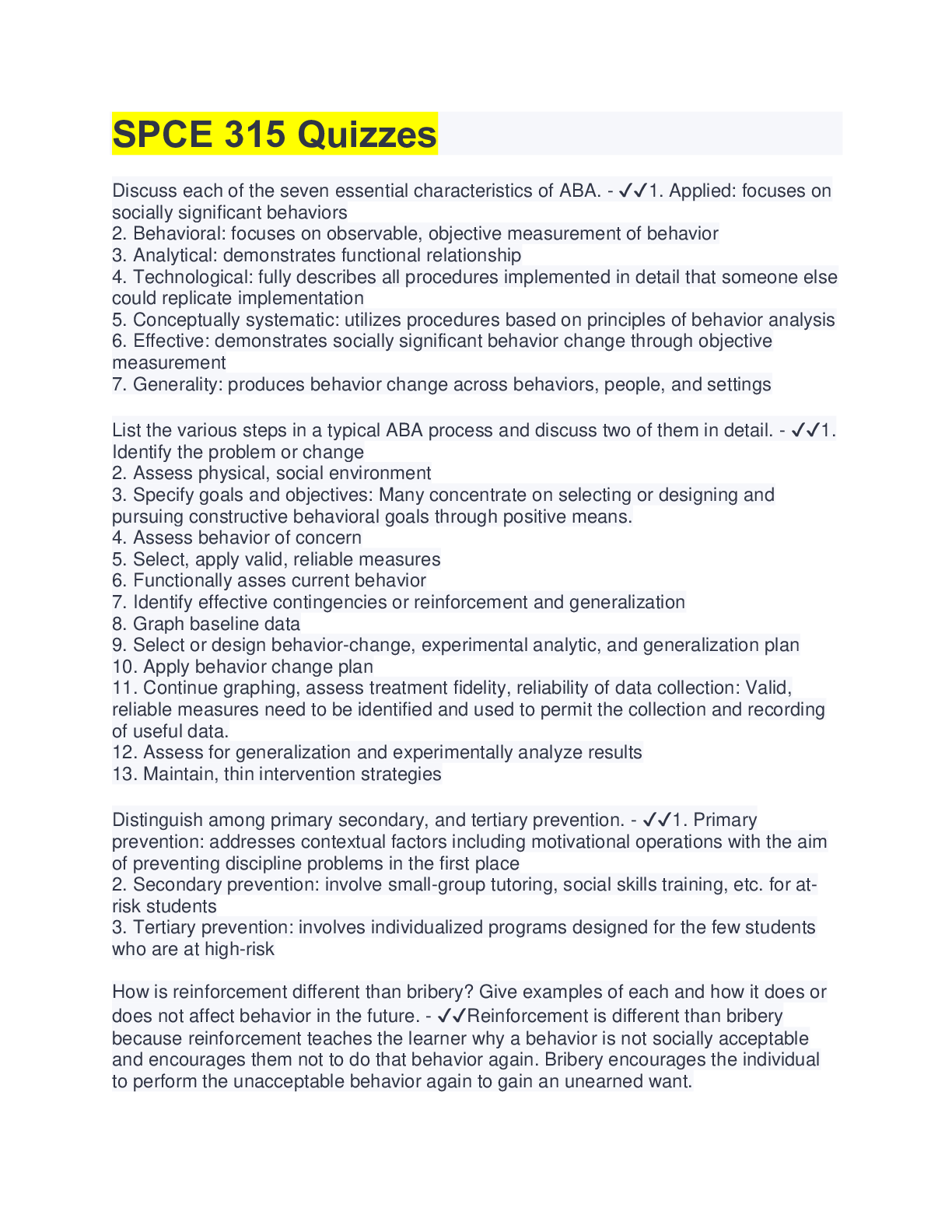
Discuss each of the seven essential characteristics of ABA. - ✔✔1. Applied: focuses on
socially significant behaviors
2. Behavioral: focuses on observable, objective measurement of behavior
3. Analytical: demonstrates functional relationship
4. Technological: fully describes all procedures implemented in detail that someone else
could replicate implementation
5. Conceptually systematic: utilizes procedures based on principles of behavior analysis
6. Effective: demonstrates socially significant behavior change through objective
measurement
7. Generality: produces behavior change across behaviors, people, and settings
List the various steps in a typical ABA process and discuss two of them in detail. - ✔✔1.
Identify the problem or change
2. Assess physical, social environment
3. Specify goals and objectives: Many concentrate on selecting or designing and
pursuing constructive behavioral goals through positive means.
4. Assess behavior of concern
5. Select, apply valid, reliable measures
6. Functionally asses current behavior
7. Identify effective contingencies or reinforcement and generalization
8. Graph baseline data
9. Select or design behavior-change, experimental analytic, and generalization plan
10. Apply behavior change plan
11. Continue graphing, assess treatment fidelity, reliability of data collection: Valid,
reliable measures need to be identified and used to permit the collection and recording
of useful data.
12. Assess for generalization and experimentally analyze results
13. Maintain, thin intervention strategies
Distinguish among primary secondary, and tertiary prevention. - ✔✔1. Primary
prevention: addresses contextual factors including motivational operations with the aim
of preventing discipline problems in the first place
2. Secondary prevention: involve small-group tutoring, social skills training, etc. for atrisk students
3. Tertiary prevention: involves individualized programs designed for the few students
who are at high-risk
[Show More]