An effective manager must consider a balance between
A. organizational demands, job skills, and personality
B. individual competencies, job demands, and stresses of the job
C. individual competencies, job stress, and
...
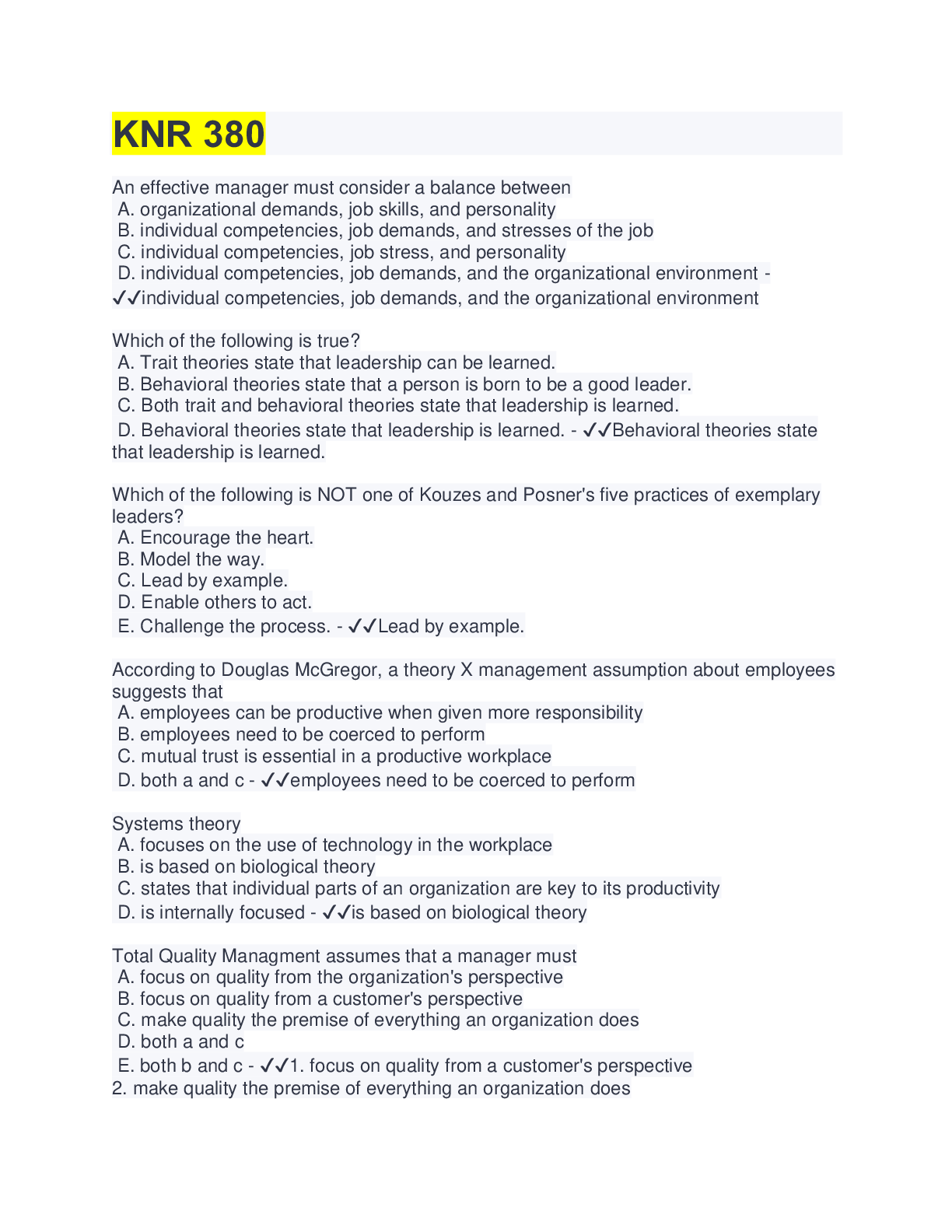
An effective manager must consider a balance between
A. organizational demands, job skills, and personality
B. individual competencies, job demands, and stresses of the job
C. individual competencies, job stress, and personality
D. individual competencies, job demands, and the organizational environment -
✔✔individual competencies, job demands, and the organizational environment
Which of the following is true?
A. Trait theories state that leadership can be learned.
B. Behavioral theories state that a person is born to be a good leader.
C. Both trait and behavioral theories state that leadership is learned.
D. Behavioral theories state that leadership is learned. - ✔✔Behavioral theories state
that leadership is learned.
Which of the following is NOT one of Kouzes and Posner's five practices of exemplary
leaders?
A. Encourage the heart.
B. Model the way.
C. Lead by example.
D. Enable others to act.
E. Challenge the process. - ✔✔Lead by example.
According to Douglas McGregor, a theory X management assumption about employees
suggests that
A. employees can be productive when given more responsibility
B. employees need to be coerced to perform
C. mutual trust is essential in a productive workplace
D. both a and c - ✔✔employees need to be coerced to perform
Systems theory
A. focuses on the use of technology in the workplace
B. is based on biological theory
C. states that individual parts of an organization are key to its productivity
D. is internally focused - ✔✔is based on biological theory
Total Quality Managment assumes that a manager must
A. focus on quality from the organization's perspective
B. focus on quality from a customer's perspective
C. make quality the premise of everything an organization does
D. both a and c
E. both b and c
[Show More]