Gradescope | View Submission
https://www.gradescope.com/courses/19415/assignments/84503/submissions/10409235 1/11
Q1 Combining Factors
16 Points
Given the factors and what is the resulting
factor after joining over
...
Gradescope | View Submission
https://www.gradescope.com/courses/19415/assignments/84503/submissions/10409235 1/11
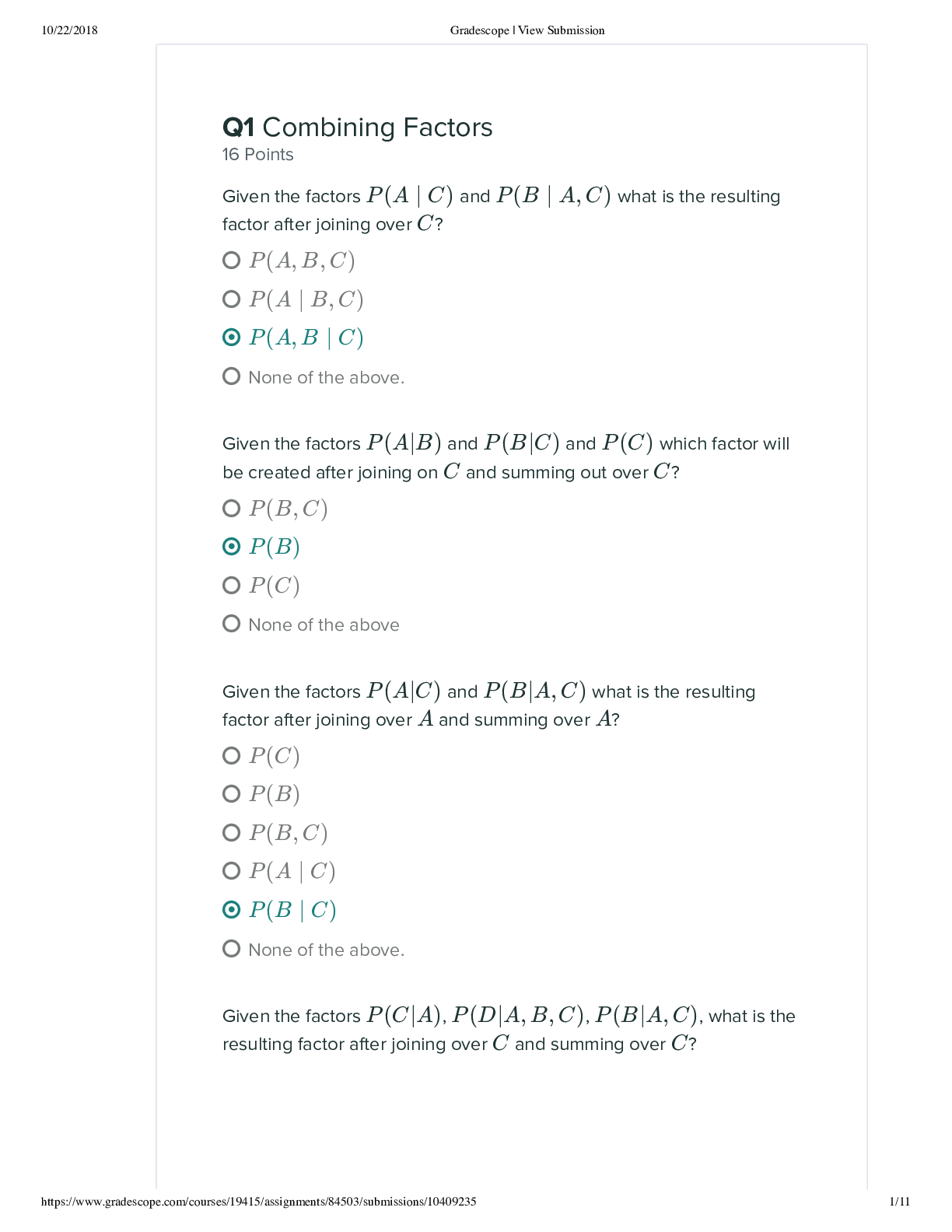
Q1 Combining Factors
16 Points
Given the factors and what is the resulting
factor after joining over ?
Given the factors and and which factor will
be created after joining on and summing out over ?
Given the factors and what is the resulting
factor after joining over and summing over ?
Given the factors , , , what is the
resulting factor after joining over and summing over ?
P(A ∣ C) P(B ∣ A, C)
C
P(A, B, C)
P(A ∣ B, C)
P(A, B ∣ C)
None of the above.
P(A∣B) P(B∣C) P(C)
C C
P(B, C)
P(B)
P(C)
None of the above
P(A∣C) P(B∣A, C)
A A
P(C)
P(B)
P(B, C)
P(A ∣ C)
P(B ∣ C)
None of the above.
P(C∣A) P(D∣A, B, C) P(B∣A, C)
C C10/22/2018 Gradescope | View Submission
https://www.gradescope.com/courses/19415/assignments/84503/submissions/10409235 2/11
Q2 Variable Elimination Tables
20 Points
Assume the following Bayes Net and corresponding CPTs. In this
exercise, we are given the query , and we will complete
the tables for each factor generated during the elimination process.
After introducing evidence, we have the following probability tables.
P(D ∣ A)
P(C, D ∣ A)
P(B, C, D ∣ A)
P(B, D ∣ A)
P(C, B ∣ A, D) ∗ P(A ∣ D)
None of the above.
P(C ∣ e = 1)10/22/2018 Gradescope | View Submission
https://www.gradescope.com/courses/19415/assignments/84503/submissions/10409235 3/11
Q2.1
15 Points
Three steps are required for elimination, with the resulting factors
listed below:
Step 1: eliminate . We get the factor
Step 2: eliminate . We get the factor
Step 3: eliminate . We get the factor
.
Fill in the missing quantities. (some of the quantities are computed for
you)
.41
.59
.2577
.5193
A f1(B) = ∑a P(a)P(B∣a)
B
f2(C, D) = ∑b P(C∣b)P(D∣b)f1(b)
D
f3(C, e = 1) = ∑d P(e = 1∣C, d)f2(C, d)
f1(B = 0) =
f1(B = 1) =
f2(C = 0, D = 0) =
f2(C = 1, D = 0) =
f2(C = 0, D = 1) = 0.083
f2(C = 1, D = 1) = 0.1410/22/2018 Gradescope | View Submission
https://www.gradescope.com/courses/19415/assignments/84503/submissions/10409235 4/11
.20442
Q2.2
5 Points
After getting the final factor , a final renormalization step
needs to be carried out to obtain the conditional probability
. Fill in the final conditional probabilities below.
.608
.392
Q3 Rejection Sampling
16 Points
We will work with a Bayes' net of the following structure.
f3(C = 0, e = 1) =
f3(C = 1, e = 1) = 0.132
f3(C, e = 1)
P (C∣e = 1)
P (C = 0 ∣ e = 1) =
P (C = 1 ∣ e = 1) =10/22/2018 Gradescope | View Submission
https://www.gradescope.com/courses/19415/assignments/84503/submissions/10409235 5/11
In this question, we will perform rejection sampling to estimate
. Perform one round of rejection
sampling, using the random samples given in the table below.
Variables are sampled in the order , , , , . In the boxes below,
choose the value (0 or 1) that each variable gets assigned to. Note that
the sampling attempt should stop as soon as you discover that the
sample will be rejected. In that case mark the assignment of that
variable and write none for the rest of the variables.
When generating random samples, use as many values as needed
from the table below, which we generated independently and
uniformly at random from . Use numbers from left to right. To
sample a binary variable with probability and
using a value from the table, choose
if and if .
P(C = 1 ∣ B = 1, E = 1)
A B C D E
[0, 1)
W P(W = 0) = p
P(W = 1) = 1 − p a W = 0
a < p W = 1 a ≥ p10/22/2018 Gradescope | View Submission
https://www.gradescope.com/courses/19415/assignments/84503/submissions/10409235 6/11
Enter either a 0 or 1 for each variable that you assign a value to. Upon
rejecting a sample, enter its assigned value, and enter none for the
remaining variables. For example, if C gets rejected, fill in none for D
and E.
A:
1
B:
0
C:
none
D:
none
E:
none
Which variable will get rejected?
A
B
C
D
E
None of the variables will get rejected10/22/2018 Gradescope | View Submission
https://www.gradescope.com/courses/19415/assignments/84503/submissions/10409235 7/11
Q4 Estimating Probabilities from Samples
16 Points
Below are a set of samples obtained by running rejection sampling for
the Bayes' net from the previous question. Use them to estimate
. The estimation cannot be made
whenever all samples were rejected. In this case, input -1 into the box
below.
Estimation:
.5
Q5 Likelihood Weighting
16 Points
We will work with a Bayes' net of the following structure.
P(C = 1 ∣ B = 1, E = 1)10/22/2018 Gradescope | View Submission
https://www.gradescope.com/courses/19415/assignments/84503/submissions/10409235 8/11
In this question, we will perform likelihood weighting to estimate
. Generate a sample and its weight, using
the random samples given in the table below. Variables are sampled in
the order A, B, C, D, E. In the table below, select the assignments to
the variables you sampled.
When generating random samples, use as many values as needed
from the table below, which we generated independently and
uniformly at random from . Use numbers from left to right. To
sample a binary variable with probability and
using a value from the table, choose
if and if .
Input Answers Here
A:
P(C = 1 ∣ B = 1, E = 1)
[0, 1)
W P(W = 0) = p
P(W = 1) = 1 − p a W = 0
a < p W = 1 a ≥ p10/22/2018 Gradescope | View Submission
https://www.gradescope.com/courses/19415/assignments/84503/submissions/10409235 9/11
1
B:
1
C:
0
D:
0
E:
1
What is the weight for the sample you obtained above?
.64
Q6 Estimating Probabilities from Weighted
Samples
16 Points
Below are a set of weighted samples obtained by running likelihood
weighting for the Bayes' net from the previous question. Use them to
estimate . Input -1 in the box below if the
estimation cannot be made.
P(C = 1 ∣ B = 1, E = 1)10/22/2018 Gradescope | View Submission
https://www.gradescope.com/courses/19415/assignments/84503/submissions/10409235 10/11
Estimation:
.7857
GRADED
16 / 16 pts
HW 7 (Electronic Component)
STUDENT
TOTAL POINTS
100 / 100 pts
QUESTION 1
Combining Factors
QUESTION 2
Variable Elimination Tables 20 pts
2.1 (no title) 15 / 15 pts
2.2 (no title) 5 / 5 pts
QUESTION 3
Rejection Sampling 16 / 16 pts
10/22/2018 Gradescope | View Submission
https://www.gradescope.com/courses/19415/assignments/84503/submissions/10409235 11/11
QUESTION 4
Estimating Probabilities from Samples 16 / 16 pts
QUESTION 5
Likelihood Weighting 16 / 16 pts
QUESTION 6
Estimating Probabilities from Weighted Samples 16 / 16 pts
[Show More]






.png)