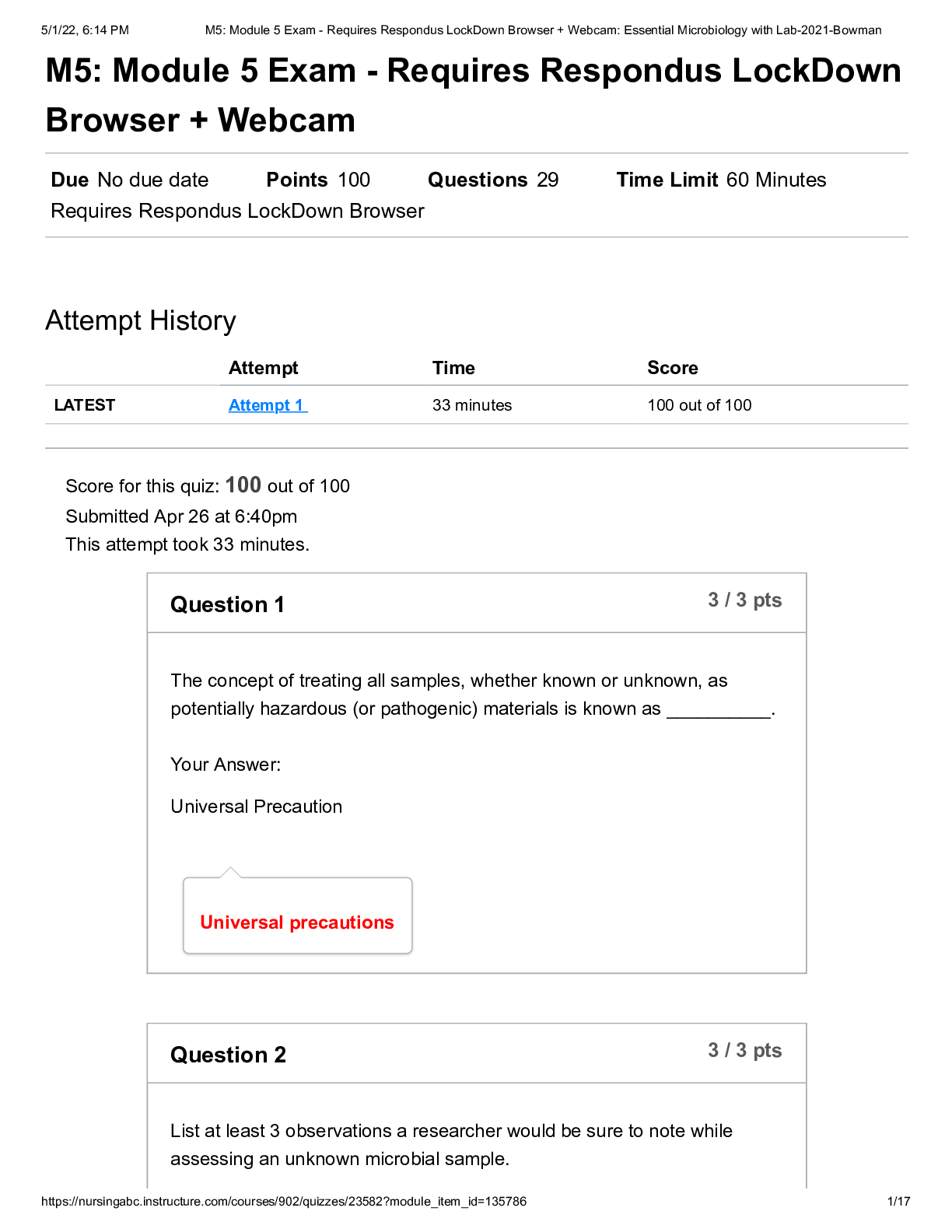
M5: Module 5 Exam - Requires Respondus LockDown Browser + Webcam
Due No due date Points 100 Questions 29 Time Limit 60 Minutes Requires Respondus LockDown Browser
Attempt History
Attempt Time Score
LATEST Atte
...
M5: Module 5 Exam - Requires Respondus LockDown Browser + Webcam
Due No due date Points 100 Questions 29 Time Limit 60 Minutes Requires Respondus LockDown Browser
Attempt History
Attempt Time Score
LATEST Attempt 1 33 minutes 100 out of 100
Score for this quiz: 100 out of 100 Submitted Apr 26 at 6:40pm
This attempt took 33 minutes.
Your Answer:
Three observations are;
The Gram status; either positive or negative The shape, size and observe any motility The presence of any chemical reactions
A lab researcher would be certain to note:
1. Size and shape
2. Any observable motility
3. Gram status (positive or negative)
4. The presence of any chemical reactions
5. Changes in color localized to the organism or the surrounding media
6. Capture (or draw) images of any of the characteristics described above
While observing an unknown sample of limited amounts, a researcher must determine the following observations: (1) the presence of any motility and (2) its Gram status using the same sample—the liquid sample cannot be divided. Which would you determine first and why?
Your Answer:
I would first determine the presence of any motility before its Gram status; because checking for presence of motility requires that you use a wet mount. Gram status requires that you heat fix the sample and by doing that the sample can be killed; also you cannot determine the presence of any motility in Gram status that has been heat fixed. Since the liquid sample cannot be divided, its most adviseable to check for the presence of any motility first then you ca heat fix the liquid for for Gram status.
While visiting his grandparents, a 10-year-old child has green beans for dinner that were harvested from his grandparents’ garden and canned the previous year. Severe illness sets in and the child is taken to the hospital. Botulism is suspected, but what form?
Explain why you chose this answer.
Your Answer:
Foodborne Botulisim. This is because clostridium toxin can be found in foods that are not canned properly, with low acidic, and anaerobic conditions the bacterium would grow. The child is older than 6months old hence it can not be infant botulisim suspected and also, there is no mention of deep wounds or injury.
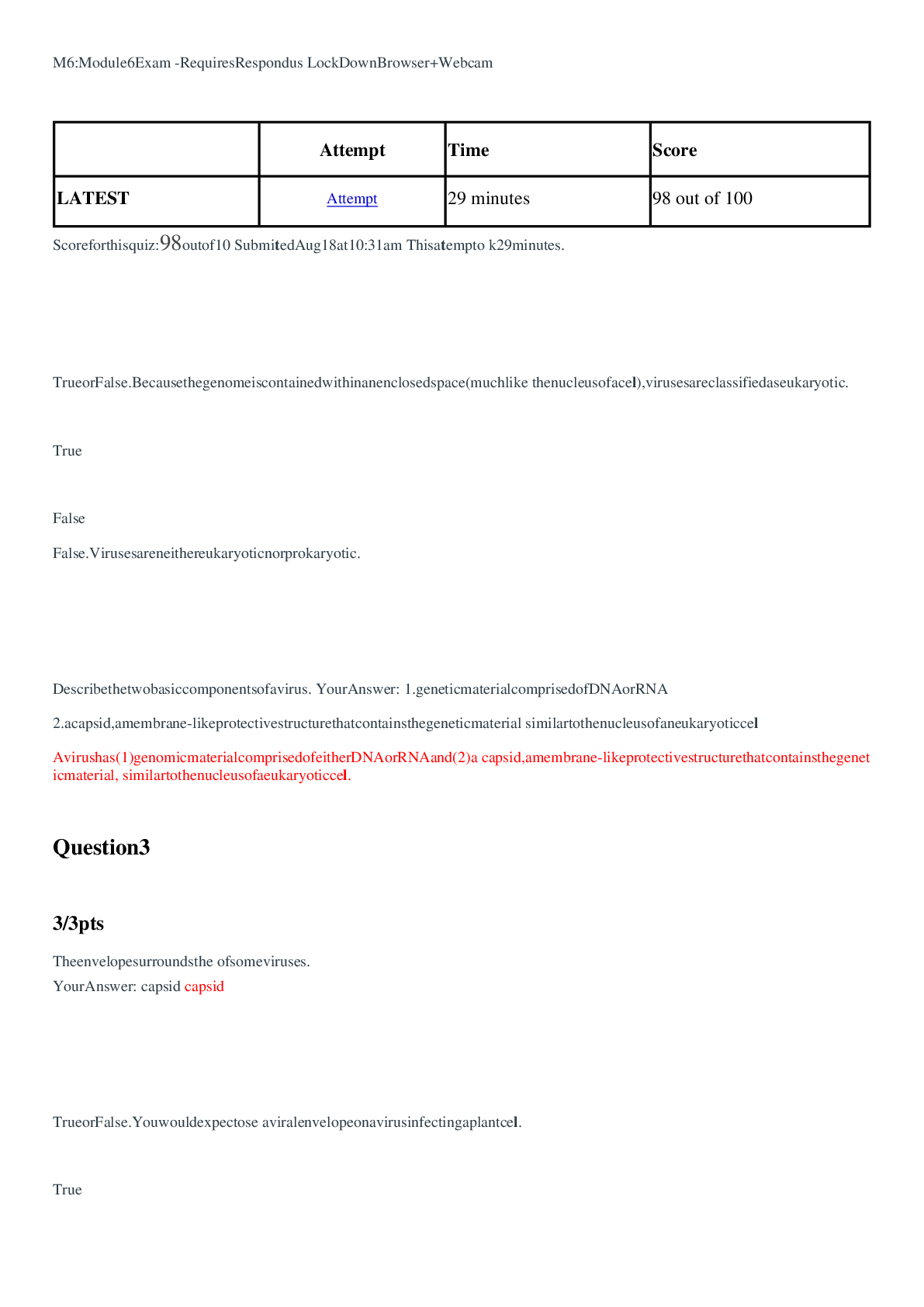
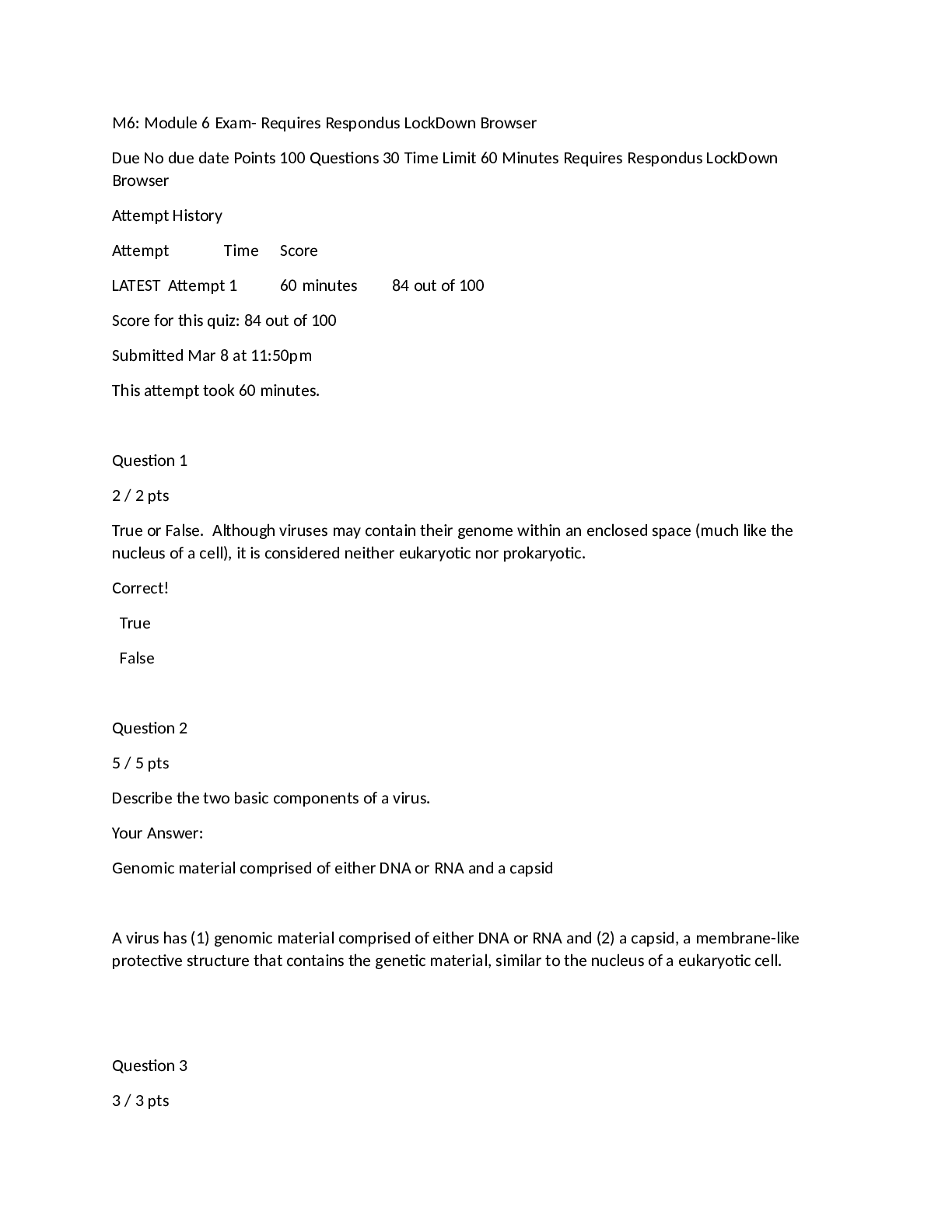
Foodborne botulism. The child is too old (> 6 months) to be considered for infant botulism and wounds were not present. The green beans were likely improperly canned and under the low-acidic, anaerobic conditions, bacterial growth was encouraged.
Question 21
10 / 10 pts
Describe the symptoms and treatment regimen for someone infected with
Clostridium perfringens.
Your Answer:
Clostridium perfringes Symptoms are Muscle necrosis, swelling in the area affected, fever and intense gas production. Treatment would be to remove tissue area affected; amputation of the site affected with strong antibiotic therapy.
Clostridium perfringens (also known as Gas gangrene) presents with muscle necrosis, swelling of infected areas, fever and intense gas production. Treatment entails removal of all infected tissue, often resulting in amputation of the affected areas, in conjunction with heavy antibiotic therapies.
Question 23
3 / 3 pts
You develop a fever, chills, and pneumonia after recently using a warm midst vaporizer in an attempt to open your sinuses. What bacterial disease would a doctor suspect is causing your symptoms? Would the doctor suspect you contracted it from touching (potentially) contaminated doorknobs?
Your Answer:
Legionnaires. No. The doctor would not suspect I contracted it from touching contaminated doorknobs because the bacterial diseases from Legionelle, cannot be transmitted from person to person but through inhalation of droplets small enough to be breathe
Legionnaires. No—legionella cannot be spread simply by direct contact between people. Legionella can only be transmitted through droplets small enough to be breathed in.
Question 29
3 / 3 pts
Match the following diseases with their respective symptoms if left untreated:
1. Gonorrhea A. Paralysis, blindness and dementia
2. Syphilis B. Painfully swollen lymph nodes
3. Chlamydia C. Cardiac and neurological complications
D. Respiratory failure associated with lock-jaw
E. Infertility and pelvic inflammatory disease.
F. Sore throat, ocular discharge and fever
Correct! 1
Correct! 2
Correct! 3
Other Incorrect Match Options: B
D F
Quiz Score: 100 out of 100
[Show More]