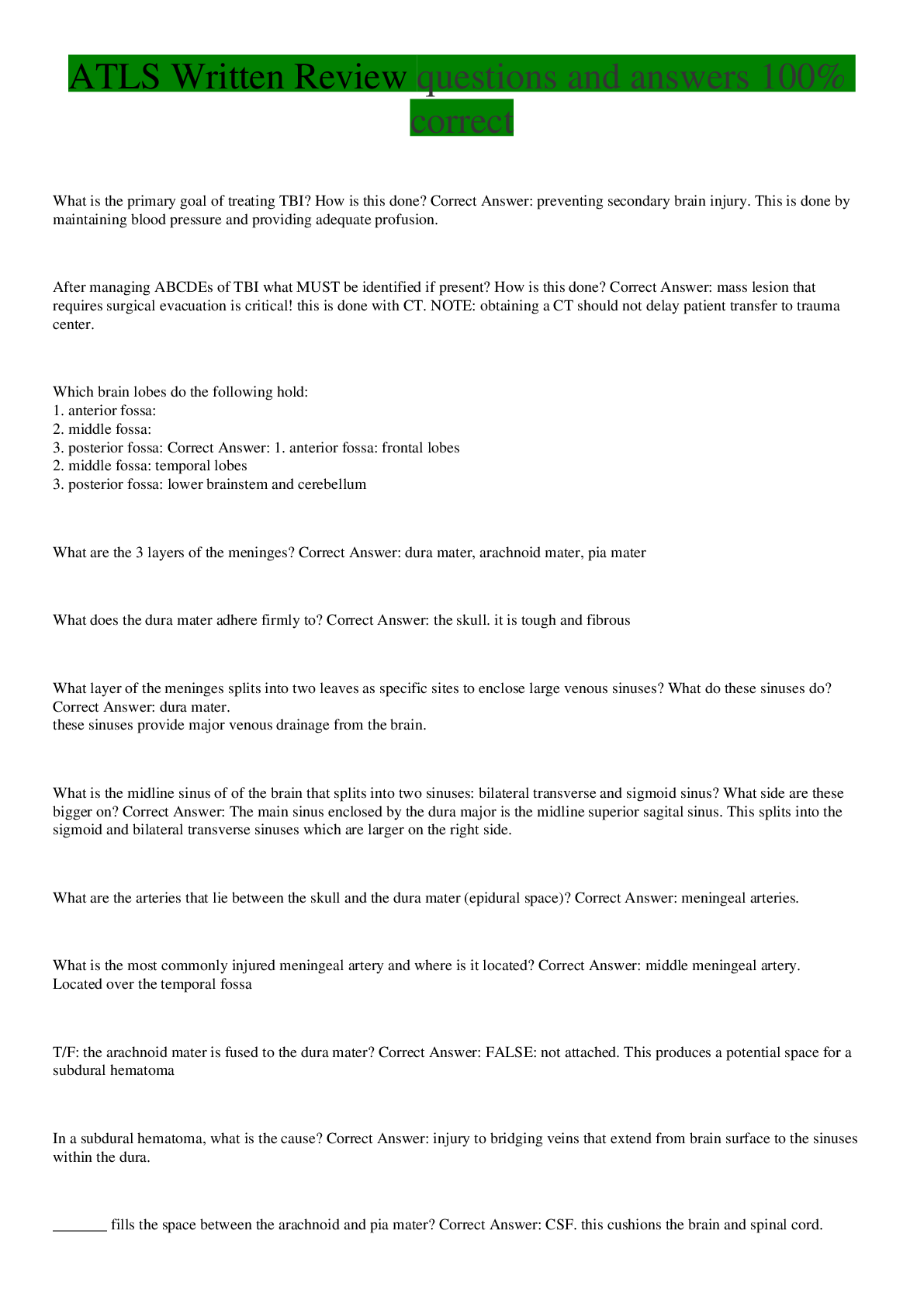
ATLS practice questions and answers| Graded A+
Assessed first in trauma patient Correct Answer: Airway
(*)Degree of burn that is characterized by bone involvement Correct Answer: Fourth
Complications of head t
...
ATLS practice questions and answers| Graded A+
Assessed first in trauma patient Correct Answer: Airway
(*)Degree of burn that is characterized by bone involvement Correct Answer: Fourth
Complications of head trauma Correct Answer: Intracerebral hematoma
Extradural hematoma
Brain abscess
Most common cause of laryngotracheal stenosis Correct Answer: Trauma
Intervention that can help prevent development of acute renal failure Correct Answer: Infusion of normal saline
A 26-year-old male is resuscitated with blood transfusion after a motor vehicle collision that was complicated by a fractured pelvis. A few hours later, the patient becomes febrile, hypotensive with a normal CVP, and oliguric. Upon examination, the patient is found to be bleeding from the NG tube and IV sites. Which of the following is the most likely diagnosis?
A. Hemorrhagic shock
B. Acute adrenal insufficiency
C. Fat embolism syndrome
D. Transfusion reaction Correct Answer: D. Transfusion reaction
Skin antiseptic Correct Answer: -Ethanol 70% is an effective skin antiseptic
-Acetic acid can be used to treat Gram- skin infections
-Salicylic acid is used to treat certain skin yeast infections
Class IV hemorrhage indicates what % blood loss Correct Answer: 55%
How does shivering affect body temperature Correct Answer: Increases body temperature
Class III hemorrhage indicates what % of blood loss Correct Answer: 35%
Management of a stable patient with kidney contusion Correct Answer: Observation
Associated with hypovolemic shock Correct Answer: -Inadequate tissue perfusion with resultant tissue hypoxia
-Blood shunting to vital organs
-Decreased circulating blood volume and decreased venous return
-Low cardiac output
-Loss of less than 20% of the blood volume is usually without symptom except for mild tachycardia
-Patients become orthostatic with losses between 20 and 40%
-Shock is evidenced by tachycardia, hypotension, oliguria, flat neck veins
The most effective method of monitoring the success of resuscitation during CPR? Correct Answer: Reactivity of pupils to light
Used to ensure correct placement of endotracheal tube Correct Answer: -Ultrasound
-Bilateral breath sounds
-Sustained end-tidal CO2
Total body surface area involved in a burn in an adult to the anterior chest and abdomen Correct Answer: 18%
What is often caused by carotid massage? Correct Answer: Bradycardia
Step in a patient diagnosed with tension pneumothorax Correct Answer: 1. Needle decompression/ thoracotomy
2. Chest tube
True statements regarding diaphragmatic injuries Correct Answer: -Blunt diaphragmatic injuries are usually associated with skeletal trauma
-Penetrating diaphragmatic injuries may be missed
-Repair of traumatic diaphragmatic injuries usually does not require prosthetic material
First priority in the treatment of an unconscious patient Correct Answer: Checking the pulse
A patient involved in a road accident is brought to the emergency department in an unconscious state. On arrival, her vitals show a temperature of 96.4 degrees Fahrenheit, a respiration rate of 24 breaths per minute, a heart rate of 140 beats per minute, and a blood pressure of 80/40 mm Hg. She is cold, shivering, and perspiring profusely. She has bilateral reactive pupils but she does not respond to pain. On physical examination, she has no obvious sign of external bleeding. Which of the following cannot be the cause of hypotension in this patient?
A. Pelvic fracture
B. Fracture of femur
C. Intracranial hemorrhage
D. Hemothorax Correct Answer: C. Intracranial hemorrhage
A patient suffered a slash to his right neck. The wound is over the mid-portion of the sternocleidomastoid. There is a large hematoma and brisk bleeding when uncovered. He is stable. What is the next step in management?
A. Get an angiogram
B. Close the wound in the ER
C. Take him to the operating room
D. CT scan to evaluate neck structure Correct Answer: C. Take him to the OR
After abdominal injury, which of the following urinalysis findings would be an indication for further testing?
A. 0-5 casts/HPF
B. 5-10 WBC/HPF
C. 10-20 RBC/HPF
D. Gross hematuria Correct Answer: D. Gross hematuria
A laceration of the neck superficial to the deep cervical fascia along the sternocleidomastoid muscle at its midpoint would cause bleeding from which structure? Correct Answer: External jugular vein
Clinical features associated with tension pneumothorax Correct Answer: Unilateral decrease in breath sounds
Hyperresonance
Respiratory distress
Tachycardia
Tracheal shift
Desatruation
Decreased breath sounds
Decreased compliance
Asymmetric chest movement
NOT hypertension, audible bronchial sounds
Not recommended as a mode of ventilation for a patient with a diaphragmatic hernia
A. Bag and mask
B. LMA
C. Endotracheal intubation
D. Jet ventilation Correct Answer: A. Bag and mask
What is the next step in the assessment of a traumatic patient after airway is established? Correct Answer: Breathing
Blood group that is considered a universal donor Correct Answer: O
A provider is examining a patient who sustained a severe traumatic head injury. He documents no Doll's eyes. What does this signify? Correct Answer: Brainstem injury
Which of the following is the least preferred method of administering IV fluids?
A. Cubital veins
B. Cephalic veins
C. Subclavian veins
D. Saphenous vein Correct Answer: Subclavian veins
Dermatome level for nipple sensation
Dermatome level for umbilicus Correct Answer: T4
T10
At which temperature would a hypothermic patient stop shivering? Correct Answer: 88 degrees F
What is the energy recommendation for the first defibrillation in an adult (*) Correct Answer: 300 J
Pharmacologic effects of Morphine Correct Answer: Behavioral changes
Analgesia
Respiratory depression
NOT diarrhea
A patient with which condition should be triaged to receive medical attention first?
A. Choking
B. Dizziness
C. Leg cramp
D. Vomiting Correct Answer: A. Choking
For pediatric patients, what volume of fluid resuscitation should be given initially in the setting of shock?
A. 750 mL of saline uniformly
B. 1 liter of saline
C. 20 mL/kg of 0.45% NaCl with 5% glucose
D. 10 to 20 mL/kg of Ringers lactate Correct Answer: D. 10 to 20 mL/kg of Ringers lactate
A patient is found unconscious after a fire in his bedroom. He is found to have severe burns around his face. What is the first aspect of treatment?
A. Tetanus toxoid
B. Cover the wound
C. Airway
D. Obtain blood work Correct Answer: C. Airway
Basilar skull fracture Correct Answer: PE: raccoon eyes, battle sign, CSF ottorrhea (rhinorrhea), loculated pneumoencephalocele
Bone MC involved = Temporal
A patient with von Willebrand disease is bleeding after sustaining a knife wound. Which of the following is most appropriate for the treatment of this patient?
A. Vitamin K
B. Cryoprecipitate
C. Protamine
D. DDAVP Correct Answer: D. DDAVP
What is the total body surface area involved in a burn to both lower extremities? Correct Answer: 36%
Which injury is most common in rear end motor vehicle accidents?
A. Cervical fractures
B. Hypextension-hyperflexion neck injuries
C. Forearm fractures
D. Rotational neck injuries Correct Answer: B. Hypextension-hyperflexion neck injuries
What is true about an unrestrained pregnant driver?
A. She is at increased risk of placenta previa
B. She is at increased risk of placental abruption
C. At 33 weeks, her fetus is well protected by an amniotic fluid cushion and thus the pregnancy is not at risk
D. If the mother's vital signs are stable, complications are unlikely Correct Answer: B. She is at increased risk of placental abruption
In adults, an aspirated foreign body is most likely to get stuck in the:
A. Left main bronchus
B. Carina
C. Right main bronchus
D. Esophagus Correct Answer: C. Right main bronchus
Skin finding characteristic of second-degree burns Correct Answer: Blisters
Which is true regarding cervical spine fractures?
A. Seen most commonly in elderly females
B. Athletic activities are the most common cause
C. Falls are the most common cause
D. Methylprednisolone should not be used in associated spinal cord injury in the first 48 hours Correct Answer: D. Methylprednisolone should not be used in associated spinal cord injury in the first 48 hours
In which patients can an oropharyngeal airway be used? Correct Answer: Non-gag reflex
If a trauma patient has clear fluid draining from the nose the provider should do which of the following?
A. Tilt the head back
B. Apply pressure
C. Collect the fluid
D. Insert nasal tampons Correct Answer: C. Collect the fluid
What is the estimated time a person's brain can be anoxic from cardiopulmonary failure and not develop permanent brain damage?
A. 10 minutes
B. 5 minutes
C. 2 minutes
D. 20 minutes Correct Answer: B. 5 minutes
The laryngeal mask airway is contraindicated in patients with what condition?
A. Spine injury
B. Head trauma
C. Giving birth
D. Propensity to aspirate Correct Answer: D. Propensity to aspirate
A patient sustains blunt trauma to the back and left leg. Vital signs in the emergency department show temperature 36 degrees C, BP 120/80 mm Hg, heart rate 92, respirations 19, GCS 15. There is bilateral lower extremity paraplegia, T12 sensory level, and decreased rectal tone. Hemoglobin is 14.2 and the same in one hour. Which of the following tests is best for diagnosing an intraperitoneal bleed?
A. Abdominal ultrasound
B. Laparotomy
C. KUB
D. Diagnostic peritoneal lavage Correct Answer: A. Abdominal ultrasound
Why is tracheostomy generally not performed at the first cartilage ring
A. The trachea is too narrow
B. A high chance of subglottic stenosis
C. A high chance of tracheo-innominate artery fistula
D. Inability to access the area Correct Answer: B. A high chance of subglottic stenosis
What does a carotid pulse indicate?
A. A functioning pump for blood flow
B. The circulating blood volume is reaching end organs
C. Diastolic blood pressure
D. None of the above Correct Answer: B. The circulating blood volume is reaching end organs
Which of the following generally causes hemorrhage associated with pelvic fractures?
A. Obturator artery injury
B. Superior gluteal artery
C. Lateral sacral artery injury
D. Venous bleeding Correct Answer: D. Venous bleeding
Hemothorax facts Correct Answer: -Must have at least 500 cc of blood to make a diagnosis on chest x-rayin an adult
-Incomplete evacuation of hemothorax can lead to empyema
-Initial treatment of hemothorax is always a chest tube
In a 66 year old intubated, comatose patient, what is one of the most important information that one needs to obtain?
A. Organ donation status
B. Power of attorney
C. Lawyer
D. Driver's license Correct Answer: B. Power of attorney
A patient is hit by a car and has severe injuries to his extremities. He is immediately brought to the emergency room by EMS. Evaluation reveals that he has multiple organ injuries. He has an open, gaping wound which measures 2 x 2 centimeters, just below the right knee. The leg appears dislocated and ecchymotic. However, pulses are present in the distal extremity. He does not complain of any paresthesias. X-ray reveals that there is a fracture of the tibia. The trauma team is called. As their arrival is awaited, which of the following should NOT be done to help manage this patient?
A. Obtain culture and close wound using a sterile technique
B. Don't reduce the dislocation
C. Give tetanus toxoid/booster shot
D. Give antibiotics Correct Answer: A. Obtain culture and close wound using a sterile technique
During resuscitation, your intubated patient's intravenous fluid infiltrates. You know that you may deliver the following drugs via the endotracheal tube: Correct Answer: Lidocaine
Atropine
Naloxone
Epinephrine
Prior to tracheobronchial suctioning, the patient should receive:
A. 5cc normal saline lavage
B. Be placed on NPO status
C. 100% oxygen prior to suctioning
D. Versed 1 mg/mL Correct Answer: C. 100% oxygen prior to suctioning
In a patient with a pneumothorax following a stab wound, the chest tube is best inserted at which level? Correct Answer: Between the 4th and 5th intercostal spaces, just anterior to the mid axillary line
Indications for a CT scan of the head in trauma patients Correct Answer: -Glasgow coma scale score of less than 14
-Evidence of basilar skull fracture
-Amnesia lasting more than 30 minutes
Most common Emergency Medical Services pediatric calls Correct Answer: -Seizures
-Respiratory problems
-Trauma
Treatments utilized in a patient with head trauma and raised intracranial pressure Correct Answer: -Elevation of the head
-Sedation
-Use of diuretics
NOT fluid restriction
How deep should the provider depress the patient's sternum during CPR in adults? Correct Answer: 2 to 3 inches
First parameter to change in patient's with hypovolemic shock?
A. Systolic blood pressure
B. Pulse rate
C. Respiratory rate
D. Skin vasoconstriction Correct Answer: B. Pulse rate
A 34-year-old with severe head trauma and elevated intracranial pressures is intubated. Which of the following should be the target for mechanical ventil
[Show More]