QUIZ 3-6003-KEY
QUESTION 1
Researchers applied a new rapid screening test to detect Hepatitis C in a group of injection drug
users. It is known that the prevalence of Hepatitis C in this group is 25%. The sensitivity
...
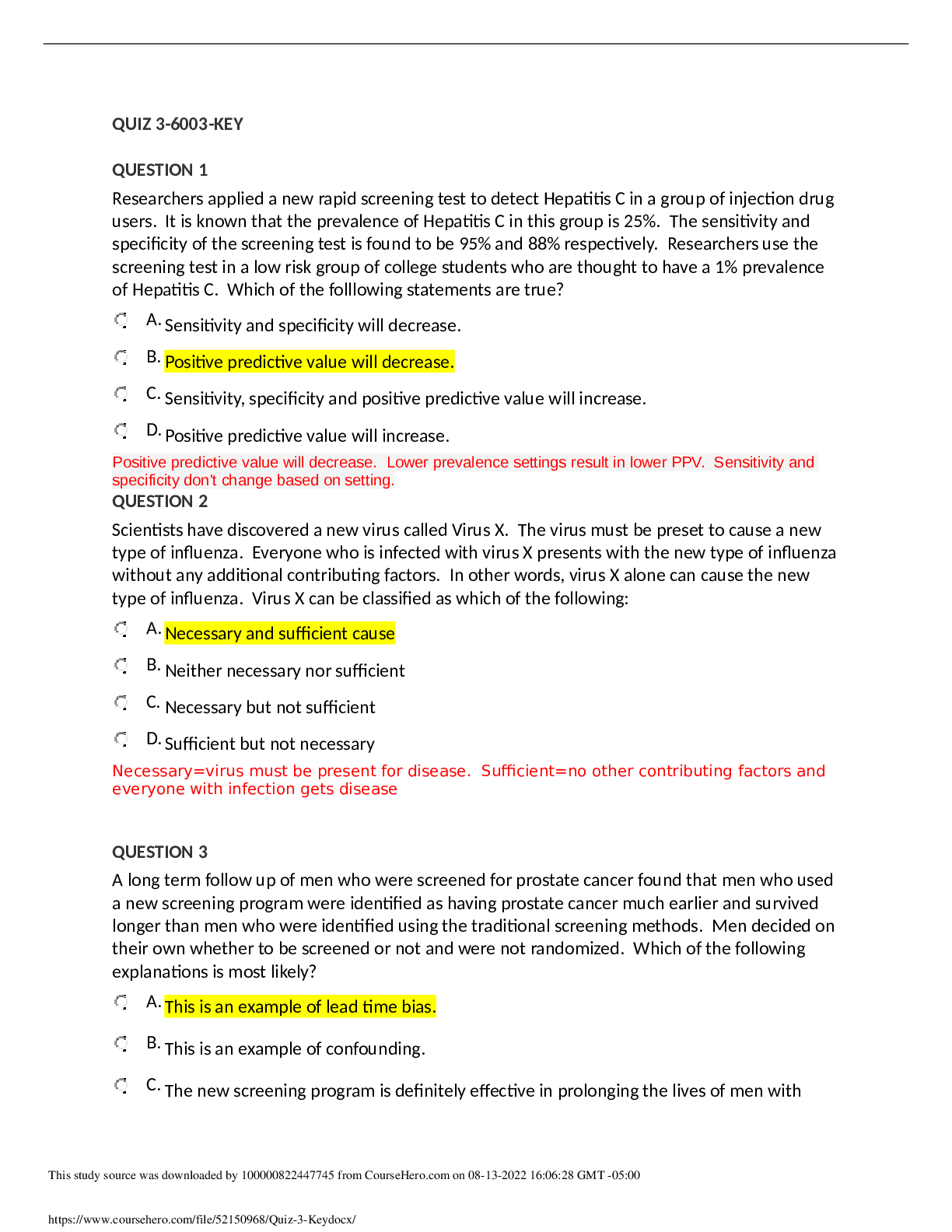
QUIZ 3-6003-KEY
QUESTION 1
Researchers applied a new rapid screening test to detect Hepatitis C in a group of injection drug
users. It is known that the prevalence of Hepatitis C in this group is 25%. The sensitivity and
specificity of the screening test is found to be 95% and 88% respectively. Researchers use the
screening test in a low risk group of college students who are thought to have a 1% prevalence
of Hepatitis C. Which of the folllowing statements are true?
A. Sensitivity and specificity will decrease.
B. Positive predictive value will decrease.
C. Sensitivity, specificity and positive predictive value will increase.
D. Positive predictive value will increase.
QUESTION 2
Scientists have discovered a new virus called Virus X. The virus must be preset to cause a new
type of influenza. Everyone who is infected with virus X presents with the new type of influenza
without any additional contributing factors. In other words, virus X alone can cause the new
type of influenza. Virus X can be classified as which of the following:
A. Necessary and sufficient cause
B. Neither necessary nor sufficient
C. Necessary but not sufficient
D. Sufficient but not necessary
QUESTION 3
A long term follow up of men who were screened for prostate cancer found that men who used
a new screening program were identified as having prostate cancer much earlier and survived
longer than men who were identified using the traditional screening methods. Men decided on
their own whether to be screened or not and were not randomized. Which of the following
explanations is most likely?
A. This is an example of lead time bias.
B. This is an example of confounding.
C. The new screening program is definitely effective in prolonging the lives of men with
prostate cancer.
D. This is an example of volunteer bias.
QUESTION 4
An article was recently published on the relationship between caffeine consumption during
pregnancy and low birth weight. The article was based on the results of a prospective cohort
study. As you know, caffeine is present in a wide variety of beverages, foods, and medications,
including coffee, tea, and colas. Select the Hill’s guideline for causality that best describes this
statement. Each term is used only once.
In the current study, there was a four-fold increased risk (RR=4.0) of giving birth to a low birth
weight infant among women who drank caffeine during pregnancy compared to women who
did not consume any caffeine during pregnancy.
A. Biologic plausibility
B. Effect modification
C. Dose response
D. Strength of association
QUESTION 5
VDRL is a screening test for syphilis. If we say "One fifth of those with syphilis will have a normal
(negative) VDRL test", the one fifth refers to the people who are?
A. True negatives
B. False negatives
C. False positives
D. True positives
FALSE NEGATIVES BECAUSE HAVE SYPHILIS BUT NEGATIVE TEST
QUESTION 6
Which of the following is not a characteristic of a confounding variable?
A. A confounder is associated with the outcome.
B. A confounder is associated with the exposure.
C. The measure of association varies by different levels of the confounding variable.
D. A confounder is not on the causal pathway between exposure and outcome.
DESCRIBES EFFECT MODIFICAITON
QUESTION 7
Which best describes how you would assess if interaction is present in a study?
A. Compare the strata specific measures of association to the adjusted measure of
association. If they are the same, then there is no interaction.
B. Compare the crude to the adjusted measure of association. If they are the same, then
there is no interaction.
C. Compare the strata specific measures of association to each other. If they are the same,
then there is no interaction.
D. Compare the strata specific measures of association to the crude measure of
association. If they are the same, then there is no interaction.
QUESTION 8
An article was recently published on the relationship between caffeine consumption during
pregnancy and low birth weight. The article was based on the results of a prospective cohort
study. As you know, caffeine is present in a wide variety of beverages, foods, and medications,
including coffee, tea, and colas. Select the Hill’s guideline for causality that best describes this
statement.
The risk of low birth weight increased as the caffeine consumption increased. Compared to
women who did not consume any caffeine during pregnancy, the relative risk of giving birth to
a low birth weight infant was 1.4 for women who had low caffeine consumption, 2.3 for
women who had moderate caffeine consumption, and 5.6 for women who had high caffeine
consumption.
A. Biologic plausibity
B. Effect size
C. Dose response
D. Replication of studies
QUESTION 9
A case control study examining the association between H. pylori infection and myocardial
infarction was conducted. The investigators were concerned about the potential for smoking to
be a confounder. The investigators found that the crude OR was 1.8 while the OR adjusted for
smoking was 1.9. We also know that smoking is not associated with H. pylori infection, but it is
associated with myocardial infarction. Assume smoking is not on the causal pathway between
H. pylori infection and myocardial infarction. Which statement best reflects whether smoking is
a confounder of the association between H. pylori infection and myocardial infarction?
A. Smoking is an effect modifier and confounding cannot be assessed.
B. Smoking is a confounder because the crude and adjusted odds ratios are similar to each
other, and smoking is associated the exposure or the outcome.
C. Smoking is not a confounder because the crude and adjusted odds ratios are similar to
each other, and smoking is not associated with both the exposure and the outcome.
D. Smoking is a confounder because it is associated with myocardial infaction.
QUESTION 10
A cohort study examining the association between alcohol consumption and heart disease
found that physical activity was an effect modifier of the association between alcohol and heart
disease. Those who had higher levels of physical activity had a RR=1.3 for the association
between alcohol and heart disease. Those who had lower levels of physical activity had a
RR=2.5 for the association between alcohol consumption and heart disease. The investigators
wanted to control for effect modification. Which of the following methods would work best?
A. Adjusting for physical activity status in the analysis
B. Randomizing study subjects to physical activity levels
C. You cannot control for effect modification because it is a real effect.
D. Matching by physical activity status
QUESTION 11
An article was recently published on the relationship between caffeine consumption during
pregnancy and low birth weight. The article was based on the results of a prospective cohort
study. As you know, caffeine is present in a wide variety of beverages, foods, and medications,
including coffee, tea, and colas. Select the Hill’s guideline for causality that best describes this
statement.
Four prior case-control studies and three cohort studies of caffeine intake during pregnancy
have shown an increased risk of low birth weight infants among women who consumed high
amounts of caffeine.
A. Strength of association
B. Confounding ruled out
C. Consistency (replication of findings)
D. Dose response
QUESTION 12
Use the information in the table to answer the following questions about the VDRL test in the
general population. Assume the total sample size tested is 100,000.
Syphilis No syphilis
VDRL + 4 9,996
VDRL- 1 89,999
The positive predictive value for the test is?
A. 40%
B. 2%
C. 4%
D. 0.04%
QUESTION 13
You are a clinician explaining the results of a test to a patient. The patient just received a
positive VDRL test result of syphilis. Assume that the positive predictive value of the VDRL
screening is low. What is the best information to provide the patient?
A. Many people have positive VDRL tests. This does not necessarily mean that you have
syphilis. The VDRL test is just a screening test. I would recommend diagnostic testing
and practicing safe sex until receiving the results of a confirmatory diagnostic test.
B. The test correctly identifies persons with syphilis most of the time. It is likely that you
have syphilis although you will need diagnostic testing.
C. It is certain that you have syphilis and although it may not be advanced, I would
recommend further assessment.
D. Without further test, we can't really tell you anything about the VDRL test results. You
probably should not have taken this screening test because it doesn't work well.
QUESTION 14
Use the information in the table to answer the following questions about the VDRL test in the
general population. Assume the total sample size tested is 100,000.
Syphilis No syphilis
VDRL + 4 9,996
VDRL- 1 89,999
What is the specificity of the test?
A. 80%
B. 99.96%
C. 10%
D. 90%
89,999 true negatives/99,995 disease negative=90%
QUESTION 15
An article was recently published on the relationship between caffeine consumption during
pregnancy and low birth weight. The article was based on the results of a prospective cohort
study. As you know, caffeine is present in a wide variety of beverages, foods, and medications,
including coffee, tea, and colas. Select the Hill’s guideline for causality that best describes this
statement.
Caffeine exposure during pregnancy could have a harmful effect because caffeine interferes with
cell division, metabolism, and growth.
A. Biological plausibility
B. Consistency (replication of findings)
C. Strength of association
D. Dose response
QUESTION 16
In a case control study, how could we address potential confounding by socioeconomic status in
the analysis stage of the study?
A. Adjust for socioeconomic status in a multivariable model
B. Randomize subjects to exposure groups
C. Match cases and controls based on socioeconomic status
D. Restrict the study to only one socioeconomic status group
QUESTION 17
Investigators conducted a case control study of the association between pesticide use and
breast cancer. What if, during data analysis, investigators found that use of vitamin
supplementation was associated with pesticide use and was an independent risk factor for
breast cancer? Should they attempt to control for this potential confounder?
A. No, investigators should not try to control for vitamin supplementation because it
is associated with the exposure and the outcome.
B. Yes, investigators should try to control for vitamin supplementation as it is on the
causal pathway between exposure and outcome.
C. No, investigators do not need to worry about vitamin supplementation because it
was not the main risk factor.
D. Yes, investigators should try to control for vitamin supplementation as it is
associated with both the exposure and the outcome.
QUESTION 18
In a given screening test, if we decided that the sensitivity of the test was too low and we
wanted to increase it, which of the following statements is true?
A. We can adjust the cutoffs for the test, but we should expect a decrease in specificity as
there is a tradeoff between sensitivity and specificity.
B. We could use the test in a higher prevalence population ton increase the sensitivity.
C. We could test more people to increase the sensitivity.
QUESTION 19
A cohort study of the risk of liver cirrhosis associated with alcohol consumption in females was
conducted. Incidence rates of cirrhosis among women who drank a lot of alcohol were
compared to the incidence rates of cirrhosis among women who did not drink any alcohol.
Women exposed and unexposed women were individually matched by year of birth. Is
sex/gender a confounder in this study?
A. We cannot determine if sex is a confounder.
B. Sex/gender is not a confounder because it is not associated with liver cirrhosis.
C. Sex/gender is a confounder because it is associated with alcohol consumption and liver
cirrhosis.
D. Sex/gender is not a confounder because the study is restricted to females.
QUESTION 20
A cohort study of the risk of liver cirrhosis associated with alcohol consumption in females was
conducted. Incidence rates of cirrhosis among women who drank a lot of alcohol were
compared to the incidence rates of cirrhosis among women who did not drink any alcohol.
Women exposed and unexposed women were individually matched by year of birth. Is age a
confounder in this study?
A. We cannot determine if age is a confounder.
B. Age is a confounder because it is associated with alcohol consumption and liver cirrhosis.
C. Age is not a confounder because it is not associated with liver cirrhosis.
D. Age is not a confounder because groups were matched on age so there is no difference
in the exposure groups with respect to age.
[Show More]