If a vial of influenza vaccine is left out of the refrigerator on the pharmacy counter
overnight, what should be done with the vaccine? - ✔✔LO 5.4; Module 5— Vaccine
Storage and Handling.
If a vaccine has been exposed
...
If a vial of influenza vaccine is left out of the refrigerator on the pharmacy counter
overnight, what should be done with the vaccine? - ✔✔LO 5.4; Module 5— Vaccine
Storage and Handling.
If a vaccine has been exposed to temperatures outside the recommended range, the
vaccine should be quarantined and stored in the refrigerator or freezer (as appropriate
based on where the vaccine should usually be stored). In the case, the IIV should be
placed back in the refrigerator. This quarantined vaccine should be clearly marked "do
not use" and the manufacturer should be contacted for further guidance. Pharmacists
should document each of these steps any time there is a break in the cold chain.
The presence of fever, diffuse maculopapular rash, and Koplik spots are characteristic
of which of the following diseases? - ✔✔Module 3—Measles, Mumps, Rubella. Measles
The classic symptoms of measles include fever, cough, coryza (runny nose),
conjunctivitis, Koplik spots (a bluish-white rash on mucous membranes, especially the
mouth), followed by the development of a maculopapular rash approximately 14 days
after exposure. Individuals infected with mumps may not have symptoms. Others may
have nonspecific symptoms, such as headache, fever, myalgia, and malaise. About
30% to 40% of individuals may experience inflammation of the parotid glands. Rubella
symptoms tend to be relatively mild and may present as a maculopapular rash that
occurs approximately 14 days after exposure. Others may experience arthritis and
arthralgia. Varicella presents as a generalized vesicular rash.
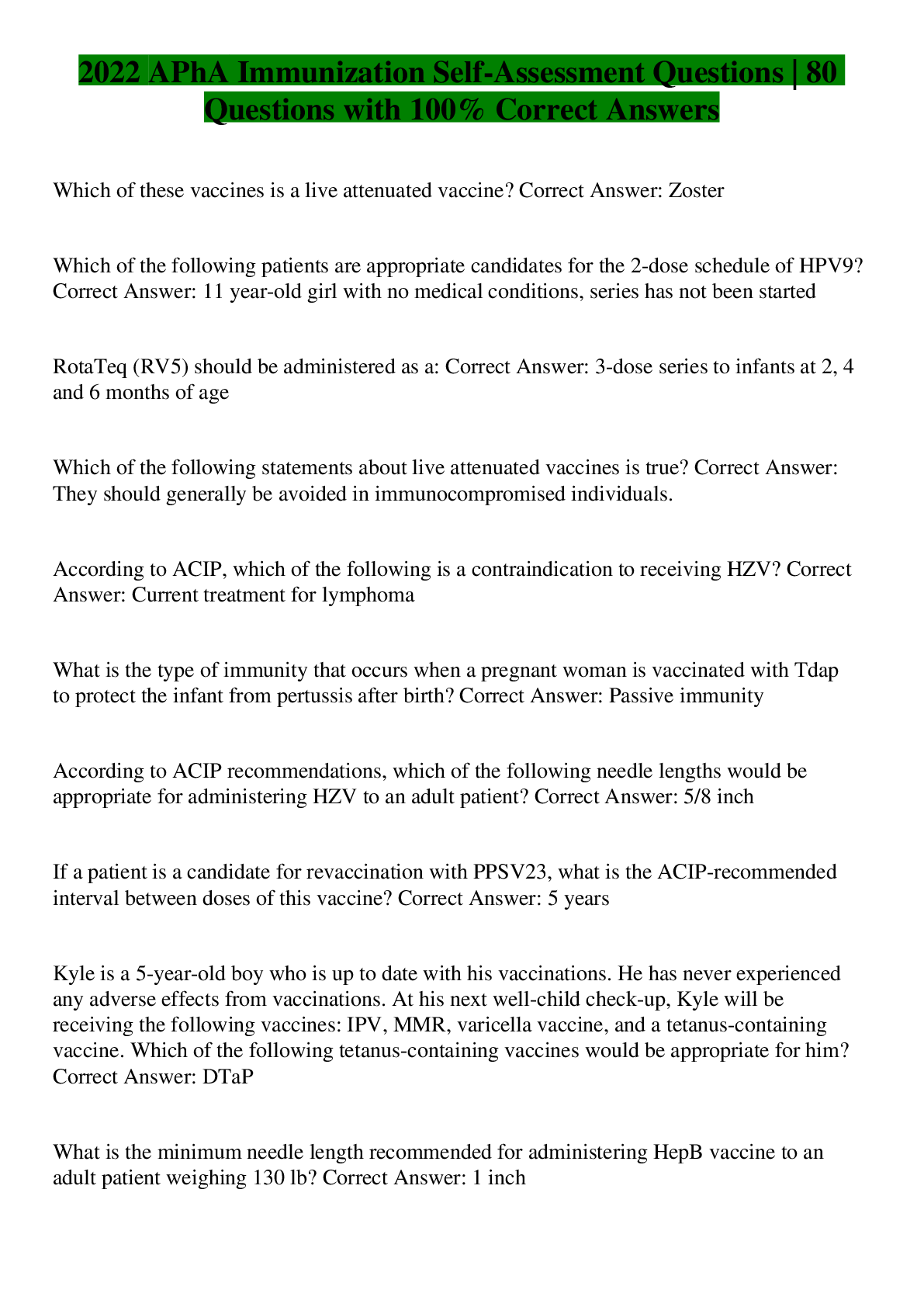
What is the type of immunity that occurs when a pregnant woman is vaccinated with
Tdap to protect the infant from pertussis after birth? - ✔✔LO2. 1; Module 2—Passive vs.
Active Immunity
Acquired immunity involves immunological memory. It is something the body develops
upon exposure to pathogens or antigens and results in antigen-antibody complex
formation. Cell-mediated immunity is a component of acquired immunity and destroys
pathogens that have entered cells. Acquired immunity can be active or passive. Active
immunity occurs when an antigen from an invading pathogen or a vaccine triggers the
immune system to respond. Passive immunity happens when antibodies are provided
from another source, such as or upon receipt of blood products or immunoglobulin when
maternal antibodies are transferred to the fetus. This is the reason Tdap is given with
every pregnancy—the maternal antibodies passed to the fetus protect the newborn from
pertussis.
Which of the following is recognized by sociologists as a factor in a patient's decision
whether to be vaccinated? -
[Show More]