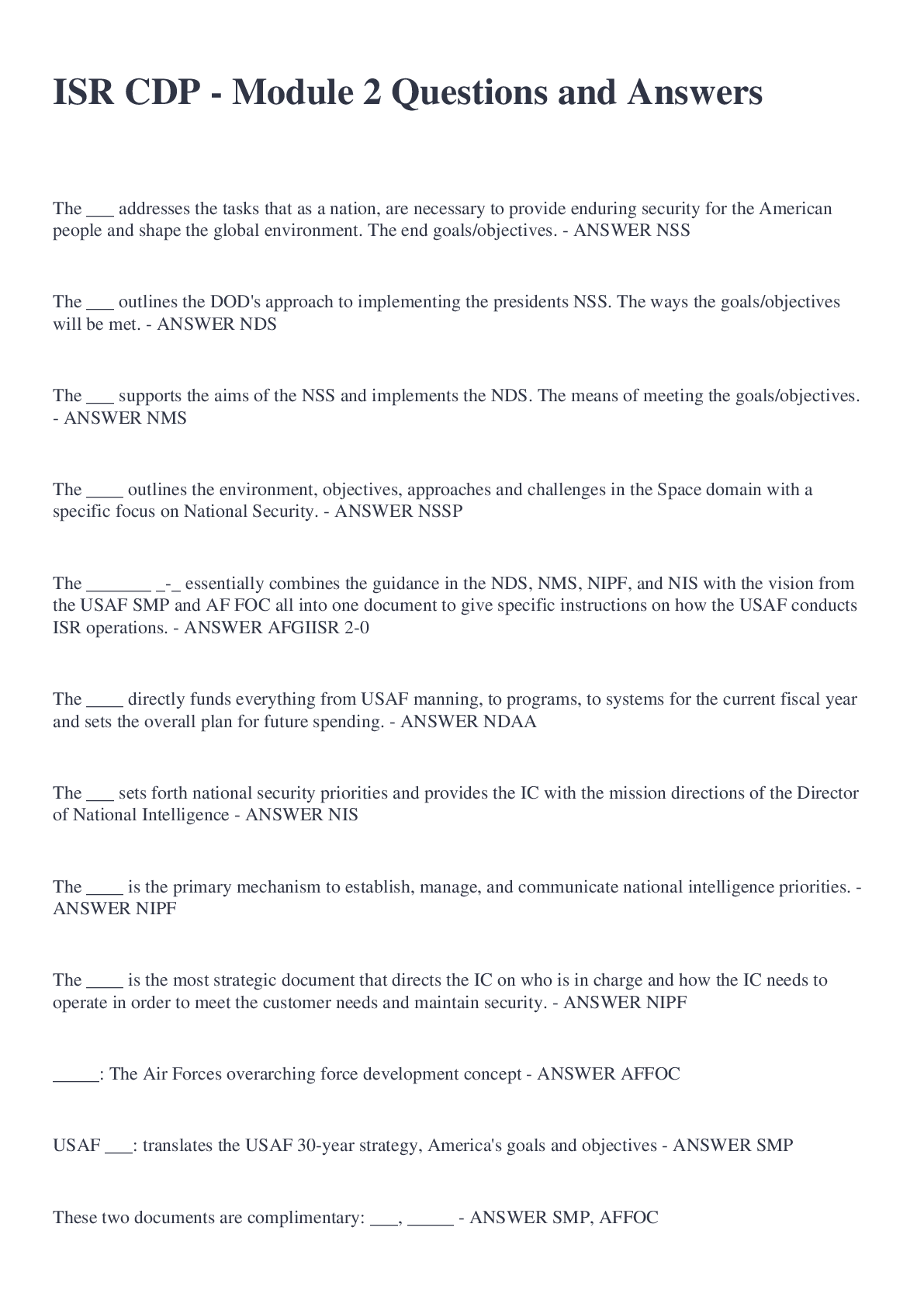
The ___ addresses the tasks that as a nation, are necessary to provide enduring security for the American people and shape the global environment. The end goals/objectives. - ANSWER NSS
The ___ outlines the DOD's appr
...
The ___ addresses the tasks that as a nation, are necessary to provide enduring security for the American people and shape the global environment. The end goals/objectives. - ANSWER NSS
The ___ outlines the DOD's approach to implementing the presidents NSS. The ways the goals/objectives will be met. - ANSWER NDS
The ___ supports the aims of the NSS and implements the NDS. The means of meeting the goals/objectives. - ANSWER NMS
The ____ outlines the environment, objectives, approaches and challenges in the Space domain with a specific focus on National Security. - ANSWER NSSP
The _______ _-_ essentially combines the guidance in the NDS, NMS, NIPF, and NIS with the vision from the USAF SMP and AF FOC all into one document to give specific instructions on how the USAF conducts ISR operations. - ANSWER AFGIISR 2-0
The ____ directly funds everything from USAF manning, to programs, to systems for the current fiscal year and sets the overall plan for future spending. - ANSWER NDAA
The ___ sets forth national security priorities and provides the IC with the mission directions of the Director of National Intelligence - ANSWER NIS
The ____ is the primary mechanism to establish, manage, and communicate national intelligence priorities. - ANSWER NIPF
The ____ is the most strategic document that directs the IC on who is in charge and how the IC needs to operate in order to meet the customer needs and maintain security. - ANSWER NIPF
_____: The Air Forces overarching force development concept - ANSWER AFFOC
USAF ___: translates the USAF 30-year strategy, America's goals and objectives - ANSWER SMP
These two documents are complimentary: ___, _____ - ANSWER SMP, AFFOC
This document has five strategic vectors: 1. Provide Effective 21st-Century Deterrence, 2. Maintain a Robust and Flexible Global Intelligence Surveillance and Reconnaissance (ISR) Capability, 3. Ensure a Full-Spectrum Capable, High-End Focused Force, 4. Pursue a Multi-Domain Approach to our Five Core Missions, 5. Continue the Pursuit of Game-Changing Technology. - ANSWER SMP
A unified combatant command is a command with a __________ continuing mission under a ________ commander. - ANSWER broad, single
The operational chain of command runs from the President, to the _________ __ _______, to the Combatant Commanders - ANSWER Secretary of Defense
As an ISR Airman, your mission will ultimately be directed by the ____'s - ANSWER CCMD
o U.S. Africa Command
o U.S. Central Command
o U.S. European Command
o U.S. Northern Command
o U.S. Indo-Pacific Command
o U.S. Southern Command
are all __________ combatant commands - ANSWER geographic
o U.S. Cyber Command
o U.S. Special Operations Command
o U.S. Strategic Command
o U.S. Transportation Command
are all __________ combatant commands - ANSWER functional
USAF is currently organized into __ MAJCOMs - ANSWER 10
o Air Combatant Command
o Air Force Reserve Command
o Air Force Central Command
o Air Education and Training Command
o Air Force Space Command
o Pacific Air Forces
o Air Force Global Strike Command
o Air Force Special Operations Command
o United States Air Forces in Europe- Air Forces Africa
o Air Mobility Command
o Air Force Material Command
are all _____ commands - ANSWER major
___ _____: primarily composed of uniformed U.S. Air Force officials who assist the CSAF in carrying out his role as the principal military advisor to the SECAF - ANSWER Air Staff
The Air Force Chief of Staff has a dual hatted role as the principal military advisor to the Secretary of the Air Force and as a member of the ___ - ANSWER JCS
_____ _____: composed of personnel from each of the five armed services that assists the CJCS and Vice-CJCS in discharging their responsibilities and is managed by the Director of the Joint Staff - ANSWER joint staff
Manpower, personnel & services - ANSWER A1
Intelligence, Surveillance, and Reconnaissance - ANSWER A2
Operations - ANSWER A3
Logistics, Engineering, & Force Protection - ANSWER A4
Strategic Plans, Programs, & Requirements - ANSWER A5/8
Studies, Analyses, Assessments, & Lessons Learned - ANSWER A9
Deterrence & Nuclear Integration - ANSWER A10
________ ___ _____ (NAF) - Echelon that resides directly under a MAJCOM - ANSWER Numbered Air Force
The Director of ________ ____________ serves as the head of the U.S. Intelligence Community, overseeing and directing the implementation of the National Intelligence Program - ANSWER National Intelligence
Operate, evaluate, and manage airborne Signals Intelligence - ANSWER 1A8X1
Acts as the principal advisor to the president, the National Security Council, and the Homeland Security Council - ANSWER DNI
Fly as primary aircrew onboard a wide variety of aircraft to operate, evaluate, and manage airborne ISR information - ANSWER 1A8X2
Prepare, maintain, and present intelligence displays, reports, and briefings - ANSWER 1N0X1
Exploit and analyze multisensory imagery in conjunction with all-source intelligence information - ANSWER 1N1X1
Support SIGINT activities and operations by monitoring and collecting non-communications electronic signals transmissions - ANSWER 1N2X1A
Perform communications SIGINT analysis to include acquiring signals through optimum antenna manipulation and receiver tuning - ANSWER 1N2X1C
Operate and manage communications equipment, translate spoken or written foreign language material - ANSWER 1N3X1
collect, identify, and exploit appropriate communications to ensure accurate targeting - ANSWER 1N4X1A
Perform detailed analysis on target network communications for additional exploitation - ANSWER 1N4X1B
Collect and report intelligence information obtained from human sources in response to requirements, assess, debrief, and interrogate sources - ANSWER 1N7X1
Determine the specific aircraft ammunition, and anticipate the effect of the weapons to minimize the collateral damage - ANSWER 1N8X1
Science based ISR career path that operates in the surveillance realm for treaty verification - ANSWER 9S100
______: Delivers intelligence-related advanced skills training and other specialized capabilities in support of Army, Joint, and Coalition commands and the U.S. IC - ANSWER INSCOM
___: Providing overall direction for and coordination of the collection of national intelligence outside the U.S. - ANSWER CIA
___: Provides military intelligence to warfighters, defense policymakers and force planners in the DoD and the IC in support of U.S. military planning - ANSWER DIA
___: Advances national security and protects financial integrity by informing Treasury decision with timely, relevant, and accurate intel and analysis - ANSWER DOT
___: Helps initiate new investigations of major drug organizations, strengthens ongoing investigations and subsequent prosecutions. - ANSWER DEA
___: Threat-focused national security organization with both intel and law enforcement responsibilities - ANSWER FBI
The ___ is the U.S. Government agency in charge of designing, building, launching and maintaining America's intelligence satellites. - ANSWER NRO
Planning is the deliberate process of balancing _____, _____, ____ to achieve directed objective and attain desired end states. - ANSWER risks, means, ways
The two main types of plans are ________ plans & ___________ plans - ANSWER campaign, contingency
Level 1 Contingency Plan - ANSWER commander's estimate
Level 2 Contingency Plan - ANSWER base plan
Level 3 Contingency Plan - ANSWER CONPLAN
Level 4 Contingency Plan - ANSWER OPLAN
What type of plans implement the military portion of national policy and defense strategy by identifying those actions the CCMDs will conduct on a daily basis? - ANSWER campaign
___________ plans identify how the command might respond in the event of a crisis of the inability to achieve objectives. - ANSWER contingency
The _____ identifies forces and supplies required and provides a schedule for moving resources. - ANSWER OPLAN
_____ is a continuous process that intelligence professionals use to manage the analysis and development of products that help the commander understand complex operating environments - ANSWER JIPOE
Step 1 of JIPOE: define the ___________ environment - ANSWER operational
Step 2 of JIPOE: describe the ______ of the operational environment - ANSWER impact
Step 3 of JIPOE: evaluate the _________ and other relevant factors - ANSWER adversary
Step 4 of JIPOE: determine adversary and other relevent actors' _______ __ ______ - ANSWER courses of action
3 LEVELS OF WARFARE:
________ - Analysis of the Operational Environment is focused on adversary forces and othadversary land, air, maritime, space, and other forces as well as other relevant aspects of the OE that could pose a direct threat to the security of the friendly force or the success of its mission - ANSWER tactical
3 LEVELS OF WARFARE:
___________ - sociocultural factors, the location of adversary political and economic support structures, military support units, force generation capabilities, potential third-nation or third-party involvement, logistic and economic infrastructure, political treaties, press coverage, adversary information activities, and the potential to affect the information environment - ANSWER operational
3 LEVELS OF WARFARE:
_________ - civil-military relations; national ideology, will, and morale; ability of the economy to sustain warfare; mobilization of the strategic reserve; and possible intervention by third-party countries - ANSWER strategic
Marine Corps intelligence activities are oriented toward the ___________ and ________ level - ANSWER operational, tactical
_________ ___________ - An entity considered for possible engagement or action to alter or neutralize the function it performs - ANSWER targeting description
_________ _______ - Systematically analyzes and prioritizes targets and matches appropriate lethal and nonlethal actions - ANSWER targeting purpose
JOINT TARGETING CYCLE:
o 1. End state and commanders objectives
o 2. Target Development and Prioritization
o 3. ____________ ________
o 4. Commander's Decision and Force Assignment
o 5. Mission Planning and Force Execution
o 6. Assessment - ANSWER capabilities analysis
JOINT TARGETING CYCLE:
o 1. End state and commanders objectives
o 2. Target ___________ ___ _______________
o 3. Capabilities Analysis
o 4. Commander's Decision and Force Assignment
o 5. Mission Planning and Force Execution
o 6. Assessment - ANSWER development and prioritization
JOINT TARGETING CYCLE:
o 1. End state and commanders objectives
o 2. Target Development and Prioritization
o 3. Capabilities Analysis
o 4. Commander's Decision and _____ __________
o 5. Mission Planning and Force Execution
o 6. Assessment - ANSWER force assignment
JOINT TARGETING CYCLE:
o 1. End state and commanders objectives
o 2. Target Development and Prioritization
o 3. Capabilities Analysis
o 4. Commander's Decision and Force Assignment
o 5. _______ ________ and Force Execution
o 6. Assessment - ANSWER mission planning
JOINT TARGETING CYCLE:
o 1. End state and commanders objectives
o 2. Target Development and Prioritization
o 3. Capabilities Analysis
o 4. Commander's Decision and Force Assignment
o 5. Mission Planning and Force Execution
o 6. __________ - ANSWER assessment
JOINT TARGETING CYCLE:
[Show More]