BIO 101 familiar questions in exam readily solved test new materials 2020
Choose the best answer for the following questions:
1. Which is true of the importance of DNA?
a. Every living thing has DNA organized int
...
BIO 101 familiar questions in exam readily solved test new materials 2020
Choose the best answer for the following questions:
1. Which is true of the importance of DNA?
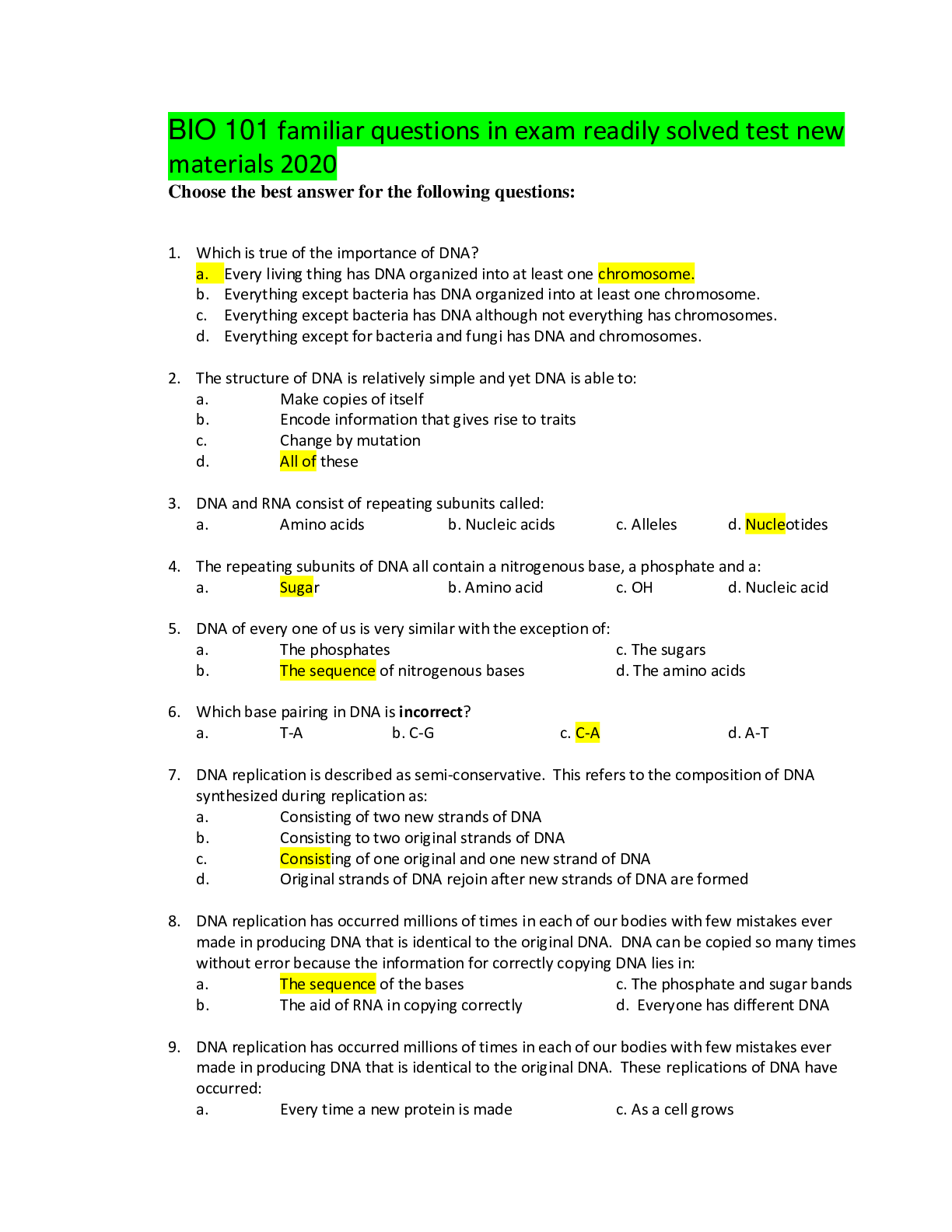
a. Every living thing has DNA organized into at least one chromosome.
b. Everything except bacteria has DNA organized into at least one chromosome.
c. Everything except bacteria has DNA although not everything has chromosomes.
d. Everything except for bacteria and fungi has DNA and chromosomes.
2. The structure of DNA is relatively simple and yet DNA is able to:
a. Make copies of itself
b. Encode information that gives rise to traits
c. Change by mutation
d. All of these
3. DNA and RNA consist of repeating subunits called:
a. Amino acids b. Nucleic acids c. Alleles d. Nucleotides
4. The repeating subunits of DNA all contain a nitrogenous base, a phosphate and a:
a. Sugar b. Amino acid c. OH d. Nucleic acid
5. DNA of every one of us is very similar with the exception of:
a. The phosphates c. The sugars
b. The sequence of nitrogenous bases d. The amino acids
6. Which base pairing in DNA is incorrect?
a. T-A b. C-G c. C-A d. A-T
7. DNA replication is described as semi-conservative. This refers to the composition of DNA synthesized during replication as:
a. Consisting of two new strands of DNA
b. Consisting to two original strands of DNA
c. Consisting of one original and one new strand of DNA
d. Original strands of DNA rejoin after new strands of DNA are formed
8. DNA replication has occurred millions of times in each of our bodies with few mistakes ever made in producing DNA that is identical to the original DNA. DNA can be copied so many times without error because the information for correctly copying DNA lies in:
a. The sequence of the bases c. The phosphate and sugar bands
b. The aid of RNA in copying correctly d. Everyone has different DNA
9. DNA replication has occurred millions of times in each of our bodies with few mistakes ever made in producing DNA that is identical to the original DNA. These replications of DNA have occurred:
a. Every time a new protein is made c. As a cell grows
b. When genes are expressed d. Prior to cell division
10. During DNA replication when the DNA molecule is unwound and separated then new DNA is assembled:
a. In the form codons consisting of three base pairs
b. When the original DNA rejoins after the passing of DNA polymerase
c. As nucleotides with complementary bases to those bases exposed in DNA are assembled based on the template in DNA
d. By another complete strand of DNA found within a gene matching up with the exposed bases in the original DNA
11. The structure of RNA differs from that of DNA in respect to:
a. Each nucleotide in DNA has two bases, but in RNA there is only one
b. DNA is a single strand of nucleotides but RNA is two strands
c. Uracil (U) replaces thymine (T) in RNA
d. Both A & C
12. There are different types of RNA. The type picture above is:
a. mRNA b. tRNA c. rRNA d. dRNA
13. The process shown in the figure above is:
a. DNA replication b. Transcription c. Translation d. A mutation
14. The order of bases in nucleotides assembled in synthesis of the RNA strand above would be:
a. TACTTCGGCTCAATT c. UACUUCGGCUCAAUU
b. ATGAAGCCGAGTTAA d. AUCCAACGGCACUUAA
15. In order to synthesize RNA for expression of a gene which of the following are required?
a. Ribonucleotides c. A blueprint of the final product
b. Fuel to drive the synthesis d. All of these
16. The first phase of protein synthesis is transcription. During transcription the information contained within a sequence of ______ is transcribed to information in a sequence of _____.
a. Nucleotides/nucleotides c. Nucleotides/Amino acids
b. Amino acids/nucleotides d. Ribonucleotides/deoxyribonucleotides
17. The second phase of protein synthesis is translation. During translation the information contained within a sequence of _____ is translated to information in a sequence of _____.
a. Nucleotides/nucleotides c. Nucleotides/Amino acids
b. Amino acids/nucleotides d. Ribonucleotides/deoxyribonucleotides
18. The language of nucleotides in DNA and RNA consists of ___ unique nucleotides (letters), whereas the language of amino acids in proteins consists of ___ unique amino acids (letters).
a. 4/4 b. 20/4 c. 4/20 d. 3/3
19. The process shown in the figure above is:
a. DNA replication b. Transcription c. Translation d. A mutation
20. The order of bases in nucleotides assembled as the short segment of DNA above is replicated would be:
a. GAACAT b. CUUGUA c. CTTGTA d. AGGACT
21. The process shown in the figure above is:
a. DNA replication b. Transcription c. Translation d. A mutation
22. The order of bases in RNA that is complimentary to sequence of bases in mRNA above would be:
a. CCCAAAUCG b. CAU c. GGGUUUAGC d. CCCTTTTCG
23. If a codon in mRNA consisted of only one nucleotide with one base rather than three nucleotides, the maximum number of different amino acids that could be coded for by unique codons would be:
a. 1 b. 2 c. 3 d. 4
24. When a codon is reached for which there is no tRNA with complimentary bases what happens?
a. A mutation c. Protein synthesis is initiated
b. The cell synthesizes the missing tRNA d. Assembly of a chain of amino acids stops
25. The table above illustrates how:
a. A codon can code for more than one amino acid
b. More than one codon may code for an amino acid
c. A codon codes for only one specific amino acid
d. Both B & C
26. Previously this semester we studied inheritance and dominant and recessive alleles. Understanding of recessive alleles makes clear that some genes in our DNA:
a. Are present but never expressed or used to synthesize a protein
b. Are expressed in response to changes in environmental conditions
c. Are expressed during different developmental stages
d. Are expressed in some cells but not others
27. Previously this semester we examined different types of cells that carry out different functions. Understanding of the large variety of cells found in humans illustrates that some genes in our DNA:
a. Are present but never expressed or used to synthesize a protein
b. Are expressed in response to changes in environmental conditions
c. Are expressed during different developmental stages
d. Are expressed in some cells but not others
28. Bacteria synthesize an enzyme to digest lactose when lactose is present, but do not synthesize this protein in the absence of lactose. This is an example of how some genes in DNA:
a. Are present but never expressed or used to synthesize a protein
b. Are expressed in response to changes in environmental conditions
c. Are expressed during different developmental stages
d. Are expressed in some cells but not others
29. In eukaryotic cells gene expression is controlled in a number of ways. These include:
a. Although a gene is present mRNA may not be synthesized
b. The mRNA may be synthesized, but modified
c. The mRNA may be synthesized but a chain of amino acids not formed
d. All of these
30. One of the major direct benefits of mutations for a population is:
a. Introduction of new genetic material
b. Weeding out of less fit individuals
c. Reduced ability to reproduce
d. Smaller populations
31. The only source of brand new genes in a population is:
a. Gene flow b. Genetic drift c. Sexual selection d. Mutations
32. Alteration of the sequence of nitrogenous base pairs in DNA is:
a. Cloning c. Transcription
b. Tetrad crossing over d. A mutation
33. Mutations may affect an organism because they may at the most basic level:
a. Kill the organism
b. Interfere with synthesis of a particular protein or group of proteins
c. Prevent the organism from reproducing
d. Cause the organism to be deformed or otherwise unattractive
34. Which is true of every type of mutation?
a. Occur only in gamete cells
b. Result in a negative trait for the organism that has the mutation
c. Involve whole chromosomes
d. None of these
35. The figure above shows different types of:
a. DNA replication
b. Point mutations
c. Chromosomal mutations
d. Control of gene expression
36. Sometimes bonds between nucleotides break and re-form improperly, resulting in mutations. This is an example of:
a. A spontaneous mutation c. An induced mutation
b. Cancer d. A carcinogen
37. Which is true of a point mutation?
a. May be responsible for changes in a single gene
b. May not affect the organism
c. May result in a genetic disorder such as sickle cell anemia
d. All of these
38. Which is true of a genetic disorder?
a. It is by definition obvious in the physical appearance of the organism
b. It may result from mutations inherited in chromosomes from parents
c. It will always be inherited by the offspring of the organism affected
d. All of these
39. Cell division is such a fundamental event in the lives of multicellular organisms that it is regulated by a variety of genes. When these genes are affected by mutations cells may divide out of control. This is a condition referred to as:
a. Angiogenesis c. Cell division genetic disorder (CDGD)
b. Cancer d. Sickle cell anemia
40. One in ___ Americans will have some form of cancer during their lifetime and one in ___ will die from cancer.
a. 3/4 b. 2/3 c. 8/15 d. 10/100
41. A tumor that spreads to other types of cells, other organs or systems is referred to as:
a. A chromosomal mutation c. Benign
b. Malignant d. A sarcoma
42. Cancer is classified into different forms depending on the types of tissues that are affected. For example carcinomas affect epithelial cells. It is not surprising that 85% of all human tumors are carcinomas because:
a. Epithelial cells are much more common than any other type of cells
b. Epithelial cells rarely divide and therefore mutations occur frequently
c. Epithelial cells divide frequently, resulting in more mutations
d. Epithelial cells usually form malignant tumors
43. Tobacco smoke, meat preservatives, UV light, and chemicals such as pesticides may affect the DNA of cells resulting in mutations. These outside agents are referred to as:
a. Induced mutations b. Carcinogens c. Carcinomas d. Sarcomas
44. Cell division is such a fundamental event in the lives of multicellular organisms that it is regulated by a variety of genes. Some genes are used for synthesis of proteins related to stimulation of cell division and if these genes are affected cells may divide out of control. Such genes are referred to as:
a. Carcinogens b. Oncogenes c. Tumor suppressors d. Stem cells
45. Almost 300,000 children are born each year with an inherited mutation in a gene that synthesizes one of the proteins in hemoglobin on chromosome #11. This leads to development of a common disease that has a genetic basis known as:
a. Leukemia b. Sickle cell anemia c. Muscular dystrophy d. Cystic fibrosis
46. What is a stem cell?
a. Cells in the stem of a plant
b. Undifferentiated cells that can give rise to virtually any type of cell
c. Cells used to produce clones
d. Cells that provide genetic material specifically for DNA testing
47. The primary source of stem cells is:
a. Trees c. Fertilized eggs not used for in vitro fertilization
b. Aborted fetuses d. Bacteria
48. DNA or molecular cloning most often uses ___ to generate multiple copies of a gene in instances where a single gene is of interest.
a. Plants b. Sheep c. Bacteria d. Viruses
49. An example of genetic engineering is genetically modified organisms (GMOs). Although these are controversial, some GMOs are extremely common in food that we eat. For example, most ____ that we eat and that is added to a wide variety of foods is from crops that have been genetically modified.
a. Chicken b. Salmon c. Corn d. Sunflowers
50. URI is a very attractive school as demonstrated even in our Bio 101 class where we have students from countries as far away as:
a. Korea b. Belarus c. Chile d. All of these
[Show More]

.png)
.png)




 answers.png)


