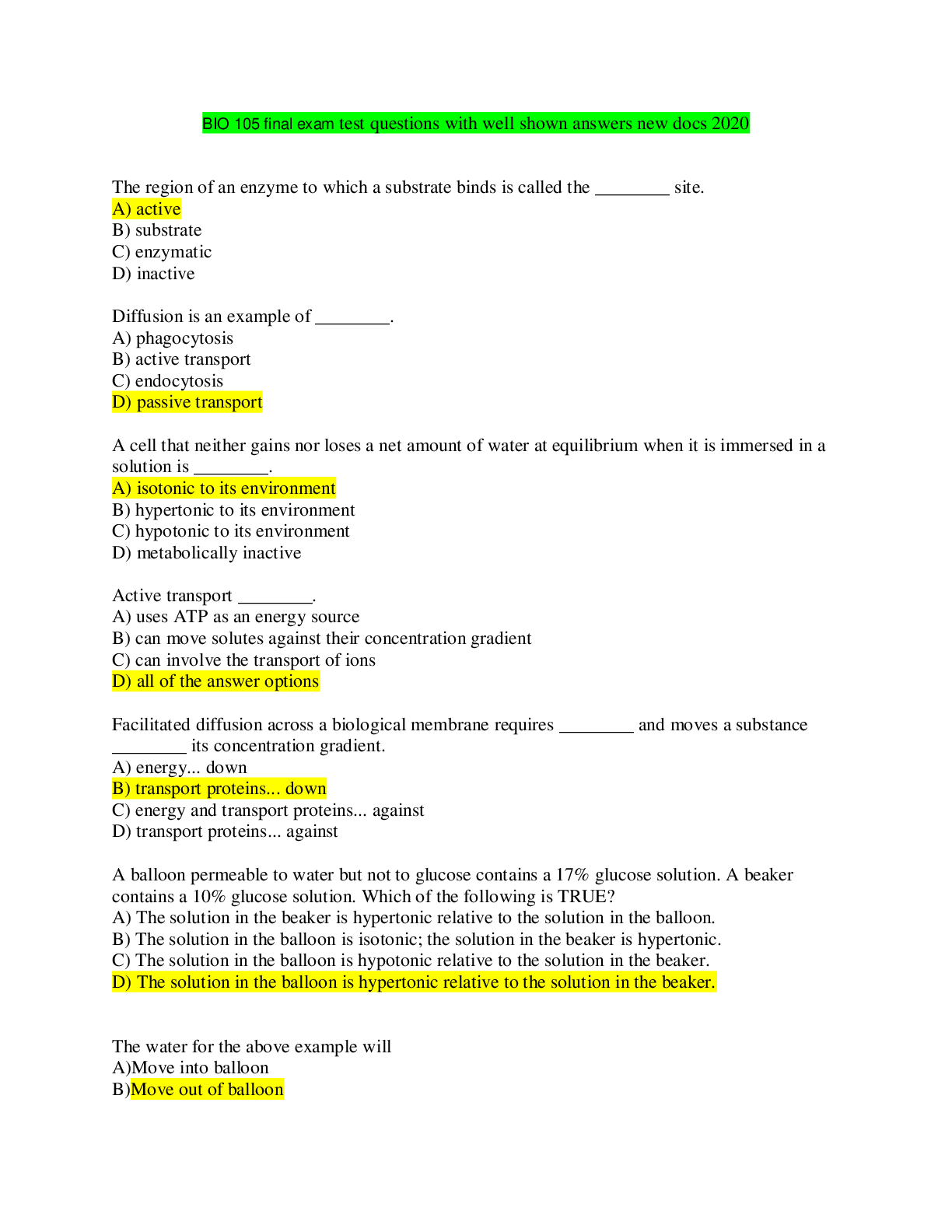
BIO 105 final exam test questions with well shown answers new docs 2020
The region of an enzyme to which a substrate binds is called the ________ site.
A) active
B) substrate
C) enzymatic
D) inactive
Diffusi
...
BIO 105 final exam test questions with well shown answers new docs 2020
The region of an enzyme to which a substrate binds is called the ________ site.
A) active
B) substrate
C) enzymatic
D) inactive
Diffusion is an example of ________.
A) phagocytosis
B) active transport
C) endocytosis
D) passive transport
A cell that neither gains nor loses a net amount of water at equilibrium when it is immersed in a solution is ________.
A) isotonic to its environment
B) hypertonic to its environment
C) hypotonic to its environment
D) metabolically inactive
Active transport ________.
A) uses ATP as an energy source
B) can move solutes against their concentration gradient
C) can involve the transport of ions
D) all of the answer options
Facilitated diffusion across a biological membrane requires ________ and moves a substance ________ its concentration gradient.
A) energy... down
B) transport proteins... down
C) energy and transport proteins... against
D) transport proteins... against
A balloon permeable to water but not to glucose contains a 17% glucose solution. A beaker contains a 10% glucose solution. Which of the following is TRUE?
A) The solution in the beaker is hypertonic relative to the solution in the balloon.
B) The solution in the balloon is isotonic; the solution in the beaker is hypertonic.
C) The solution in the balloon is hypotonic relative to the solution in the beaker.
D) The solution in the balloon is hypertonic relative to the solution in the beaker.
The water for the above example will
A)Move into balloon
B)Move out of balloon
Within the inner membrane of a chloroplast, interconnected sacs of membrane called ________ are suspended in a thick fluid called the ________.
A) chlorophyll... thylakoid
B) thylakoids... grana
C) thylakoids... stroma
D) grana... thylakoid
What is the function of stomata?
A) water absorption
B) Calvin cycle
C) location of photosystems
D) gas exchange
Which of the following equations best summarizes photosynthesis?
A) 6 CO2 + 6 H2O + 6 O2 → C6H12O6
B) 6 CO2 + 6 H2O → C6H12O6 + 6 O2
C) 6 CO2 + 6 O2 → C6H12O6 + 6 H2O
D) C6H12O6 + 6 O2 → 6 CO2 + 6 H2O
Which of the following is produced during the light reactions of photosynthesis?
A) O2
B) CO2
C) C6H12O6
D) ADP
The Calvin cycle requires ________ and ________ from the light reactions in order to operate.
A) glucose... carbon dioxide
B) electrons... NADH
C) ATP... NADPH
The color that we see when looking at a pigmented object is ________.
A) the wavelengths that are absorbed by the pigmented object
B) the wavelengths that are reflected or transmitted by the pigmented object
C) the wavelengths that have been raised to an excited state by the pigmented object
D) the wavelengths that the pigmented object created after interacting with sunlight
NAD+ turning into NADH is
A)Oxidation reaction
B)Reduction reaction
The light reactions of photosynthesis take place ________.
A) in the stroma
B) in the mitochondria
C) in the thylakoid membrane
D) in the cytosol
A process is referred to as aerobic if it requires ________.
A) oxygen
B) carbon dioxide
C) ATP
D) carbohydrates
Plant cells ________.
A) do not need chloroplasts because their mitochondria meet their energy needs
B) have chloroplasts and mitochondria
C) use carbon dioxide but do not use oxygen
D) do not need mitochondria because their chloroplasts meet their energy needs
Which of the following are produced as a result of cellular respiration?
A) ATP and water
B) carbon dioxide and ATP
C) carbon dioxide, water, and ATP
D) oxygen and glucose
Where in the cell does glycolysis occur?
A) cytoplasm
B) endoplasmic reticulum (ER)
C) within the fluid just inside the inner mitochondrial membrane
D) between the inner and outer mitochondrial membrane
Which of the following is the CORRECT sequence of stages in cellular respiration?
A) glycolysis, citric acid cycle, electron transport
B) citric acid cycle, glycolysis, electron transport
C) citric acid cycle, electron transport, glycolysis
D) electron transport, glycolysis, citric acid cycle
A product of glycolysis is ________.
A) lactic acid
B) ethyl alcohol
C) O2
D) pyruvic acid
Electron transport takes place in the ________.
A) mitochondria
B) chloroplasts
C) cytoplasm
D) ribosomes
ATP synthase plays a role in ________.
A) pulling electrons down the electron transport chain
B) glycolysis
C) pumping hydrogen ions across the inner mitochondrial membrane
D) generating ATP
Anaerobic respiration produces a maximum of ________ ATP per glucose.
A) 0
B) 2
C) 10
D) 38
What waste product do yeast produce under anaerobic conditions?
A) ethyl alcohol
B) pyruvic acid
C) lactic acid
D) creatine
The mitotic cell cycle results in the production of ________.
A) four cells, each with the same amount of genetic material and the same genetic information
B) two cells, each with the same amount of genetic material but with different genetic information
C) two cells, each with the same amount of genetic material and the same genetic information
D) four cells, each with the same amount of genetic material but with different genetic information
The CORRECT sequence of stages of mitosis is ________.
A) prophase, metaphase, anaphase, telophase
B) telophase, prophase, anaphase, metaphase
C) anaphase, interphase, prophase, metaphase, telophase
D) interphase, prophase, metaphase, anaphase, telophase
Which of these events occurs during anaphase?
A) Sister chromatids become separate chromosomes.
B) Chromosomes line up in the middle of the cell.
C) The nuclear envelope reappears.
D) The nuclear envelope breaks up.
Cytokinesis typically begins during the ________ stage of mitosis.
A) telophase
B) prophase
C) metaphase
D) anaphase
During metaphase I, ________.
A) crossing over occurs
B) homologous chromosomes line up in the middle of the cell
C) the nuclear envelope breaks up
D) sister chromatids separate and migrate to opposite poles
Crossing over takes place during -------------------- stage of meiosis
Prophase I
What is crossing over?
Exchange of genes between homologous chromosomes
Homologous chromosomes separate during -------------------- stage of meiosis
Anaphase I
What is independent assortment? During which phase of meiosis does it take place?
homologous pairs of chromosomes line up at the equator of the cell. The two pairs of chromosomes can line up in either of two equally probable ways.
Metaphase I
At the end of meiosis, how many cells result? Are they diploid or haploid?
4 daughter cells and 23 chromosomes haploids
Meiosis result in genetically identical cells
A) True B)False
What is nondisjunction? During which stages of meiosis does it take place?
When chromosomes fail to separate properly, occurs in Anaphase
[Show More]


.png)
 answers.png)



.png)