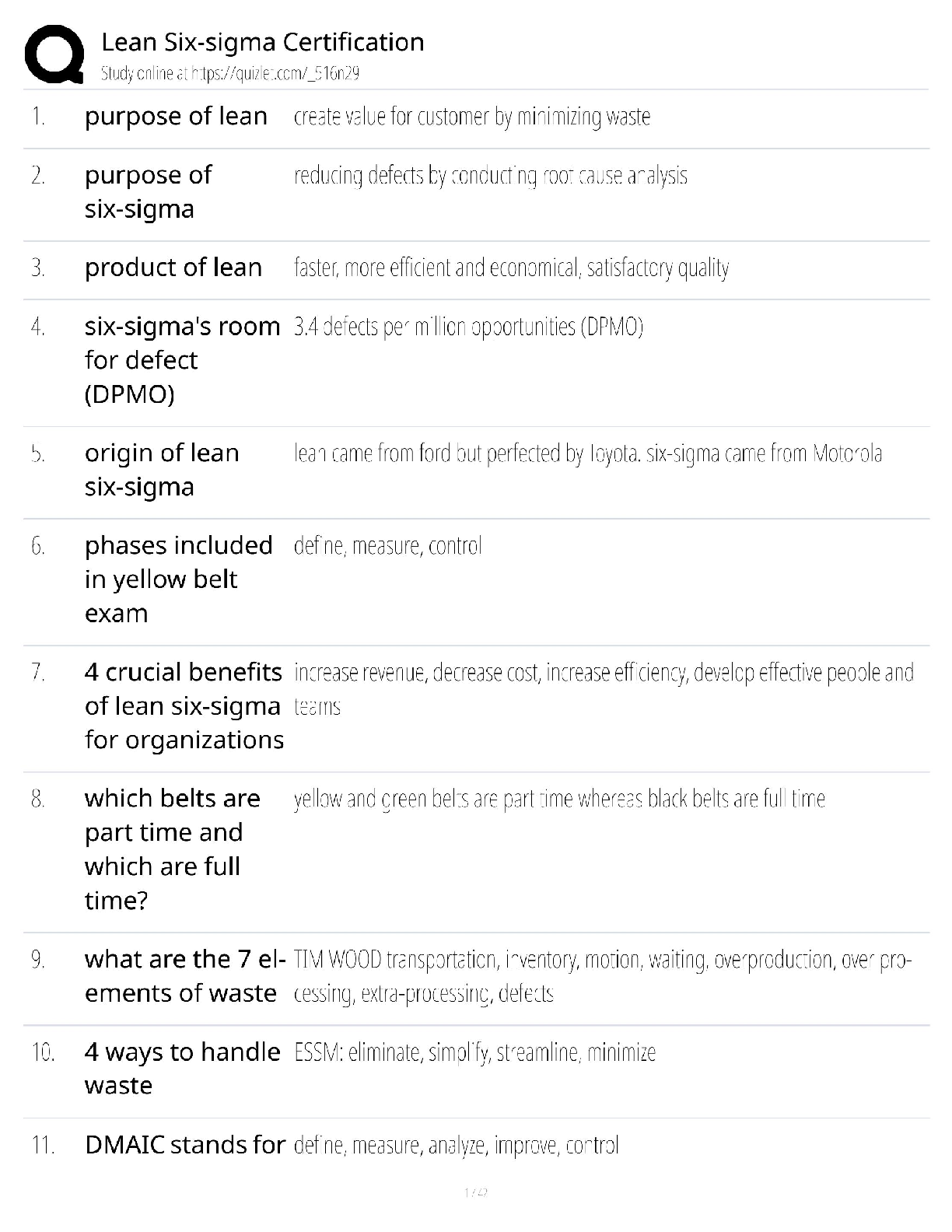
What is Six Sigma? - ANSWER Improvement methodology that uses DMAIC to reduce variation and continually improve to perform defect free work with a failure rate of 3.4 parts per million, or 99.9997%'
What is customer f
...
What is Six Sigma? - ANSWER Improvement methodology that uses DMAIC to reduce variation and continually improve to perform defect free work with a failure rate of 3.4 parts per million, or 99.9997%'
What is customer feedback? - ANSWER the Voice of the Customer
How important are customers to quality (CTQ) outcomes? - ANSWER Understanding your customers, their feedback, and prioritizing product issues.
What steps do you take to reduce poor quality? - ANSWER Determine internal processes and variation; defect causes, ways to address defects, and metrics to standardize and measure changes.
Who introduced Six Sigma and when? - ANSWER Bill Smith in 1986. Worked to Motorola.
What is Sigma? - ANSWER Denotes variance from the mean average of an event
What is DPMO? - ANSWER Defects per Million Opportunities. Event of non-conformance to specification.
What is the defect rate for 6th, 5th, 4th, 3rd, 2nd, and 1st level of sigma? - ANSWER 3.4 defects per million, 233, 6,210, 66,807, 308,538, 690,000.
Who is the father of mass production and interchangeable equipment parts? - ANSWER Eli Whitney
Why is sigma important to quality? - ANSWER Because understanding deviations can help place them under control
Who is Joseph Juran? - ANSWER In 1954, he introduced quality concept to Japanese factories.
When did ISO create a quality standard? - ANSWER 1987
How do companies save $$ with six sigmas? - ANSWER Via reduced repair times, increased customer satisfaction, reduced order delays, reduced defects, increased productivity, and decreased measurement error.
Who explained that 3 sigma is bad? - ANSWER Walter Shewart in 1920.
Who is the father of system improvement and management? - ANSWER Edwards Deming
What are the four parts of Deming's System of Knowledge? - ANSWER Theory of Optimization, Theory of Variation, Theory of Knowledge, and Theory of Psychology.
What is the theory of optimization? - ANSWER Optimize whole system, not each subsystem
What is theory of variation? - ANSWER Improve product service and variability in design and manufacturing
What is theory of knowledge? - ANSWER What knowledge is not possible without theory, and experience is not theory. Theory needs to be understood before implementation.
What is theory of psychology? - ANSWER How to understand and interact with people in a management system.
What is Deming Cycle? - ANSWER Plan-Do-Check-Act (PDCA) and Plan-Do-Study-Act (PDSA). Invented by Walter Shewhart.
PDCA and PDSA are what? - ANSWER Cyclic processes for planning and testing improvement activites for full scale production.
What are the steps of the Deming Cycle? - ANSWER Plan a change, Do it on small scale, Check it, Study it, Act on what you learned, and repeat.
What are the deliverables of the Define Phase? - ANSWER Create fully-trained project team, support, and provide resources. Identify Critical to Quality characteristics, project charter, and map business processes.
What are the deliverables of the Measure Phase? - ANSWER Identify key measures, develop and deploy data collection plan, develop baseline performance, document variation, and communicate to stakeholders/team.
What are the deliverables of the Analysis Phase? - ANSWER Root cause analysis, gap analysis, and top-to-bottom data and process analysis.
What are the deliverables of the Improve Phase? - ANSWER Develop possible solutions, determine best ones, develop implementation plan.
What are the deliverables of the Control Phase? - ANSWER Standardize processes, document procedures, implement monitoring plan, transfer ownership of project and close it.
What is Y=f(x) + E (epsilon)? - ANSWER Y = desired outcome (cake); x = inputs for outcome (ingredients), f = process applied to variables (transformation processor/mix/bake) and E (epsilon) = level of error/uncertainty/unpredictability (variables in heat, ingredients, cooking time).
What is the Principle of Determinism? - ANSWER Every outcome is a result of a process applied to it or determined by the application of a function.
What do customers define? - ANSWER Needs, requirements, and wants.
What are KPOVs? - ANSWER Key Process Metrics.
What is QFD? - ANSWER Quality Function Deployment - translates customer service into performance measures.
What is CTQ flow-down? - ANSWER Used to convert VOC to specific needs using tree map.
How can VOC data be pulled? - ANSWER Reactively or proactively.
What are the input components of quality? - ANSWER Customer, employee, and process.
What are the roles in Six Sigma? - ANSWER Champions (Executives), Master BBs, BBs, GBs, YBs (Consultants), Project Team (Process), and SMEs (expertise). Champions sponsor, BBs guide, GBs operate, YBs identify processes, teams do work, and SMEs guide like BBs.
What is function? - ANSWER Relates to a process or application.
What is variation? - ANSWER Refers to difference from expected outcome
What is variance and standard deviation? - ANSWER Stat terms used to measure variations.
What is error? - ANSWER Amount of difference or variation from perfect expected outcome.
What is SPC? - ANSWER Statistical Process Control
What is the limit of ISO certification? - ANSWER That a process exists, doesn't mean it is being followed and improving quality.
What is Lean Methodology? - ANSWER Eliminate waste in the business.
What is Muda, Muri, and Mura? - ANSWER Waste, too much demand that causes haste, and Inconsistent demand/workflow.
What are the two types of Muda? - ANSWER Type 1 - necessary non-value - meet regs
Type II - unnecessary non-value
What are the seven forms of Muda? - ANSWER Transport, Inventory, Motion, Waiting, Overproduction, Over Processing, and Defects
What is the limitation of TQM? - ANSWER It doesn't quantify process improvement.
What is deployment? - ANSWER The use of Six Sigma to examine quality of a business area.
What is PPI? - ANSWER Pareto Priority Index (PPI) = savings X prob of success/cost X completion time.
What can you use PPI for? - ANSWER To prioritize what projects would benefit greater from quality improvement, either in savings or success. The higher the PPI, the better.
Where does PPI lack? - ANSWER Does not take into account business rep, customer/stakeholder weight, supplier timing, staffing impacts.
What is rDMAIC? - ANSWER R = recognition phase that improvement is needed in business area.
What is the define stage? - ANSWER Write problem statement, goal objective, launch the project.
What is the measure stage? - ANSWER Using data, after identifying the problem, to set a benchmark metric.
What is the control stage? - ANSWER When the results of the project/process improvement are given back to the process owner to implement.
What is DMAVD? - ANSWER Define, Measure, Analyze, Design, and Verify. Design and Verify is where you create a brand new process.
What are the duties of a Yellow Belt? - ANSWER Assist with gathering data. Act as SME. Ensuring project matches business terms. Translating improvements to workforce. Acts as change agent. Measures results of process improvement.
How do you define a process? - ANSWER 1) Find the process owner
2) Define the scope, limits, or boundaries of a process
3) Develop a process map (SIPOC)
What is SIPOC? - ANSWER Suppliers, Inputs, Process, Outputs, and Customers of a process.
What are suppliers? - ANSWER Provide inputs
What are inputs? - ANSWER Activities that trigger the process.
What are processes? - ANSWER Activities that convert inputs to outputs.
What are outputs? - ANSWER Tangible products or services.
Who gets the output? - ANSWER Customers. Every process should have one.
What are the more common forms of CTQ? - ANSWER CTC = Cost
CTS = Safety
CTP = Process
CTD = Delivery
What is COPQ? - ANSWER Cost of poor quality - sum of internal/external failures.
What do Pareto Diagrams/Analysis do? - ANSWER Show balance between effort and resources.
What is Pareto? - ANSWER 20% inputs result in 80% output.
What created Pareto? - ANSWER Joseph Juran...named after Vilfredo Pareto.
What is RTY? - ANSWER Rolled Throughput Yield. Product will pass through entire production or service process without rework/defects.
What is DPU? - ANSWER Defects per unit - product/service nonfulfillment
What is FPY/FTY? - ANSWER First Pass Yield/First Time Yield - # of perfect units/total unit inputed. FTY = # processes * perfect units/total number of products. Used to measure rework.
What are the four types of process measurement? - ANSWER Time, Cost, Quality, or Safety
What does CTC mean? - ANSWER Cost of inventory
Amount of production labor
Cost of raw materials
Overhead costs
What does CTQ mean? - ANSWER Accuracy of product
What does CTS mean? - ANSWER Related to time to pass through one of more stages of process
Delivery timing, time on hand of goods stocked, and material arrival times.
What is yield? - ANSWER % of usable product produced. Doesn't take into account rework.
What is the define stage in specific steps? - ANSWER Define problem, agree on goals, listen to VOC. Develop project name/purpose. Project charter. High level process map. Process owner, chamption, team. Customers/requirements CTQ, Align goals with business initiatives. Determine ROI.
What tools are avail during define phase? - ANSWER Brainstorming
Graphs
Stakeholder Analysis
Charter Template
Historical Data
VOC
What is a project charter? - ANSWER Informal contract that is created at start of project to set work arrangement and information development. Define problem. Define scope and data - why are we doing this? Create deliverables. Id stakeholders. Develop timeline. Kick off meeting. Agree to all the items above with stakeholders, team members, process owner, and sponsor/champion.
What is Cpk? - ANSWER Process capability index = ability to create product within specs
What is TOP? - ANSWER Total opportunities
How to do calculate DPMO? - ANSWER Find TOP by taking U times O. Then take D and divide by TOP to get DPO. Then multiple a million. Basically, figure out how many chances can a product or service be messed up, then measure how many defects for a give production amount (units) to include all defects (not just defective units, but defects for each defective unit), then figure out TOP, then DPO, then DPMO.
Who created fishbone/cause and effect diagrams? - ANSWER Dr. Kaoru Ishikawa
What is FMEA? - ANSWER Failure Modes and Effects Analysis. Systematic technique of identifying and ranking potential failure modes of a design or manufacturing process in order to prioritize improvement. It quantifies priorities, risk, and characteristics of a problem. Failure modes are the ways (modes) in which something might fail.
What is RPN? - ANSWER Risk Priority Numbers. RPNs are calculated with three factors (severity, occurrence, and detection) on a scale of 1 to 10 for each. Then you can rank the potential failure.
What is Design FMEA? - ANSWER Uses FMEA to design a product and find ways it might fail in the real-world.
What is Process FMEA? - ANSWER A tool used to identify and evaluate potential failures of a process.
What is 5s? - ANSWER Sort, Straighten, Shine, Standardize, Sustain. Sort - go through what is needed and what is not. Organize what is needed. Clean the area and create a cleaning schedule. Imbed 5S into culture.
What is a value stream? - ANSWER A tool used to find necessary factors that contribute to value and eliminate those factors that do not. Customer focused. Comes from Lean. It's added to a process map and you look at each stage and assess whether it adds value to customer, does not but is necessary, or adds no value and is not necessary. 3 buckets of value.
How can you reduce cycle time with a value stream? - ANSWER By eliminating non-value elements and time-consuming activities that add no value without being necessary. Get rid of waste. Basically, map the process, then judge whether each step is vital to the process or not, and if its not vital, does the customer want it or not (will they pay for it).
How is setup defined in Lean? - ANSWER Prep, replacement, location, and adjustment. Prep means you gather materials. Replacement means adding or removing items to keep the process moving.
How are variations used in Lean? - ANSWER Analysis produces results that can show sufficient variation in data which can justify a need to change the process.
What are natural process limits? - ANSWER + or - 3 standard deviations from target. About 99.7% of process is within natural process limits if its stable.
What are specification limits? - ANSWER Limits required by customer that supplier must produce.
What are cyclical variations? - ANSWER Time based repeated patterns.
What are temporal variations? - ANSWER Variations over time.
What is ANOVA? - ANSWER Analysis of Variance - Divides data into components in order to test hypothesis. Used to test means of any samples using variation vice mean.
What is the ideal state? - ANSWER Processes are within statistical control.
What is threshold state? - ANSWER Process does NOT meet customer specs.
What is on the brink state? - ANSWER Products meet customer specs but are not in statistical control.
What is red light state? - ANSWER Not in statistical control nor meeting customer needs. Very bad.
What is common cause variation? - ANSWER Typical cause of variation from understood and predicable sources. Can be foreseen, eliminated, understood using statistical analysis. Cannot be eliminated reacting to individual variations.
What is special cause of variation? - ANSWER Not falling in range of other factors.. Found via process analysis, control, or documentation. Its unusual. Might happen if important variables are not identified.
What are several techniques for reducing process variation? - ANSWER Standardize materials and sources
Standardize work
Standardize gauging
Ensure control of new materials and tools
What is the Taguchi Method? - ANSWER Design of Experiments (DOE). Used to evaluate factors controlling parameters.
[Show More]