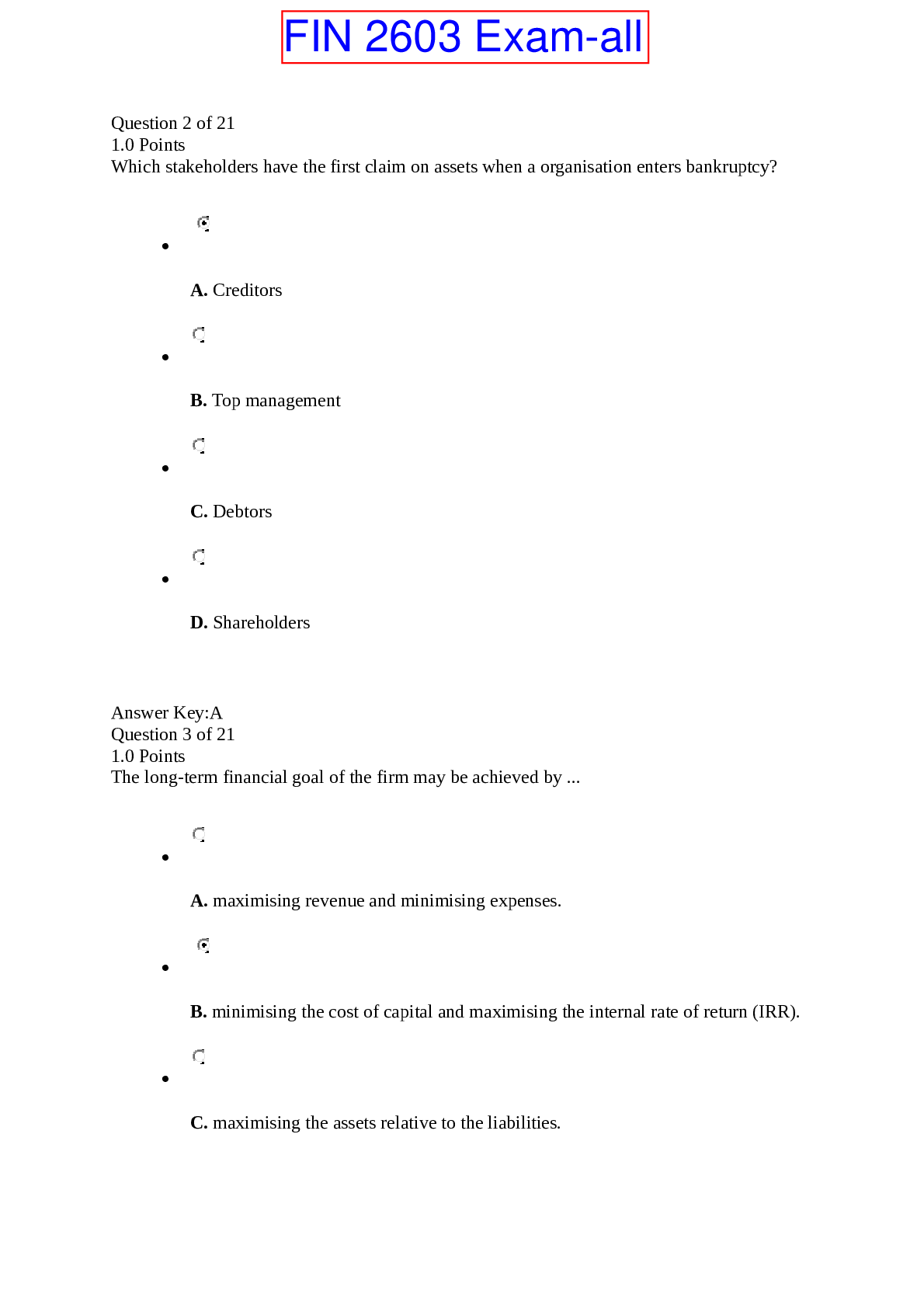
Question 2 of 21
1.0 Points
Which stakeholders have the first claim on assets when a organisation enters bankruptcy?
•
A. Creditors
•
B. Top management
•
C. Debtors
•
D. Shareholders
Question 3 of 21
1.0 Po
...
Question 2 of 21
1.0 Points
Which stakeholders have the first claim on assets when a organisation enters bankruptcy?
•
A. Creditors
•
B. Top management
•
C. Debtors
•
D. Shareholders
Question 3 of 21
1.0 Points
The long-term financial goal of the firm may be achieved by ...
•
A. maximising revenue and minimising expenses.
•
B. minimising the cost of capital and maximising the internal rate of return (IRR).
•
C. maximising the assets relative to the liabilities.
•
D. accelerating cash inflows.
Question 4 of 21
1.0 Points
What is the main function of a financial manager?
•
A. To prevent bad debts.
•
B. To ensure liquidity and solvency.
•
C. To increase the value of ordinary shares.
•
D. To earn returns greater than those of the competitors.
Part 3 of 5 - Section 2
Question 5 of 21 10.0 Points
1.0 Points
The statement of comprehensive income measures ... and it is also known as ...
•
A. revenue and gross profit; earnings-after-tax trial balance.
•
B. gross profit, earnings before income and tax (EBIT) and net profit;Statement of
financial performance.
•
C. cost of goods sold and operating expenses; balance sheet.
•
D. sales, EBIT and earnings-after-tax; cash flow statement.
Question 6 of 21
1.0 Points
B and C Limited extend credit terms of 43 days to its customers. Its credit collection would
likely be considered poor if its average collection period was ...
•
A. 30 days.
•
B. 36 days.
•
C. 43 days.
•
D. 45 days.
Question 7 of 21
1.0 Points
Sharewealth Limited has fixed assets worth R600 000 and current assets worth R240 000.
The company owes R250 000 on a mortgage bond and money owed to creditors amounts to
R100 000. Owners’ equity equals ...
•
A. R380 000.
•
B. R420 000.
•
C. R490 000.
•
D. R570 000.
Question 8 of 21
1.0 Points
Current liabilities can be viewed as ...
•
A. debts that mature in one year or less.
•
B. debts that mature in more than one year.
•
C. sources of cash inflows.
•
D. irrelevant in calculating net working capital.
Question 9 of 21
1.0 Points
A company wishes to raise funds without lessening the control of current owners. Which
source(s) of capital would be the most appropriate for the company?
•
A. Share issue
•
B. Debt
•
C. Preference shares
•
D. Options b and c
Question 10 of 21
1.0 Points
Which ratio is useful in evaluating credit and collection policies?
•
A. Average payment period
•
B. Current ratio
•
C. Average collection period
•
D. Current asset turnover
Question 11 of 21
1.0 Points
All of the following are examples of fixed assets, except ...
•
A. vehicles.
•
B. equipment.
•
C. marketable securities.
•
D. buildings.
Question 12 of 21
1.0 Points
If accounts receivable increases by R400, inventory increases by R500 and accounts payable
decreases by R200, net working capital would ...
•
A. decrease by R1100.
•
B. decrease by R 700.
•
C. increase by R 700.
•
D. increase by R1100.
Question 13 of 21
1.0 Points
A current ratio of 4:1 may indicate that the firm has too much ...
•
A. cash.
•
B. inventory.
•
C. accounts receivable.
•
D. all of the above.
Question 14 of 21
1.0 Points
A decrease in assets is recorded by means of a ... entry and an increase in owners’ equity is
recorded by means of a ... entry.
•
A. debit; credit
•
B. credit; debit
•
C. debit; debit
•
D. credit; credit
Part 4 of 5 - Section 3
Question 15 of 21 5.0 Points
1.0 Points
ABC Limited has fixed costs of R2 000 000. The company’s products are sold at R 2 000 per
unit, while variable cost amounts to R800 per unit. Calculate the company’s breakeven point
in units.
•
A. 1 000 units
•
B. 1 333 units
•
C. 1 500 units
•
D. 1 667 units
Question 16 of 21
1.0 Points
A company has fixed operating costs of R4 500, the selling price per unit is R12 and its
variable cost per unit is R9. The company’s breakeven point is ... units.
•
A. 1 000
•
B. 1 333
•
C. 1 500
•
D. 2 500
Question 17 of 21
1.0 Points
A Swiss based company sells watches for R50 each. Variable costs per watch amounts to R30
and the company has fixed operating costs of R75 000. Calculate the company’s breakeven
point in units.
•
A. 938 units
•
B. 1 500 units
•
C. 2 500 units
•
D. 3 750 units
Question 18 of 21
1.0 Points
A company has fixed operating costs of R15 000.Products are sold at R15 per unit and the
variable cost per unit is R6. Calculate the company’s breakeven point in rand.
•
A. R 1 111
•
B. R 1 667
•
C. R29 000
•
D. R1 363
Question 19 of 21
1.0 Points
Operating profit is defined as ...
•
A. gross profit minus operating expenses.
•
B. sales revenue minus cost of goods sold.
•
C. earnings before depreciation and taxes.
•
D. sales revenue minus depreciation expense.
Part 5 of 5 - Section 4 2.0 Points
Question 20 of 21
1.0 Points
Use the following information for BMC Limited in order to answer the question:
Opening inventory R 70 000
Closing inventory R 50 000
Cash R 30 000
Accounts receivable R 40 000
Long-term assets R 500 000
Accounts payable R 50 000
Equity R 270 000
Long-term debt R 300 000
Sales R 400 000
Cost of Goods sold R 200 000
Profit before tax R 60 000
Tax rate 35%
The return on assets (ROA) for BMC Limited is closest to ...
•
A. 6.29%
•
B. 14.77%
•
C. 24.00%
•
D. None of the above
Question 21 of 21
1.0 Points
Use the following information for BMC Limited in order to answer the question:
Opening inventory R 70 000
Closing inventory R 50 000
Cash R 30 000
Accounts receivable R 40 000
Long-term assets R 500 000
Accounts payable R 50 000
Equity R 270 000
Long-term debt R 300 000
Sales R 400 000
Cost of Goods sold R 200 000
Profit before tax R 60 000
Tax rate 35%
The inventory turnover for BMC Limited is closest to ...
•
A. 2.86 times p.a.
•
B. 3.33 times p.a
•
C. 4.00 times p.a
•
D. 6.23 times p.a
Question 2 of 21
1.0 Points
The long-term financial goal of the firm may be achieved by ...
•
A. maximising revenue and minimising expenses.
•
B. minimising the cost of capital and maximising the internal rate of return (IRR).
•
C. maximising the assets relative to the liabilities.
•
D. accelerating cash inflows.
Question 3 of 21
1.0 Points
Finance can be defined as the ...
•
A. system of debits and credits.
•
B. art and science of managing money.
•
C. art of merchandising products and services.
•
D. science of the production, distribution and consumption of wealth.
Question 4 of 21
1.0 Points
Which source of the following funds are the most likely to be relayed on by small firms ?
•
A. Long-term debt
•
B. Equity
•
C. Preference shares
•
D. Short-term debt
Part 3 of 5 - Section 2
Question 5 of 21 10.0 Points
1.0 Points
A current ratio of 4:1 may indicate that the firm has too much ...
•
A. cash.
•
B. inventory.
•
C. accounts receivable.
•
D. all of the above.
Question 6 of 21
1.0 Points
All of the following are examples of fixed assets, except ...
•
A. vehicles.
•
B. equipment.
•
C. marketable securities.
•
D. buildings.
Question 7 of 21
1.0 Points
Operating profit is defined as ...
•
A. gross profit minus operating expenses.
•
B. sales revenue minus cost of goods sold.
•
C. earnings before depreciation and taxes.
•
D. sales revenue minus depreciation expenses.
Question 8 of 21
1.0 Points
Which ratio is a measure of the speed with which various accounts are converted into sales
and cash?
•
A. Activity ratio
•
B. Liquidity ratio
•
C. Debt ratio
•
D. Profitability ratio
Question 9 of 21
1.0 Points
West Wing Limited has total liabilities of R500 000 and owner’s equity of R250 000. The
company’s total assets are ...
•
A. R250 000.
•
B. R400 000.
•
C. R750 000.
•
D. R950 000.
Question 10 of 21
1.0 Points
The statement of comprehensive income measures ... and it is also known as ...
•
A. revenue and gross profit; earnings-after-tax trial balance.
•
B. gross profit, earnings before income and tax (EBIT) and net profit;Statement of
financial performance.
•
C. cost of goods sold and operating expenses; balance sheet.
•
D. sales, EBIT and earnings-after-tax; cash flow statement.
Question 11 of 21
1.0 Points
The best way in which a firm may improve its profitability without incurring additional
expenses, would involve ...
•
A. reducing expenditure on non-core business activities.
•
B. employing fewer permanent staff and using contract workers during peak
periods.
•
C. increasing sales by means of improved marketing.
•
D. selling all its non-core assets.
Question 12 of 21
1.0 Points
A firm’s cash inflow becomes more predictable as the ...
•
A. current ratio increases.
•
B. return on owners’ equity increases.
•
C. current liabilities decrease.
•
D. current assets decrease.
Question 13 of 21
1.0 Points
In the past year a firm received cash from clients amounting to R10 500. The firm paid
creditors and employees an amount of R3 700. Interest paid amounted to R1 500. No
dividends were paid out. The firm paid normal tax amounting to R700. The cash flow from
operations amount to ...
•
A. R1 700
•
B. R4 600
•
C. R5 300
•
D. R6 800
Question 14 of 21
1.0 Points
A current ratio of 4,5:1 may indicate the firm has too much ...
•
A. cash.
•
B. inventory.
•
C. accounts receivable.
•
D. All of the above.
Part 4 of 5 - Section 3
Question 15 of 21 5.0 Points
1.0 Points
Hackleys Ltd. sold 10 000 units for the current financial year. Total fixed costs for the year
amounted to R2 000 000. The selling price per unit is R2 000, whereas the variable cost per
unit is R500.
Calculate the marginal income for the year.
•
A. R10 000 000
•
B. R12 000 000
•
C. R15 000 000
•
D. R17 000 000
Question 16 of 21
1.0 Points
Which type of budget indicates expected expenses for line- items such as buildings,
machinery and equipment?
•
A. Cash budget
•
B. Pro forma balance sheet
•
C. Capital budget
•
D. Pro forma income statement
Question 17 of 21
1.0 Points
Which of the following statements are not true with regards to management accounting.
•
A. Management accounting is internally focused.
•
B. Management accounting is future-orientated.
•
C. Management accounting is historical orientated.
•
D. Management accounting is multidisciplinary.
Question 18 of 21
1.0 Points
A company has fixed operating costs of R15 000.Products are sold at R15 per unit and the
variable cost per unit is R6. Calculate the company’s breakeven point in rand.
•
A. R 1 111
•
B. R 1 667
•
C. R29 000
•
D. R1 363
Question 19 of 21
1.0 Points
A company has fixed operating costs of R4 500, the selling price per unit is R12 and its
variable cost per unit is R9. The company’s breakeven point is ... units.
•
A. 1 000
•
B. 1 333
•
C. 1 500
•
D. 2 500
Part 5 of 5 - Section 4 2.0 Points
Question 20 of 21
1.0 Points
Use the following information for BMC Limited in order to answer the question:
Opening inventory R 70 000
Closing inventory R 50 000
Cash R 30 000
Accounts receivable R 40 000
Long-term assets R 500 000
Accounts payable R 50 000
Equity R 270 000
Long-term debt R 300 000
Sales R 400 000
Cost of Goods sold R 200 000
Profit before tax R 60 000
Tax rate 35%
The gross profit margin for BMC Limited is closest to ...
•
A. 20%
•
B. 50%
•
C. 100%
•
D. 200%
Question 21 of 21
1.0 Points
Use the following information for BMC Limited in order to answer the question:
Opening inventory R 70 000
Closing inventory R 50 000
Cash R 30 000
Accounts receivable R 40 000
Long-term assets R 500 000
Accounts payable R 50 000
Equity R 270 000
Long-term debt R 300 000
Sales R 400 000
Cost of Goods sold R 200 000
Profit before tax R 60 000
Tax rate 35%
The return on assets (ROA) for BMC Limited is closest to ...
•
A. 6.29%
•
B. 14.77%
•
C. 24.00%
•
D. None of the above
Question 2 of 21
1.0 Points
One method often used by companies to ensure that management decisions are in the best
interest of the shareholders is to ...
•
A. have a shareholder meeting once a year.
•
B. threaten to fire managers who do not performing adequately.
•
C. tie management compensation to the performance of the company share price.
•
D. tie management compensation to the level of earnings per share.
Question 3 of 21
1.0 Points
Any organisation that is managed in accordance with business principles should be able to
ensure its survival because it will ...
•
A. maximise its revenue from sales and control its expenses.
•
B. plan its cash inflows and outflows by means of a cash budget.
•
C. keep its cost of financing as low as possible.
•
D. undertake all the above-mentioned financial measures.
Question 4 of 21
1.0 Points
What is the main function of a financial manager?
•
A. To prevent bad debts.
•
B. To ensure liquidity and solvency.
•
C. To increase the value of ordinary shares.
•
D. To earn returns greater than those of the competitors.
Part 3 of 5 - Section 2
Question 5 of 21 10.0 Points
1.0 Points
A firm can best improve its ROE by increasing its ...
•
A. cash sales and decreasing liabilities.
•
B. net profit and using assets needed for core business only.
•
C. profitability, asset turnover and financial leverage.
•
D. sales and decreasing expenditure.
Question 6 of 21
1.0 Points
Current liabilities can be viewed as ...
•
A. debts that mature in one year or less.
•
B. debts that mature in more than one year.
•
C. sources of cash inflows.
•
D. irrelevant in calculating net working capital.
Question 7 of 21
1.0 Points
With which type of funds would an organisation typically finance temporary current assets?
•
A. Long-term debt
•
B. Equity
•
C. Preference shares
•
D. Short-term debt
Question 8 of 21
1.0 Points
All of the following are examples of fixed assets, except ...
•
A. vehicles.
•
B. equipment.
•
C. marketable securities.
•
D. buildings.
Question 9 of 21
1.0 Points
A current ratio of 4,5:1 may indicate the firm has too much ...
•
A. cash.
•
B. inventory.
•
C. accounts receivable.
•
D. All of the above.
Question 10 of 21
1.0 Points
In general, a lending institution would consider a decrease in which of the following ratios to
be positive news?
•
A. Interest coverage
•
B. Debt to total assets
•
C. Return on assets
•
D. Current ratio
Question 11 of 21
1.0 Points
Which one of the following is a major expense associated with issuing new ordinary shares.
•
A. Underpricing
•
B. Legal fees
•
C. Registration fees
•
D. Underwriting fees
Question 12 of 21
1.0 Points
A current ratio of 4:1 may indicate that the firm has too much ...
•
A. cash.
•
B. inventory.
•
C. accounts receivable.
•
D. all of the above.
Question 13 of 21
1.0 Points
An increase in sales revenue as a result of a credit sales is recorded by ...
•
A. crediting cash.
•
B. crediting sales.
•
C. debiting cash.
•
D. debiting sales.
Question 14 of 21
1.0 Points
If accounts receivable increases by R400, inventory increases by R500 and accounts payable
decreases by R200, net working capital would ...
•
A. decrease by R1100.
•
B. decrease by R 700.
•
C. increase by R 700.
•
D. increase by R1100.
Part 4 of 5 - Section 3 5.0 Points
Question 15 of 21
1.0 Points
If a company expects to sell 100 000 units of tubes in a year, what will the company’s margin
of safety ratio be if the company’s breakeven volume is 75 000 units?
•
A. 25%
•
B. 50%
•
C. 75%
•
D. 125%
Question 16 of 21
1.0 Points
... costs are a function of volume, not time.
•
A. Fixed financial
•
B. Variable
•
C. Fixed operating
•
D. Semi-variable
Question 17 of 21
1.0 Points
Which of the following statements are not true with regards to management accounting.
•
A. Management accounting is internally focused.
•
B. Management accounting is future-orientated.
•
C. Management accounting is historical orientated.
•
D. Management accounting is multidisciplinary.
Question 18 of 21
1.0 Points
ABC Limited has fixed costs of R2 000 000. The company’s products are sold at R 2 000 per
unit, while variable cost amounts to R800 per unit. Calculate the company’s breakeven point
in units.
•
A. 1 000 units
•
B. 1 333 units
•
C. 1 500 units
•
D. 1 667 units
Question 19 of 21
1.0 Points
... costs are a function of time, not volume.
•
A. Fixed financial
•
B. Variable
•
C. Fixed operating
•
D. Semi-variable
Part 5 of 5 - Section 4 2.0 Points
Question 20 of 21
1.0 Points
Use the following information for BMC Limited in order to answer the question:
Opening inventory R 70 000
Closing inventory R 50 000
Cash R 30 000
Accounts receivable R 40 000
Long-term assets R 500 000
Accounts payable R 50 000
Equity R 270 000
Long-term debt R 300 000
Sales R 400 000
Cost of Goods sold R 200 000
Profit before tax R 60 000
Tax rate 35%
The current ratio for BMC Limited is closest to ...
•
A. 1.2
•
B. 1.8
•
C. 2.0
•
D. 2.4
Question 21 of 21
1.0 Points
Use the following information for BMC Limited in order to answer the question:
Opening inventory R 70 000
Closing inventory R 50 000
Cash R 30 000
Accounts receivable R 40 000
Long-term assets R 500 000
Accounts payable R 50 000
Equity R 270 000
Long-term debt R 300 000
Sales R 400 000
Cost of Goods sold R 200 000
Profit before tax R 60 000
Tax rate 35%
The net profit margin for BMC Limited is closest to ...
•
A. 6.58%
•
B. 8.44%
•
C. 9.75%
•
D. 12.43%
Question 2 of 26
1.0 Points
What amount must be invested annually (at the beginning of each year) for 5 successive years
at 8% p.a. compounded interest in order to yield R500 000?
•
A. R78 915.03
•
B. R82 047.05
•
C. R89 383.21
•
D. R92 000.44
Question 3 of 26
1.0 Points
You invest R1 000 annually (at the end of each year) for 5 successive years in a savings
account at 9% p.a. compound interest. At the end of the fifth year you withdraw R984, 71 and
the balance is invested at 13% interest p.a., compounded semi-annually for four years. The
end value of the investment is closest to ...
•
A. R5 000
•
B. R6 655
•
C. R8 275
•
D. R9 655
Question 4 of 26
1.0 Points
If John invests R20 000 in a unit trust offering a rate of return of 16% per annum, calculate
how long it will take for the investment to reach R100 000.
•
A. 10 years
•
B. 11 years
•
C. 14 years
•
D. 15 years
Question 5 of 26
1.0 Points
William, the export manager of an international company, wishes to replace a machine five
years from now with a new machine that will cost R1 000 000 in five years' time. If equal
end-of-year deposits are made into an account paying an interest of 9% per annum, calculate
the size of each deposit.
•
A. R 23 535.24
•
B. R 89 382.38
•
C. R 123 546.23
•
D. R 167 092.45
Question 6 of 26
1.0 Points
Calculate the future value (FV) of R35 000 invested for six years at an interest rate of 8%,
compounded semi-annually.
•
A. R14 026
•
B. R44 106
•
C. R56 036
•
D. R76 734
Question 7 of 26
1.0 Points
Find the present value of the following stream of cash flows by assuming that the
organisation has an opportunity cost of 11%.
Years 1–2: R 20 000
Years 3–8: R 30 000
•
A. R 71 203.41
•
B. R100 268.41
•
C. R137 258.45
•
D. R152 356.88
Question 8 of 26
1.0 Points
If Brett invests R5 000 at the beginning of each year at an interest rate of 8% over a ten-year
period, the future value of the investment would be ...
•
A. R58 687.43
•
B. R60 000.00
•
C. R78 227.44
•
D. R81 000.00
Question 9 of 26
1.0 Points
Find the present value of the following stream of cash flows by assuming that the
organisation has an opportunity cost of 12%.
Years 1–3: R 23 000
Years 4–7: R 38 000
•
A. R 71 203.41
•
B. R100 268.41
•
C. R122 268.41
•
D. R137 395.28
Question 10 of 26
1.0 Points
If you were to invest R150 000 in a savings account that earns 12% interest compounded
semi-annually today, how much would you have in the account at the end of a 10-year
period?
•
A. R 268 627.16
•
B. R 465 877.23
•
C. R 481 070.32
•
D. R1 446 943.96
Part 3 of 6 - Section 2: Chapter 6 4.0 Points
This section will test your knowledge on Capital budgeting.
Question 11 of 26
1.0 Points
Bigbuy Ltd has made an initial investment of R500 000 on a new project. The firm’s cost of
capital is 8%. The investment is expected to generate the following cash inflows: Year 1:
R100 000 Year 2: R120 000 Year 3: R 80 000 Year 4: R140 000 Year 5: R 30 000 The
profitability index (PI) is...thus the investment should ...
•
A. 0.7646; be undertaken.
•
B. 0.7646; not be undertaken.
•
C. 1.3079; be undertaken.
•
D. 1.3079; not be undertaken.
Question 12 of 26
1.0 Points
The present value of the cash flows of an investment is expected to total R180 000. The
profitability index is calculated at 1.50.
Calculate the initial investment.
A. R120 000
B. R130 000
C. R140 000
D. R150 000
Question 13 of 26
1.0 Points
The financial manager is evaluating a proposal for a new project with the following cash
flows:
Year Net cash flow
0 -R1 000 000
1 R 550 000
2 R 350 000
3 R 400 000
The payback period is ...
•
A. one year.
•
B. two years.
•
C. between one and two years.
•
D. between two and three years.
Question 14 of 26
1.0 Points
Blue Bay Ltd. has made an initial investment of R 500 000 in a new project. The firm’s cost
of capital is 12%. The investment is expected to generate the following cash inflows over the
next five years: Year 1: R 50 000 Year 2: R 60 000 Year 3: R 150 000 Year 4: R 140 000 Year
5: R 500 000 The profitability index (PI) is ... ; therefore, the investment should ...
•
A. 1.14; not be undertaken.
•
B. 1.14; be undertaken.
•
C. 1.29; be undertaken.
•
D. 1.29; not be undertaken.
Part 4 of 6 - Section 3: Chapter 7 4.0 Points
This section will test your knowledge on Financing.
Question 15 of 26
1.0 Points
PPT Ltd. has determined its optimal capital structure, which comprises the following:
Form of capital Weight After-tax cost
Long-term debt 70% 6%
Preference shares 20% 13%
Ordinary shares 10% 9%
The weighted average cost of capital is ...
•
A. 5.3%
•
B. 7.7%
•
C. 8.4%
•
D. 9.1%
Question 16 of 26
1.0 Points
A firm has a loan with an interest rate of 15%. The firm is subject to a tax rate of 30%. What
is the firm’s of debt?
•
A. 4.5%
•
B. 10.5%
•
C. 15.0%
•
D. 22.5%
Question 17 of 26
1.0 Points
The before-tax cost of debt for a firm, which has a 45% marginal tax rate, is correctly
calculated at 11%.
Calculate the after-tax cost of debt.
•
A. 4.20%
•
B. 6.05%
•
C. 9.60%
•
D. 12.06%
Question 18 of 26
1.0 Points
Morningstar Ltd. has determined its optimal capital structure, which comprises the following:
Form of capital Weight After-tax cost
Long-term debt 60% 4%
Preference shares 20% 13%
Ordinary shares 20% 10%
The weighted average cost of capital is ...
•
A. 5.3%
•
B. 7.0%
•
C. 8.4%
•
D. 9.1%
Part 5 of 6 - Section 4: Chapter 8 5.0 Points
This section will test your knowledge on the Management of Working Capital.
Question 19 of 26
1.0 Points
Which one of the following statements is incorrect?
•
A. Relaxation of credit standards will cause an increase in sales volume.
•
B. Relaxation of credit standards will cause an increase in accounts receivable.
•
C. Relaxation of credit standards will cause a decrease in bad debt costs.
•
D. Tightening of credit standards will cause a decrease in bad debt costs.
Question 20 of 26
1.0 Points
If accounts receivable increases by R300, inventory increases by R600 and accounts payable
increases by R200, net working capital would ...
•
A. decrease by R1 100.
•
B. decrease by R700.
•
C. increase by R700.
•
D. increase by R1 100.
Question 21 of 26
1.0 Points
Calculate the EOQ given the following information:
18 506 units used annually, purchased at R55 per unit. Order cost is R336 per order.
Carrying cost is 9% of inventory value.
•
A. 1 585 units
•
B. 1 599 units
•
C. 1 614 units
•
D. 1 633 units
Question 22 of 26
1.0 Points
A company has a cash conversion cycle of 50 days. Annual outlays are R10 million and the
cost of negotiated financing is 9%. Calculate its annual savings if the company reduces its
average age of inventory by 15 days. Assume 360 days per year.
•
A. R15 679
•
B. R17 778
•
C. R37 500
•
D. R52 500
Question 23 of 26
1.0 Points
During the past year a firm received cash from clients amounting to R11 000. The firm paid
creditors and employees an amount of R3 900. Interest paid amounted to R1 200. No
dividends were paid out. The firm paid normal tax amounting to R500. The cash flow from
operations amounts to ...
•
A. R7 100.
•
B. R4 500.
•
C. R4 600.
•
D. R5 400.
Part 6 of 6 - Section 5: Cash budget 3.0 Points
This section will test your knowledge on Constructing a Cash Budget.
Question 24 of 26
1.0 Points
The actual sales for Premium Services for February and March, together with its forecast
sales for the period April to July, are supplied in the following table:
MONTH SALES (R)
February 206 600
March 188 220
April 154 400
May 128 200
June 146 480
July 130 200
Of the sales of the organisation, 80% is sold for cash and the balance is collected the
following month.
The organisation purchases its stock one month in advance of expected sales dates at 50% of
the projected sales value and pays cash for such purchases.
The firm owns the building in which it operates and space not utilised by the firm provides
rental income from other small businesses worth R40 000 per month.
The business anticipates increasing the current rental fees charged by 10% as from 1 June.
The business currently employs a manager, 4 sales people, a cashier, a driver and 5
technicians. Salaries (cost to company, excluding sales commission) will amount to
R90 448 in April, R91 200 in May and R93 600 in June. Sales commission normally amounts
to 4% of the sales.
The following expenses are also payable in cash and need to be budgeted for on a monthly
basis as follows:
•VAT estimated at 14%, based the purchases paid for each month.
•water and electricity amounting to R5 500 for April, R5 800 for May and R5 200 for June.
•telephone costs (including Internet) amounting to R4 755 for April, R4 266 for May and R3
800 for June.
A sponsorship to a school amounting to R12 000 is payable in May.
Assuming a beginning cash balance of R63 000 on 1 April, determine the cash receipts,
disbursements and balances for the months of April, May, and June by means of a cash
budget.
The total cash inflow for April is expected to be closest to ...
•
A. R 101 164
•
B. R 167 145
•
C. R 201 164
•
D. R 222 222
Question 25 of 26
1.0 Points
The actual sales for Premium Services for February and March, together with its forecast
sales for the period April to July, are supplied in the following table: MONTH SALES (R)
February 206 600 March 188 220 April 154 400 May 128 200 June 146 480 July 130 200 Of
the sales of the organisation, 80% is sold for cash and the balance is collected the following
month. The organisation purchases its stock one month in advance of expected sales dates at
50% of the projected sales value and pays cash for such purchases. The firm owns the
building in which it operates and space not utilised by the firm provides rental income from
other small businesses worth R40 000 per month. The business anticipates increasing the
current rental fees charged by 10% as from 1 June. The business currently employs a
manager, 4 sales people, a cashier, a driver and 5 technicians. Salaries (cost to company,
excluding sales commission) will amount to R90 448 in April, R91 200 in May and R93 600
in June. Sales commission normally amounts to 4% of the sales. The following expenses are
also payable in cash and need to be budgeted for on a monthly basis as follows: •VAT
estimated at 14%, based the purchases paid for each month. •water and electricity amounting
to R5 500 for April, R5 800 for May and R5 200 for June. •telephone costs (including
Internet) amounting to R4 755 for April, R4 266 for May and R3 800 for June. A sponsorship
to a school amounting to R12 000 is payable in May. Assuming a beginning cash balance of
R63 000 on 1 April, determine the cash receipts, disbursements and balances for the months
of April, May, and June by means of a cash budget. The total cash disbursements for April is
expected to be closest to ...
•
A. R 179 953
•
B. R 189 543
•
C. R 198 222
•
D. R 207 999
Question 26 of 26
1.0 Points
The actual sales for Premium Services for February and March, together with its forecast
sales for the period April to July, are supplied in the following table: MONTH SALES (R)
February 206 600 March 188 220 April 154 400 May 128 200 June 146 480 July 130 200 Of
the sales of the organisation, 80% is sold for cash and the balance is collected the following
month. The organisation purchases its stock one month in advance of expected sales dates at
50% of the projected sales value and pays cash for such purchases. The firm owns the
building in which it operates and space not utilised by the firm provides rental income from
other small businesses worth R40 000 per month. The business anticipates increasing the
current rental fees charged by 10% as from 1 June. The business currently employs a
manager, 4 sales people, a cashier, a driver and 5 technicians. Salaries (cost to company,
excluding sales commission) will amount to R90 448 in April, R91 200 in May and R93 600
in June. Sales commission normally amounts to 4% of the sales. The following expenses are
also payable in cash and need to be budgeted for on a monthly basis as follows: •VAT
estimated at 14%, based the purchases paid for each month. •water and electricity amounting
to R5 500 for April, R5 800 for May and R5 200 for June. •telephone costs (including
Internet) amounting to R4 755 for April, R4 266 for May and R3 800 for June. A sponsorship
to a school amounting to R12 000 is payable in May. Assuming a beginning cash balance of
R63 000 on 1 April, determine the cash receipts, disbursements and balances for the months
of April, May, and June by means of a cash budget. The net cash flow for May is expected to
be closest to ...
•
A. (-R 45 567)
•
B. (-R 33 688)
•
C. R 201 888
•
D. R 203 345
Question 2 of 26
1.0 Points
Find the present value of the following stream of cash flows by assuming that the
organisation has an opportunity cost of 12%.
Years 1–3: R23 000
Years 4–7: R38 000
•
A. R 71 203.41
•
B. R100 268.41
•
C. R122 268.41
•
D. R137 395.28
Question 3 of 26
1.0 Points
Find the present value of the following stream of cash flows by assuming that the
organisation has an opportunity cost of 11%.
Years 1–2: R 20 000
Years 3–8: R 30 000
•
A. R 71 203.41
•
B. R100 268.41
•
C. R137 258.45
•
D. R152 356.88
Question 4 of 26
1.0 Points
Find the present value of the following stream of cash flows by assuming that the
organisation has an opportunity cost of 12%.
Years 1–3: R 23 000
Years 4–7: R 38 000
•
A. R 71 203.41
•
B. R100 268.41
•
C. R122 268.41
•
D. R137 395.28
Question 5 of 26
1.0 Points
If R50 000 was invested in a fund offering a rate of 15% per year, approximately how many
years will it take for the investment to reach R100 000?
•
A. 4 years
•
B. 5 years
•
C. 7 years
•
D. 13 years
Question 6 of 26
1.0 Points
Ben Johnson has arranged for a 60-day loan at an annual interest rate of 7.5% per annum. If
the loan amount is R1 000 000, how much interest will Mr Johnson pay in rand terms?
(Assume a 360-day year.)
•
A. R0
•
B. R12 500
•
C. R25 000
•
D. R75 000
Question 7 of 26
1.0 Points
What amount must be invested annually (at the beginning of each year) for 5 successive years
at 8% p.a. compounded interest in order to yield R500 000?
•
A. R78 915.03
•
B. R82 047.05
•
C. R89 383.21
•
D. R92 000.44
Question 8 of 26
1.0 Points
If Joel invests R50 000 in an unit trust offering a rate of return of 17% per annum, calculate
how long it will take for the investment to reach R200 000.
•
A. 8.80 years
•
B. 10.80 years
•
C. 11.40 years
•
D. 13.50 years
Question 9 of 26
1.0 Points
Mr Parker has arranged for a 60-day loan at an annual interest rate of 9.5%. If the loan
amount is R1 000 000, how much interest will Mr Parker pay in rand terms? (Assume a 360-
day year.)
•
A. R12 500
•
B. R15 833
•
C. R23 556
•
D. R45 000
Question 10 of 26
1.0 Points
If Abraham invests R9 000 at the beginning of each year at an interest rate of 6.5% over a sixyear period, the future value of the investment will be ...
•
A. R58 687.43
•
B. R60 000.00
•
C. R63 382.42
•
D. R67 705.83
Part 3 of 6 - Section 2: Chapter 6 4.0 Points
This section will test your knowledge on Capital budgeting.
Question 11 of 26
1.0 Points
Renmax Ltd has made an initial investment of R1000 000 in a new project. The firm’s cost of
capital is 13%. The investment is expected to generate the following cash inflows over the
next five years: Year 1: R 50 000 Year 2: R 60 000 Year 3: R 70 000 Year 4: R400 000 Year 5:
R500 000 The profitability index (PI) is ... therefore, the investment should ...
•
A. 0.66; be undertaken.
•
B. 0.66; not be undertaken.
•
C. 1.52; be undertaken.
•
D. 1.52; not be undertaken.
Question 12 of 26
1.0 Points
The financial manager is evaluating a proposal for a new project with the following cash
flows:
Year Net cash flows
0 -R 1 000 000
1 R 550 000
2 R 350 000
3 R 90 000
The payback period is ...
•
A. two years.
•
B. between one and two years.
•
C. three years.
•
D. more than three years.
Question 13 of 26
1.0 Points
The present value of the cash flows of an investment is expected to total R250 000. The
profitability index is calculated at 1.40. Calculate the initial investment.
•
A. R127 562.43
•
B. R148 571.43
•
C. R162 857.14
•
D. R178 571.43
Question 14 of 26
1.0 Points
Blue Bay Ltd. has made an initial investment of R 500 000 in a new project. The firm’s cost
of capital is 12%. The investment is expected to generate the following cash inflows over the
next five years: Year 1: R 50 000 Year 2: R 60 000 Year 3: R 150 000 Year 4: R 140 000 Year
5: R 500 000 The profitability index (PI) is ... ; therefore, the investment should ...
•
A. 1.14; not be undertaken.
•
B. 1.14; be undertaken.
•
C. 1.29; be undertaken.
•
D. 1.29; not be undertaken.
Part 4 of 6 - Section 3: Chapter 7 4.0 Points
This section will test your knowledge on Financing.
Question 15 of 26
1.0 Points
A firm has a loan with an interest rate of 15%. The firm is subject to a tax rate of 30%. What
is the firm’s after-tax cost of debt?
•
A. 4.5%
•
B. 10.5%
•
C. 15.0%
•
D. 22.5%
Question 16 of 26
1.0 Points
The before-tax cost of debt for a firm, which has a 45% marginal tax rate, is correctly
calculated at 11%.
Calculate the after-tax cost of debt.
•
A. 4.20%
•
B. 6.05%
•
C. 9.60%
•
D. 12.06%
Question 17 of 26
1.0 Points
A company’s cost of capital is influenced by ...
•
A. the current ratio.
•
B. par value of ordinary shares.
•
C. capital structure.
•
D. net income.
Question 18 of 26
1.0 Points
A company has financed 45% of its assets through a 11% after-tax cost of debt loan. The
remainder of its assets are financed through equity. The firm’s required return on equity is
16%.
What is the company's weighted average cost of capital (WACC)?
•
A. 11.25%
•
B. 13.75%
•
C. 28.50%
•
D. 43.56%
Part 5 of 6 - Section 4: Chapter 8 5.0 Points
This section will test your knowledge on the Management of Working Capital.
Question 19 of 26
1.0 Points
The cost of a giving-up-cash discount under the terms of sale 4/10 net 35 is ... (Assume a
360-day year.)
•
A. 40.11%
•
B. 60.00%
•
C. 78.00%
•
D. 99.34%
Question 20 of 26
1.0 Points
If accounts receivable increases by R300, inventory increases by R600 and accounts payable
increases by R200, net working capital would ...
•
A. decrease by R1 100.
•
B. decrease by R700.
•
C. increase by R700.
•
D. increase by R1 100.
Question 21 of 26
1.0 Points
A company has a cash conversion cycle of 50 days. Annual outlays are R9 million and the
cost of negotiated financing is 9%. Calculate its annual savings if the company reduces its
average age of inventory by 15 days. Assume 360 days per year.
•
A. R15 679
•
B. R37 778
•
C. R87 750
•
D. R99 500
Question 22 of 26
1.0 Points
Credit terms of 3/10 net 30 are set for a business. These terms imply ...
•
A. a 3% discount if paid within 30 days; otherwise, the balance is due in 30 days.
•
B. that the bond must be amortised before 3 October 2030.
•
C. that the lease agreement expires on 10 March 2030.
•
D. a 3% discount if paid within 10 days; otherwise, the balance is due in 30 days.
Question 23 of 26
1.0 Points
Credit terms of 2/10 net 30 are set for a business. These terms imply ...
•
A. a 2% discount if paid within 10 days; otherwise, the balance is due in 30 days.
•
B. that the bond must be amortised before 2 October 2030.
•
C. that the lease agreement expires on 10 October 2030.
•
D. a 2% discount if paid within 30 days; otherwise, the balance is due in 10 to 30
days.
Part 6 of 6 - Section 5: Cash budget 3.0 Points
This section will test your knowledge on Constructing a Cash Budget.
Question 24 of 26
1.0 Points
The actual sales for Premium Services for February and March, together with its forecast
sales for the period April to July, are supplied in the following table: MONTH SALES (R)
February 206 600 March 188 220 April 154 400 May 128 200 June 146 480 July 130 200 Of
the sales of the organisation, 80% is sold for cash and the balance is collected the following
month. The organisation purchases its stock one month in advance of expected sales dates at
50% of the projected sales value and pays cash for such purchases. The firm owns the
building in which it operates and space not utilised by the firm provides rental income from
other small businesses worth R40 000 per month. The business anticipates increasing the
current rental fees charged by 10% as from 1 June. The business currently employs a
manager, 4 sales people, a cashier, a driver and 5 technicians. Salaries (cost to company,
excluding sales commission) will amount to R90 448 in April, R91 200 in May and R93 600
in June. Sales commission normally amounts to 4% of the sales. The following expenses are
also payable in cash and need to be budgeted for on a monthly basis as follows: •VAT
estimated at 14%, based the purchases paid for each month. •water and electricity amounting
to R5 500 for April, R5 800 for May and R5 200 for June. •telephone costs (including
Internet) amounting to R4 755 for April, R4 266 for May and R3 800 for June. A sponsorship
to a school amounting to R12 000 is payable in May. Assuming a beginning cash balance of
R63 000 on 1 April, determine the cash receipts, disbursements and balances for the months
of April, May, and June by means of a cash budget. The total cash disbursement for June is
expected to be closest to ...
•
A. R 182 673
•
B. R 189 345
•
C. R 195 000
•
D. R 199 123
Question 25 of 26
1.0 Points
The actual sales for Premium Services for February and March, together with its forecast
sales for the period April to July, are supplied in the following table: MONTH SALES (R)
February 206 600 March 188 220 April 154 400 May 128 200 June 146 480 July 130 200 Of
the sales of the organisation, 80% is sold for cash and the balance is collected the following
month. The organisation purchases its stock one month in advance of expected sales dates at
50% of the projected sales value and pays cash for such purchases. The firm owns the
building in which it operates and space not utilised by the firm provides rental income from
other small businesses worth R40 000 per month. The business anticipates increasing the
current rental fees charged by 10% as from 1 June. The business currently employs a
manager, 4 sales people, a cashier, a driver and 5 technicians. Salaries (cost to company,
excluding sales commission) will amount to R90 448 in April, R91 200 in May and R93 600
in June. Sales commission normally amounts to 4% of the sales. The following expenses are
also payable in cash and need to be budgeted for on a monthly basis as follows: •VAT
estimated at 14%, based the purchases paid for each month. •water and electricity amounting
to R5 500 for April, R5 800 for May and R5 200 for June. •telephone costs (including
Internet) amounting to R4 755 for April, R4 266 for May and R3 800 for June. A sponsorship
to a school amounting to R12 000 is payable in May. Assuming a beginning cash balance of
R63 000 on 1 April, determine the cash receipts, disbursements and balances for the months
of April, May, and June by means of a cash budget. The net cash flow for June is expected to
be closest to ...
•
A. R 4 899
•
B. R 5 789
•
C. R 6 903
•
D. R 7 807
Question 26 of 26
1.0 Points
The actual sales for Premium Services for February and March, together with its forecast
sales for the period April to July, are supplied in the following table: MONTH SALES (R)
February 206 600 March 188 220 April 154 400 May 128 200 June 146 480 July 130 200 Of
the sales of the organisation, 80% is sold for cash and the balance is collected the following
month. The organisation purchases its stock one month in advance of expected sales dates at
50% of the projected sales value and pays cash for such purchases. The firm owns the
building in which it operates and space not utilised by the firm provides rental income from
other small businesses worth R40 000 per month. The business anticipates increasing the
current rental fees charged by 10% as from 1 June. The business currently employs a
manager, 4 sales people, a cashier, a driver and 5 technicians. Salaries (cost to company,
excluding sales commission) will amount to R90 448 in April, R91 200 in May and R93 600
in June. Sales commission normally amounts to 4% of the sales. The following expenses are
also payable in cash and need to be budgeted for on a monthly basis as follows: •VAT
estimated at 14%, based the purchases paid for each month. •water and electricity amounting
to R5 500 for April, R5 800 for May and R5 200 for June. •telephone costs (including
Internet) amounting to R4 755 for April, R4 266 for May and R3 800 for June. A sponsorship
to a school amounting to R12 000 is payable in May. Assuming a beginning cash balance of
R63 000 on 1 April, determine the cash receipts, disbursements and balances for the months
of April, May, and June by means of a cash budget. The closing balance for June is expected
to be closest to ...
•
A. R 42 716
•
B. R 50 523
•
C. R 63 000
•
D. R 84 211
[Show More]