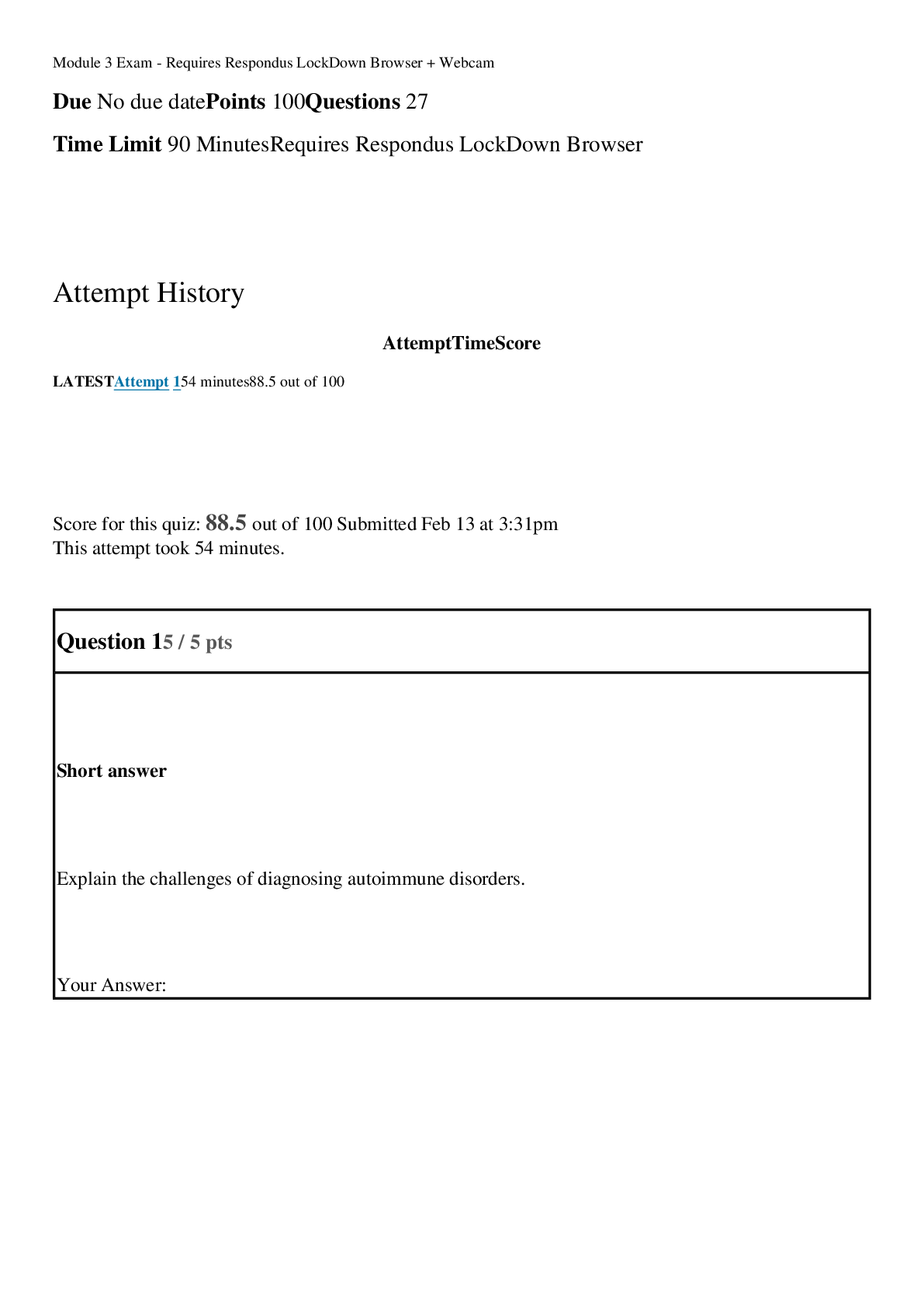
Module 3 Exam - Requires Respondus LockDown Browser + Webcam
Question 1 5 / 5 pts
Short answer
Explain the challenges of diagnosing autoimmune disorders.
Your Answer:
aut
...
Module 3 Exam - Requires Respondus LockDown Browser + Webcam
Question 1 5 / 5 pts
Short answer
Explain the challenges of diagnosing autoimmune disorders.
Your Answer:
autoimmune disorders are challeching because, it can potentaily effect the cells and the tissue of the body systemic, organ, and blood. moreover, there are over 80 idetified many are overlapping and non- specif. to get the correct autoimmune diagnosis must be follow PT history, physical evedience, and serological finding. Blood test are more generic therefore its bit challenging. however to conclude the correct autoimmune disorder there must be autouimmune reaction, the immunlogilocal finding cant be secondry disease , and there must not be no other findings of disease . so for all these reasons it is diffecult to diagnose autoimmune disroders
There are over 80 identified, many with overlapping presentations. Many manifestations are nonspecific and are seen in other non-autoimmune diseases. Blood testing isn’t perfect either, as some tests are more generic and can be elevated in the presence of other diseases.
Question 2 2.5 / 2.5 pts
Multiple choice:
Which cells serve an important role innate and adaptive immunity?
Natural killer cells
Neutrophils
Correct!
Correct!
Question 4 3 / 3 pts
B lymphocytes produce what type of immunity? Your Answer:
humural immunity
humoral
Correct!
Question 6 2 / 2 pts
Correct!
Correct!
Microbe recognition is specific
Question 8 10 / 10 pts
A 9-year-old boy with a peanut allergy was exposed to peanuts. He presents to the emergency room with an anaphylactic reaction. (1) What symptoms might he present with? (2) Does the quantity of exposure mean he will have a more severe reaction? (3) What is the initial immediate treatment? (4) What are 2 things people with anaphylaxis should always carry?
Your Answer:
he can present any of the grade 1-5
Grade 1 is the reaction cuteneouse mucosal tisue with erythema and urticaria with or without engioedema , to all the way to grade 5 which is cardia arrest which the healthcare provider will be focusing on resusctitatio
quantity does not matter epinephiner
ID for the food he is to allergic to and Epi pen
(1) Any of the following reactions are accepted.
Grade I: erythema and urticaria, with or without angioedema.
Grade II: hypotension, tachycardia, dyspnea, and GI manifestations, like nausea, vomiting, diarrhea, and abdominal cramping from mucosal edema.
Grade III: bronchospasm, cardiac dysrhythmias, and cardiac collapse.
Grade IV: cardiac arrest
(2) No
(3) Epinephrine
(4) identification about allergy, EpiPen
u Answered
rrect Answe
Correct!
Question 11 3.5 / 3.5 pts
Correct!
Correct!
Question 13 2.5 / 2.5 pts
Correct!
Question 14 3.5 / 3.5 pts
Type I hypersensitivity reactions are mediated reactions. Your Answer:
IgE
IgE
Question 15 3.5 / 3.5 pts
Multiple Choice:
Which of the following hypersensitivity reactions can be treated with the administration of epinephrine?
Correct!
u Answered
rrect Answe
Question 17 3.5 / 3.5 pts
Correct!
Question 18 5 / 5 pts
Short answer:
What are the 2 factors that play a role in the development of autoimmune diseases?
Your Answer:
genetic and environmental exporsure
Answer: genetics and environmental factors
Question 19 10 / 10 pts
1, A 32-year-old woman presents to the clinic for her initial obstetrics visit, about 10 weeks into her pregnancy. She is in a monogamous relationship. (1) Should an HIV test be part of her initial blood work? Why?
2. An infant is born, and its initial antibody test is positive for HIV. (2) Does this mean the infant is infected? What would be the more appropriate test to detect HIV in this infant?
Your Answer:
1-yes she should be tested for HIV,2- because mother and fetus is the very high and coomon that she will pass the virus to fetus, also the CDS recommonds anyone who is the age between 13-64 sould be tested for the disease.
1-no it does not mean the fetus is positive for the disease. 2-apporpiate test will be PCR test which detect the presence of the trace amount in the DNA of the infected fetus, regardless of the outcome the fetus will have the mothers antibodies,however the PCR test will give alternative startegy to ditermine if the virus is presence in the fetus's .
1. Yes. Transmission from mother to infant is the most common way that children become infected. The CDC recommends all people between ages 13 and 64 be routinely screened for HIV. Earlier detection and treatment lead to better outcomes.
2. No. The polymerase chain reaction (PCR) test is a nucleic acid test that can detect HIV DNA. It tests for the presence of the virus, rather than the antibody, which is helpful in diagnosing HIV infection in infants born to infected mothers. These infants would have their mother’s antibodies whether or not they have been infected.
Correct!
Question 21 3.5 / 3.5 pts
While labile and stable cells can regenerate themselves, cells are unable to undergo mitotic division.
Your Answer:
premenant cells like the neuron
Permanent cells
Question 22 1.5 / 3.5 pts
Fill in the blank
HIV is a virus that destroys the body’s immune system by taking over and destroying cells.
Your Answer: antiviral immune
Answer: retrovirus, CD4 T cells
Question 23 3.5 / 3.5 pts
The term to describe the time when an infected person’s blood converts from being negative for HIV antibodies to being positive is called what?
Your Answer: seroconversion
Answer: seroconversion
Question 24 3.5 / 3.5 pts
Multiple Choice:
The best diagnostic method to detect HIV is the HIV antibody test called what? If this is positive, what follow-up test will be done to confirm?
Polymerase chain reaction (PCR); Western blot
Correct!
Correct!
Question 26 2.5 / 2.5 pts
Multiple Choice:
The process of leukocyte accumulation in the cellular phase of acute inflammation is called what?
Correct!
rrect Answe
u Answered
Quiz Score: 88.5 out of 100
[Show More]