BIO 171 Module 5 TEST- Questions and Answers Portage
Learning
Define the concept of universal precautions. - Universal precautions is used when
handling an unknown specimen. They should be treated as being potential
...
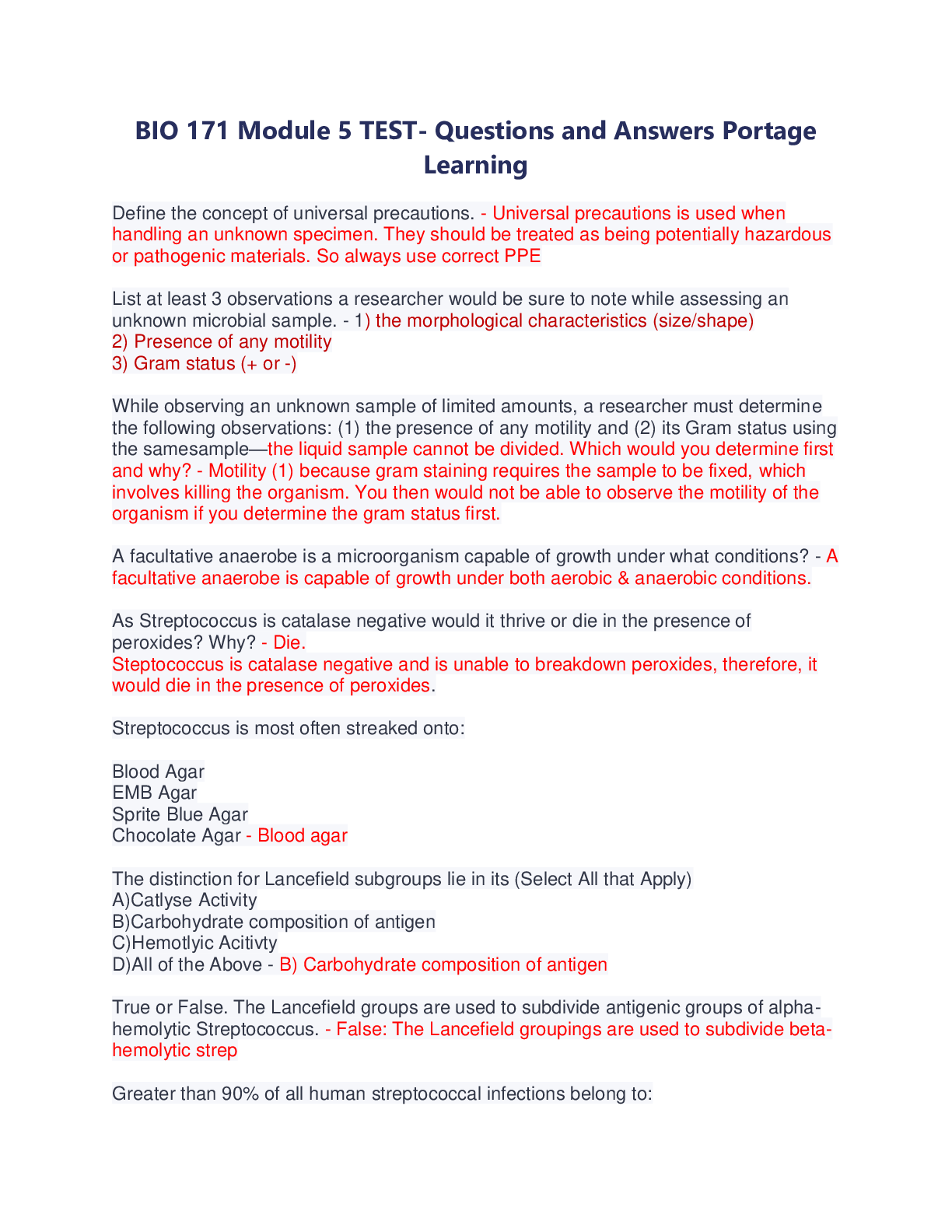
BIO 171 Module 5 TEST- Questions and Answers Portage
Learning
Define the concept of universal precautions. - Universal precautions is used when
handling an unknown specimen. They should be treated as being potentially hazardous
or pathogenic materials. So always use correct PPE
List at least 3 observations a researcher would be sure to note while assessing an
unknown microbial sample. - 1) the morphological characteristics (size/shape)
2) Presence of any motility
3) Gram status (+ or -)
While observing an unknown sample of limited amounts, a researcher must determine
the following observations: (1) the presence of any motility and (2) its Gram status using
the samesample—the liquid sample cannot be divided. Which would you determine first
and why? - Motility (1) because gram staining requires the sample to be fixed, which
involves killing the organism. You then would not be able to observe the motility of the
organism if you determine the gram status first.
A facultative anaerobe is a microorganism capable of growth under what conditions? - A
facultative anaerobe is capable of growth under both aerobic & anaerobic conditions.
As Streptococcus is catalase negative would it thrive or die in the presence of
peroxides? Why? - Die.
Steptococcus is catalase negative and is unable to breakdown peroxides, therefore, it
would die in the presence of peroxides.
Streptococcus is most often streaked onto:
Blood Agar
EMB Agar
Sprite Blue Agar
Chocolate Agar - Blood agar
The distinction for Lancefield subgroups lie in its (Select All that Apply)
A)Catlyse Activity
B)Carbohydrate composition of antigen
C)Hemotlyic Acitivty
D)All of the Above - B) Carbohydrate composition of antigen
True or False. The Lancefield groups are used to subdivide antigenic groups of alpha�hemolytic Streptococcus. - False: The Lancefield groupings are used to subdivide beta�hemolytic strep
Greater than 90% of all human streptococcal infections bel
[Show More]